
Executive Summary
Every finance leader who has sat through a renewal cycle knows that an ASC 606 adjustment rarely announces itself. It arrives quietly, buried inside a repriced subscription or a bundled upsell. The commercial team has often moved on to the next deal. That is usually true by the time an auditor or an acquirer asks about it.
This piece walks through how contract modifications actually get classified under ASC 606. It also covers when revenue recognition should run prospectively versus retrospectively. And it looks at what it takes to build a finance function that catches these changes before they become findings. The goal is not a technical recitation of the standard. It is a practitioner’s account of what happens when growth outruns the systems built to account for it. It is also a look at what a finance organization needs to put in place. The goal is revenue recognition that scales alongside the business instead of trailing behind it.
Why Every Contract Modification Demands an ASC 606 Adjustment
Contracts change because businesses succeed. A customer adds seats, a service scope widens, or a long-term agreement takes on new pricing mid-term. Each of these moments signals deeper engagement, even as it forces finance to revisit judgments that once felt settled. Under ASC 606, a contract modification occurs whenever both parties agree to a change in scope or price. The standard requires finance to evaluate every one of these changes before revenue recognition continues unchanged.
That evaluation resolves into one of three paths, and the difference between them is not academic. It determines whether a company restates revenue, defers it, or leaves the original contract untouched.
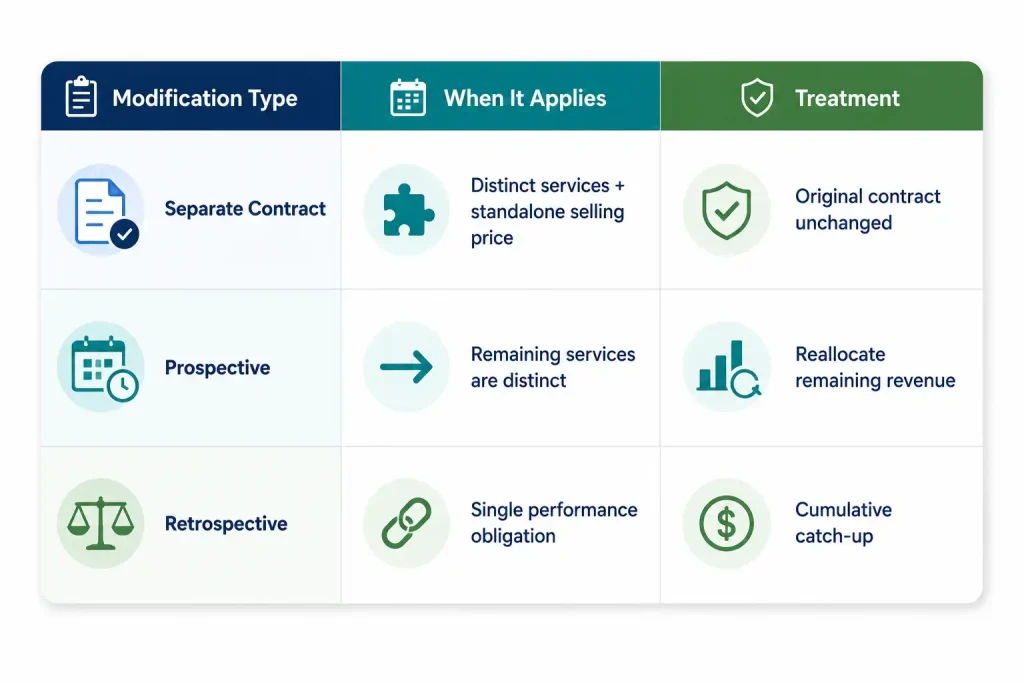
In practice, most companies want the first row. A cybersecurity and identity access management company operated under a de facto head of finance role. Revenue grew past $30M in annual recurring revenue during that period. That growth came during the same period the ASC 606 revenue recognition framework was built. Clean, distinct upsells drove much of that growth. The ASC 606 revenue recognition framework and controls environment was built from the ground up. That work gave the business a defensible answer every time a deal desk question came up during acquisition diligence. That framework did not happen by accident. It required a standing definition of standalone selling price. It also required a habit, enforced well before the contract reached finance, of pricing new modules within that range.
Separate Contract, Prospective Update, or Retrospective ASC 606 Adjustment
Consider a managed IT services agreement worth $120K for a year. Six months in, the customer adds 24-hour monitoring, pushing the total contract value to $180K. If the monitoring is distinct and priced at its standalone value, the remaining six months absorb the new pricing. The first six months stay as originally recognized. Nothing about the earlier revenue changes.
But if the monitoring is tightly bundled with the base service, inseparable in any practical sense from what the customer already receives, the calculus shifts. Finance may need to treat the whole arrangement as one performance obligation and restate revenue from the beginning of the contract, producing a cumulative catch-up that can swing a quarter’s earnings, margin, and even ARR in either direction depending on how the repricing lands. The accounting outcome should track the commercial reality of the deliverable, not merely the language the sales team used when the amendment was signed.
Renewals Are Modifications in Disguise
Renewals feel routine, and that sense of routine is precisely why they cause trouble. A renewal negotiated at market rates that begins only after the prior term ends typically qualifies as a new contract, and revenue recognition starts fresh. A renewal signed before the current term expires, carrying revised pricing or expanded scope, behaves like a modification instead, and the same separate-contract test applies all over again.
I have watched a renewal automation system quietly trigger early renewals bundled with loyalty discounts, and auditors flagged the resulting prices as a deviation from standalone selling price. The contracts required prospective treatment instead of clean separate recognition, deferred revenue had to be reallocated, and a sales operations win turned into a reporting burden inside a single audit cycle. The lesson was not that automation is dangerous. It was that automation without an embedded revenue recognition rule set simply moves the risk faster.
Standalone Selling Price Discipline and the Deviations That Cause Trouble
Discounts, bundling, and loyalty incentives are where standalone selling price quietly erodes, and once pricing deviates from that baseline, the remaining performance obligations often need to be revalued and reallocated. In a venture-backed digital marketing organization where I helped scale revenue from $9M to $180M over 24 months, we would not have sustained that growth without building customer acquisition cost, lifetime value, and contribution margin discipline directly into how deals were priced and approved before they ever reached a signature. The same discipline that protects unit economics protects revenue recognition, because both depend on knowing, deal by deal, what a customer is actually paying relative to fair value.
Deal desk controls, pre-approval thresholds for discounting, and a standardized pricing matrix reduce this risk before it reaches the general ledger. Firms that integrate standalone selling price logic directly into their CRM, flagging any custom pricing outside approved ranges, give finance a chance to intervene before the contract closes instead of reconstructing intent months later.
Operationalizing Revenue Recognition Across Systems and Teams
Contract modifications start as customer conversations, but revenue recognition lives in systems, and the finance organizations that scale well embed contract metadata (pricing, term, SKU, standalone selling price deviation) into the CRM, CPQ, and billing tools upstream of the general ledger. As Chief Financial Officer of a Euronext Paris-listed gaming and digital entertainment company operating across five countries, rolling out Oracle Financials and MicroStrategy firmwide gave the organization a single, unified definition of revenue for the first time and materially compressed statutory reporting cycles under both IFRS and US GAAP. None of that infrastructure removed judgment from the process. It simply meant judgment got applied once, consistently, instead of reinvented deal by deal.
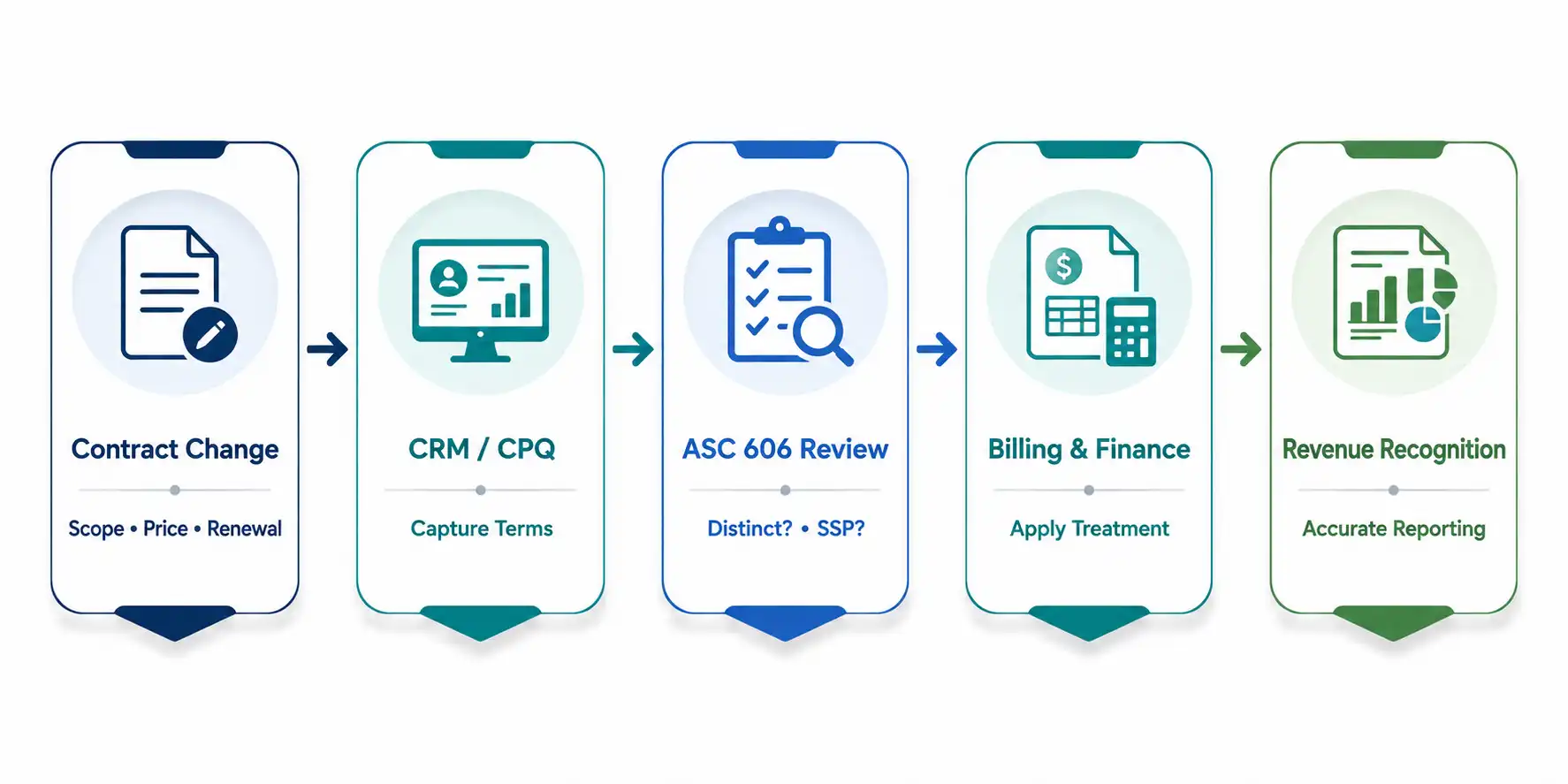
A written contract changes request template, however plain it sounds, does more work than most finance teams expect. Requiring a standard form for every modification, stating the nature of the change and whether the new services are distinct, gives auditors the documentation they need and gives sales a faster path to accurate billing once the friction of the first few forms wears off.
Preparing for Audit, Diligence, and the Board
Auditors and acquirers ask the same handful of questions about every modification: was it approved, were the added services distinct, was pricing at standalone value, and was revenue recognized in line with policy. A modification playbook answers all four before anyone has to ask, and the strongest ones I have built or reviewed include the following:
- A policy memo explaining how ASC 606 applies to the company’s specific contract structures
- Worked examples distinguishing prospective from retrospective treatment
- Documented standalone selling price ranges and the approval matrix behind them
- A sample population of reviewed modifications with recognition outcomes attached
Boards, in my experience running finance and audit committee reporting for a mission-driven education and research institution, rarely want the technical detail behind a revenue swing. What they want is a plain explanation of what changed and why, delivered before the number surprises them rather than after. Opening a board update with a short account of what shifted in bookings versus recognition, and what it means for margin going forward, builds a kind of trust that a footnote never will.
Knowing When to Reassess Your Revenue Recognition Policy
Revenue policy that worked at $5M in ARR often breaks at $50M, and a handful of signals tend to arrive before the audit finding does:
- Contracts routinely deviate from standalone selling price
- Renewals carry embedded discounts or informal bundling
- Multiple systems track contract terms with no single source of truth
- Finance still classifies modifications by manual review rather than by rule
- Prior audits have already flagged inconsistent treatment
Any one of these is reason enough to revisit the policy before the next renewal cycle rather than after it.
Three Key Takeaways
- Classify every modification against the three-path test (separate contract, prospective adjustment, or retrospective catch-up) at the moment it is signed, not during quarter-end close, because the classification decision is far cheaper to make early than to unwind later.
- Standalone selling price discipline is the control that prevents most ASC 606 adjustments in the first place, and it belongs in the CRM and deal desk, not only in the revenue recognition policy memo.
- Revenue recognition scales only when it lives inside systems and documented playbooks rather than inside the judgment of whoever happens to be closing the books that month.
Disclaimer: This article is intended for informational purposes only and does not constitute legal, tax, or accounting advice. You should consult your own tax advisor or counsel for advice tailored to your specific situation.
Hindol Datta is a four-time CFO and senior finance executive with over 25 years of leadership experience across cybersecurity, SaaS, gaming, logistics, digital marketing, medical devices, consumer products, and nonprofit organizations. He has led more than $120M in fundraising and over $150M in M&A transactions while building the financial and operational systems that let complex businesses scale with confidence. He is the author of seven books in the Systems CFO Series and holds active CPA, CMA, and CIA credentials.
AI-assisted insights, supplemented by 25 years of finance leadership experience.