
Executive Summary
Companies often treat segment reporting under ASC 280 as a disclosure checklist. It is something the accounting team assembles after the books close, once auditors ask for it. In practice, ASC 280 segment reporting behaves more like a mirror than a form. It asks a company to describe, in financial terms, how its own leadership actually views and runs the business. It offers little room for a version built for public consumption rather than internal use.
This article works through the core mechanics of segmentation reporting. It covers how a company identifies its chief operating decision maker, or CODM. The 10 percent and 75 percent thresholds determine which segments a company must disclose. Judgment calls around aggregation are where many companies go wrong. The article also looks at the systems and governance work segment reporting demands. That work needs to happen well before an audit or an S-1 filing forces the question. This draws from more than two decades of building the finance function behind that reporting across several industries. This draws from more than two decades of building the finance function behind that reporting across several industries.
Why ASC 280 Segment Reporting Starts With the CODM, Not the Org Chart
Every serious conversation about segment reporting eventually arrives at the same term: the chief operating decision maker. The CODM is not a title on a business card. It is a function, sometimes a single executive, sometimes a management committee. This function allocates resources and assesses performance across the business. That person or group’s lens becomes the basis for segmentation. This holds true whether the company likes that answer or not.
At one cybersecurity and identity access management company, the finance leader organized the monthly package by delivery geography. Service line was the other axis. That structure matched how staffing, pricing, and margin decisions actually drove US and offshore delivery centers. That internal reality, not the marketing narrative, was what governed the segment disclosures once the company approached acquisition diligence. A company can describe itself publicly as a single, unified offering. If the CODM reviews payer category, product line, or geographic profit and loss separately each month, segmentation reporting under ASC 280 will follow that internal structure regardless of the external story.
Defining an operating segment requires three conditions: the component must engage in business activities that generate revenue and expense, the CODM must review its operating results regularly, and discrete financial information must exist for it. None of those conditions require a formal legal entity or a separate division. A cross-functional product line reviewed monthly for resource allocation can qualify as readily as a geographic subsidiary.
The Quantitative Thresholds Behind Segment Reporting
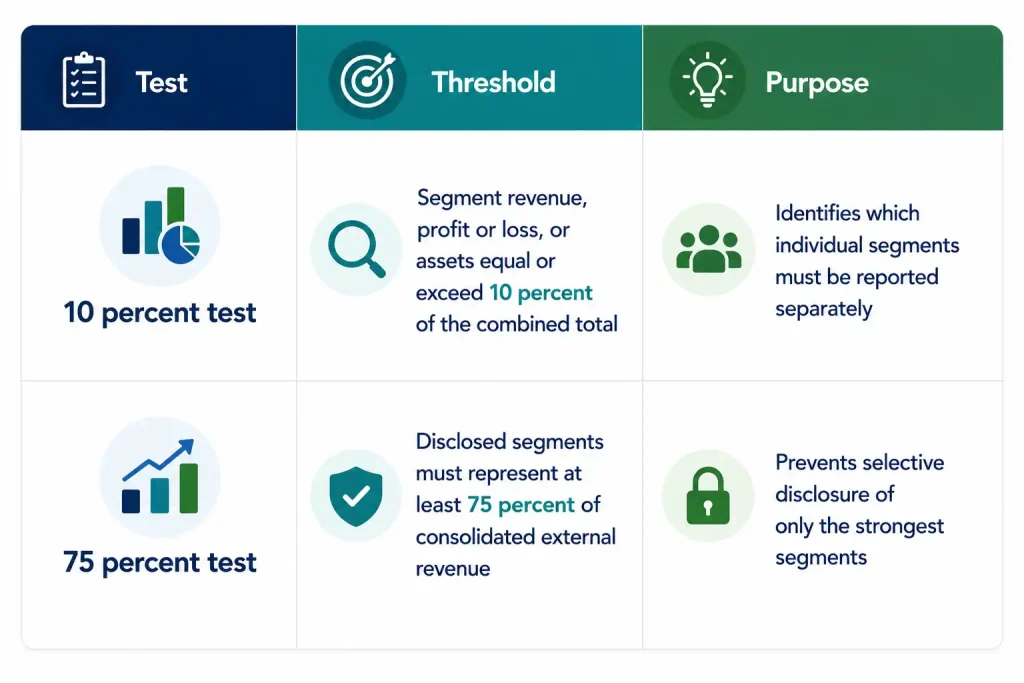
Once operating segments are identified, ASC 280 applies two thresholds that determine what must be separately disclosed. The first is a materiality test applied segment by segment. The second is a completeness test applied to the disclosure as a whole, designed to prevent a company from disclosing only its most flattering units while burying the rest inside an unlabeled residual category.
Why the 75 Percent Threshold Matters
The 75 percent rule matters more than it first appears. A company can pass the 10 percent test for two segments and still be required to disclose additional segments if those two do not add up to enough of total revenue. This is where segment reporting distinguishes itself from a public relations exercise: the standard forces a more complete economic picture, not merely the two or three business lines a company would prefer to feature.
When Internal Structure Changes Faster Than the Reporting Cycle
For companies moving through venture rounds, the internal view of the business rarely stays still. A firm organized regionally at the Series B stage may reorganize around product lines by the time it reaches Series C, then revert to a regional model after a strategy reset eighteen months later. Each shift raises the question of whether the segment disclosures must change with it, and a change can require restatement of prior periods for comparability. Handled with intention, this signals adaptive leadership to a board. Handled reactively, it reads as drift, and boards notice the difference.
Where Segmentation Reporting Judgment Calls Go Wrong
ASC 280 permits companies to aggregate operating segments into a single reportable segment when the segments share similar economic characteristics: comparable products, customers, production processes, and regulatory environments. The standard for aggregation is similarity, not resemblance in a pitch deck.
At a $127M global consumer products company, the business spanned direct-to-consumer, Amazon, and wholesale channels, each with a distinct margin profile, working capital cycle, and demand pattern feeding a supply chain across China and Vietnam. Treating those channels as a single undifferentiated segment would have flattened the variance that mattered most to lenders and to the board evaluating where capital should go next. Businesses that aggregate hardware and software into one segment because both are described internally as enablers of a broader platform vision are a recurring case, even when gross margins differ by 45 points and sales cycles bear no resemblance to one another. The recommendation in that setting was disaggregation. The story was not weak; it was simply more accurate once separated, and accuracy tends to serve a company better over a full fundraising cycle than a tidier narrative does.
Common pitfalls that surface repeatedly in this work include the following:
- Aggregating segments based on a brand narrative rather than shared economic characteristics such as margin, customer type, or regulatory exposure.
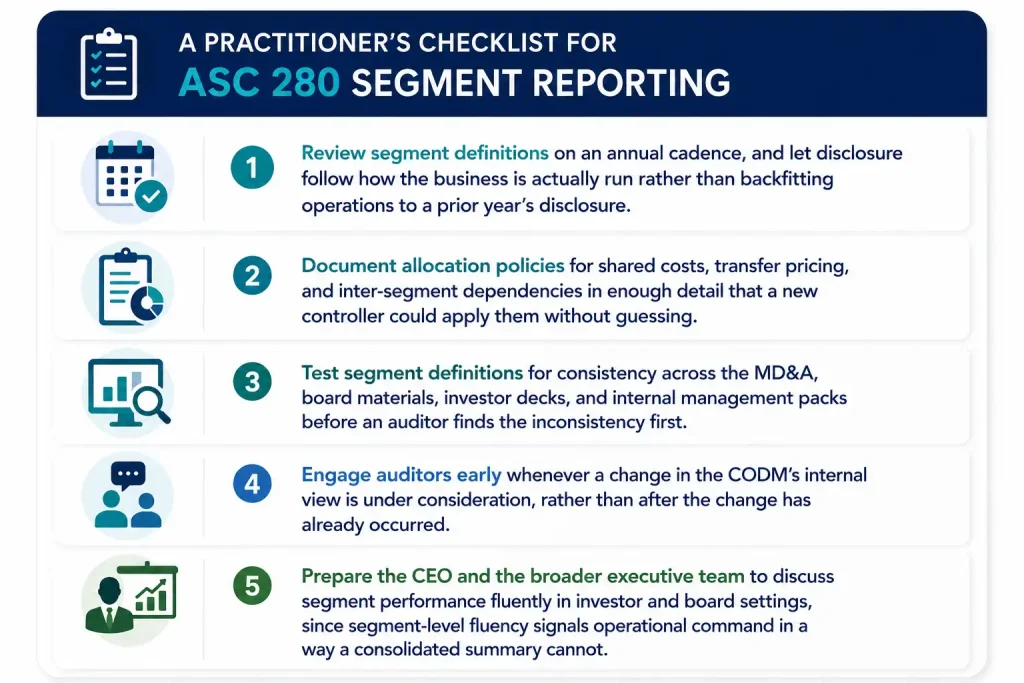
- Allowing segment definitions to diverge across the MD&A, board materials, and internal management packs, which auditors and the SEC treat as a signal that disclosure is disconnected from actual decision-making.
- Retrofitting ERP and cost allocation systems only after an audit request, rather than architecting the chart of accounts to produce segment-level data from the outset.
- Underinvesting in allocation policy documentation for shared costs, transfer pricing, and inter-segment dependencies.
Segment Reporting as a Governance and Investor Relations Discipline
Segment disclosures carry weight well beyond the footnotes. During the S-1 and IPO-readiness process for a Euronext Paris-listed gaming and digital entertainment company operating across five countries, segment reporting was one of the areas underwriters and Big Four auditors scrutinized most closely, because segment data has to align with the MD&A narrative and the risk factors, not merely with GAAP mechanics. A company that claims geographic expansion in its narrative but does not present segments by geography invites the kind of comment letter that slows a filing down.
Private-company investors have grown comparably attentive. Series D investors have conditioned participation on receiving quarterly segment profit and loss statements for international operations, having watched too many companies burn capital overseas without segment-level visibility into where that capital was actually going. That is not a diligence formality. It is an operating discipline investor now expect as a baseline.
Three Key Takeaways
- Segment reporting under ASC 280 is governed by how the CODM actually reviews the business internally, not by how a company chooses to describe itself externally, which means the disclosure cannot be designed after the fact without inviting audit and SEC scrutiny.
- The 10 percent and 75 percent thresholds work together to prevent selective disclosure, and aggregation decisions must rest on genuine economic similarity across margin, customer type, and regulatory environment rather than on a shared narrative.
- Segment reporting infrastructure, from chart-of-accounts design to allocation policy documentation, should be built into a company’s financial architecture well before an audit, an investor, or an S-1 filing forces the question, because retrofitting it under pressure is where most companies lose credibility.
Disclaimer: This article is intended for informational purposes only and does not constitute legal, tax, or accounting advice. You should consult your own tax advisor or counsel for advice tailored to your specific situation.
Hindol Datta is a four-time CFO and senior finance executive with over 25 years of leadership experience across cybersecurity, SaaS, gaming, logistics, digital marketing, medical devices, consumer products, and nonprofit organizations. He has led more than $120M in fundraising and over $150M in M&A transactions while building the financial and operational systems that let complex businesses scale with confidence. He is the author of seven books in the Systems CFO Series and holds active CPA, CMA, and CIA credentials.
AI-assisted insights, supplemented by 25 years of finance leadership experience.