
Executive Summary
Every CFO eventually faces a moment like this. A large foreign currency contract lands on the desk. A rate-sensitive debt load carries the same risk. So does a volatile input cost. There is no plan behind it. A sound hedging strategy exists to close that gap. Under ASC 815, it takes two primary forms. These are the cash flow hedge and the fair value hedge. Each is built for a different kind of exposure. This article walks through the mechanics of both. It covers the documentation and effectiveness testing that qualify a hedge for special accounting treatment. It also covers the operational discipline that separates a durable hedging strategy from a one-time transaction.
The experience spans cybersecurity, digital marketing, consumer products, and medical device manufacturing. That experience shapes the discussion here. It moves beyond the accounting rulebook. It reaches into the governance structures, systems, and cross-functional habits that make a hedging strategy work in practice. The goal is not to eliminate risk. It is to decide with intention which risks a business carries and which it offsets.
Why Hedging Strategies Matter More Than Ever
Volatility used to be a topic for treasury desks at large multinationals. It no longer stays there. A Series B company invoicing in euros, a consumer products firm sourcing from two continents, or a SaaS business with floating rate debt all carry exposures that used to belong only to Fortune 500 balance sheets. In accounting terms, volatility is a standard deviation. In the boardroom, it is the gap between the forecast a CFO promised and the number that lands three months later, and that gap is where credibility is won or lost.
Hedge accounting under ASC 815 offers a formal method for managing that gap. The standard governs when and how a company can recognize derivative instruments in a way that reflects the underlying economics rather than distorting them. Done well, a hedging strategy aligns purpose with presentation. Done poorly, or not at all, it invites the kind of earnings surprise that erodes investor trust.
The Two Core Hedge Accounting Models
Cash Flow Hedges
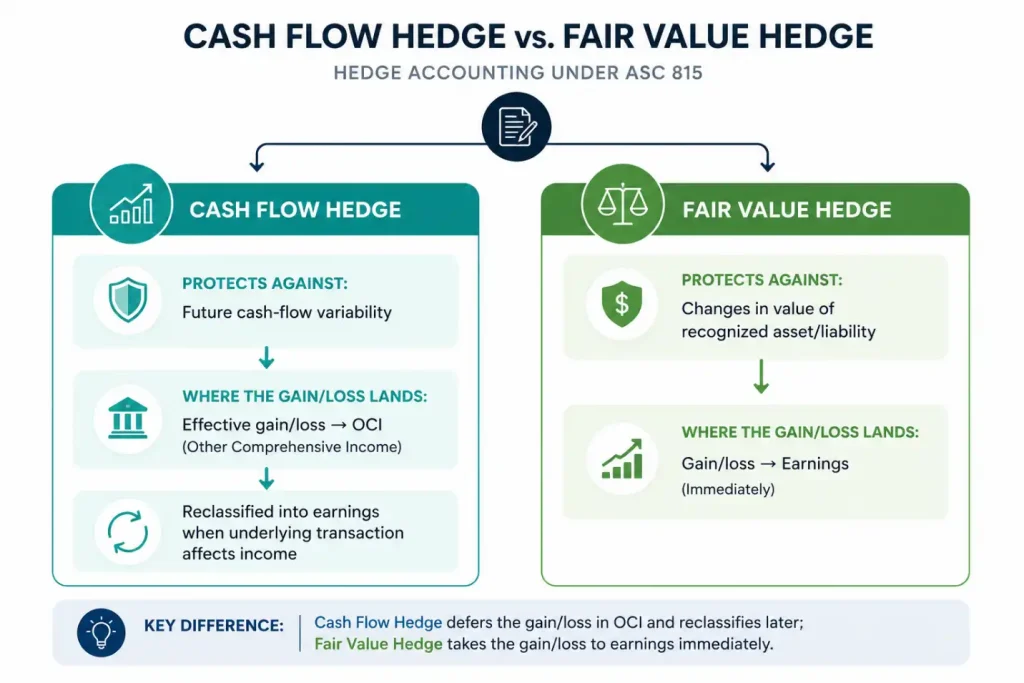
A cash flow hedge addresses variability in the amount of a future payment or receipt. Picture a growth-stage company whose overseas supplier insists on payment in a local currency rather than U.S. dollars. A forward contract locks in a predictable cost and shields gross margin from currency swings between now and settlement. The effective portion of the gain or loss sits in other comprehensive income until the underlying transaction hits the income statement, which keeps reported earnings tied to operations rather than to market noise from the hedge itself.
Fair Value Hedges
A fair value hedge neutralizes changes in the value of a recognized asset or liability rather than the timing of a cash flow. A company holding fixed rate debt that expects rates to rise might enter an interest rate swap to convert that exposure into a floating rate synthetically. The instrument does not change, but its economic character does. Under this model, both the derivative and the hedged item are marked to market through earnings, which produces a more volatile income statement but one that mirrors the company’s true economic position.
Qualifying for Hedge Accounting Under ASC 815
Qualifying for hedge accounting is not a formality that can be handled after the fact. ASC 815 requires formal documentation at inception that identifies the hedging instrument, the item being hedged, the specific risk being managed, and the method used to assess effectiveness. Auditors test the rigor of this documentation closely, and in fast-growing companies where exposures shift quarter to quarter, that scrutiny only intensifies.
Effectiveness testing, both prospective and retrospective, is mandatory and ranges from simple dollar offset comparisons to regression-based models. A hedge that passes the statistical test but lacks operational logic behind it can still unravel under audit committee questioning, so the numbers need to make sense alongside the story of why the hedge exists.
Building the Operational Backbone for a Hedging Strategy
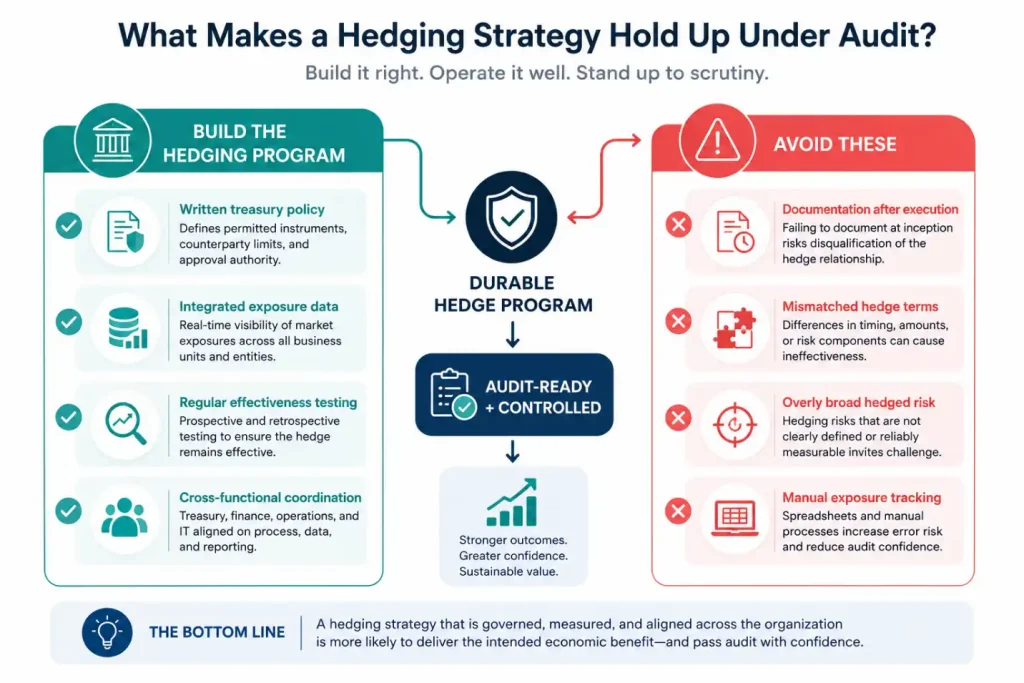
A hedging strategy is only as strong as the governance and systems supporting it. In practice, that means a treasury policy defining which instruments are permitted, what counterparty limits apply, and who holds authority to execute and document each relationship. Several elements tend to separate programs that hold up under audit from those that do not.
- A written treasury policy naming approved instruments, counterparty limits, and approval authority
- Exposure data integrated into ERP and treasury management systems rather than tracked in spreadsheets
- Effectiveness testing built into the monthly close cadence, not performed only at year end
- Cross-functional coordination among treasury, FP&A, legal, and the operating teams that originate exposures
Cross-functional collaboration deserves its own emphasis. Hedge programs that live entirely inside finance tend to miss exposures that originate elsewhere, whether procurement negotiating a contract with embedded commodity risk or a sales team signing a deal denominated in a foreign currency. In a high-growth cybersecurity and identity access management company managing operations across five countries, the forecasting engine and reporting cadence that eventually held actuals within five percent of plan for eight consecutive quarters only worked because treasury, delivery, and revenue operations were reading from the same exposure data.
Hedging Strategies in Practice
Real engagements make the tradeoffs concrete. At a global consumer products company sourcing from manufacturing partners across Asia, currency and input cost volatility touched nearly every line of the P&L, and the discipline of matching hedge instruments to actual purchase order timing, rather than to a rough annual estimate, was what kept gross margin from swinging with every shipment.
A similar lesson showed up in a venture-backed digital marketing organization that scaled from $9M to $180M in revenue over 24 months. Rapid international expansion brought foreign currency receivables that had not existed a year earlier, and building the finance function to track those exposures in real time, rather than discovering them at quarter close, made the difference between a manageable variance and a board-level surprise.
At a global medical device manufacturer with plants across three countries, cost accounting and supply chain finance operated under a different kind of pressure, since standard costing assumptions had to hold up against regulatory audit scrutiny as well as market movement, which meant hedging decisions had to be documented with the same precision as the bill of materials itself.
Common Pitfalls That Undermine a Hedging Strategy
The pitfalls that recur most often share a common root, which is treating hedge accounting as a formality rather than a discipline.
- Documenting the hedge relationship after the derivative has already been executed, which disqualifies the hedge from special accounting treatment entirely
- Mismatching terms, such as a hedge that matures before the exposure does or covers a different notional amount than the underlying transaction
- Defining the hedged risk too broadly, which creates ambiguity that auditors will flag during effectiveness reviews
- Relying on manual tracking for exposures that change weekly, which all but guarantees a gap will eventually go unnoticed
A Practical Checklist for Reviewing Hedging Strategies
- Review hedge accounting policy at least once a year as the business model and exposures evolve
- Treat exposure mapping as a proactive discipline rather than something discovered through a financial statement variance
- Build hedge documentation into the transaction workflow itself, not as a step added after the fact
- Frame hedging in investor and board conversations as margin management rather than speculation
- Invest in systems that make exposure tracking and effectiveness testing routine rather than heroic
Three Key Takeaways
- A hedging strategy is a discipline built on documentation and governance as much as on the derivative instrument itself, and the paperwork completed at inception often matters as much to the outcome as the trade.
- Cash flow hedges and fair value hedges solve different problems, one smoothing the timing of future cash flows and the other reflecting the current value of an asset or liability, and choosing between them starts with understanding which kind of exposure the business actually carries.
- The strongest hedging programs are cross-functional by design, pulling treasury, FP&A, legal, and the operating teams that originate exposure into a shared view of risk long before that risk shows up as a variance on the income statement.
Disclaimer: This article is intended for informational purposes only and does not constitute legal, tax, or accounting advice. You should consult your own tax advisor or counsel for advice tailored to your specific situation.
Hindol Datta is a four-time CFO and senior finance executive with over 25 years of leadership experience across cybersecurity, SaaS, gaming, logistics, digital marketing, medical devices, consumer products, and nonprofit organizations. He has led more than $120M in fundraising and over $150M in M&A transactions while building the financial and operational systems that let complex businesses scale with confidence. He is the author of seven books in the Systems CFO Series and holds active CPA, CMA, and CIA credentials.
AI-assisted insights, supplemented by 25 years of finance leadership experience.