Executive Summary
The arm’s length principle sounds simple in a textbook. In practice, it gets complicated fast. A single company might operate in three countries. Its IP could be developed across two of them, with revenue scaling in four currencies. This piece walks through what the arm’s length principle actually requires in practice. That includes pricing intercompany services and structuring cost-sharing agreements for intangibles. It also means building the functional analysis that regulators and acquirers want to see.
Readers who lead finance, tax, or treasury functions inside a multinational will find a working framework here. This is not a legal treatise. The goal is simple. Show how the arm’s length principle connects to cash flow, audit defense, and operational credibility. Every company’s story has to hold up under scrutiny eventually.
What the Arm’s Length Principle Actually Requires
At its core, transfer pricing is the method multinational entities use to price transactions with each other. These include goods, services, intangibles, and capital exchanged between the parent, subsidiaries, and affiliates. The governing standard is the arm’s length principle. It requires companies to price these intercompany transactions as though the parties were unrelated, each pursuing its own commercial interest. This standard sits underneath nearly every transfer pricing regime in the world. Examples include Section 482 of the Internal Revenue Code and the OECD Transfer Pricing Guidelines. Informal search sometimes shortens the arm’s-length principle to the arm length principle. Either way, it is the same concept. A controlled transaction should look on paper and in substance, like one two strangers might have negotiated.
Applying that standard is where the difficulty begins. Two companies tend to fail this test in mirror-image ways. Some default to a flat cost-plus markup on every intercompany service. This is administratively tidy, but it ignores where the real entrepreneurial risk sits. Others build an elaborate structure of cost-sharing agreements, valuations, and risk recharacterizations. They do this without first understanding how the business actually operates day to day. The result is a model that is technically compliant and operationally hollow.
Pricing Intercompany Services
Nearly every multinational operating across borders has some form of intercompany service arrangement in place. A parent entity might provide executive leadership to its subsidiaries. An offshore engineering center might support product development that benefits the whole enterprise. A regional office might handle localized marketing for products designed elsewhere. These services consume real resources and create real value, and the arm’s length principle demands that they be priced accordingly. The OECD recognizes five primary methods for establishing an arm’s length charge.
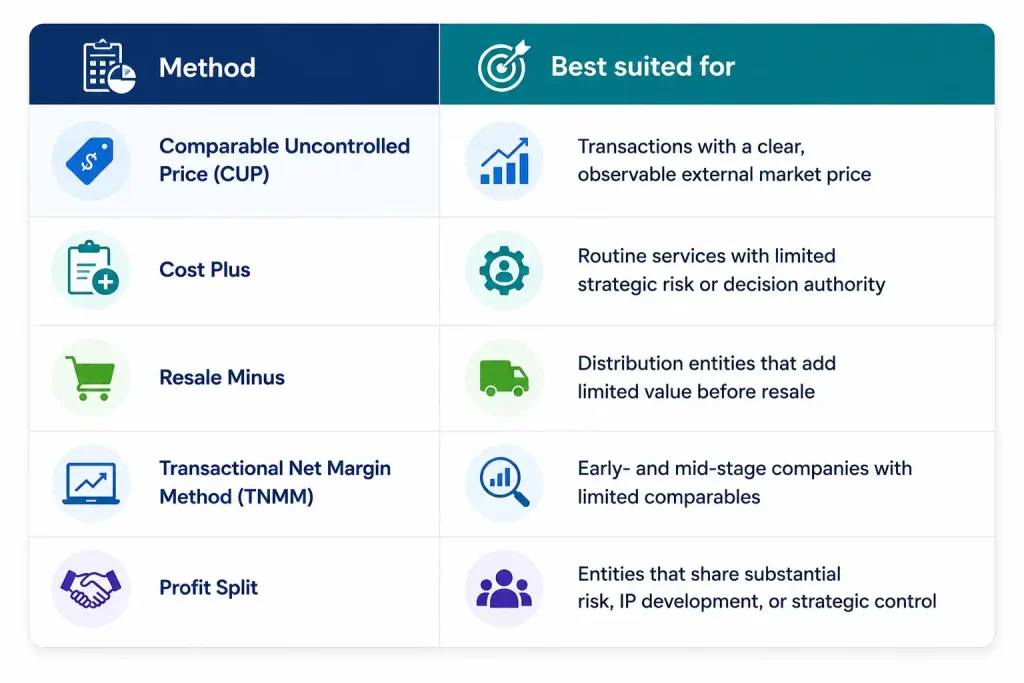
A high-growth cybersecurity and identity access management business operated across the United States, Canada, Mexico, India, and Nepal. It had more than 230 employees. There, the offshore engineering center was not simply executing instructions from headquarters. The team owned delivery timelines, influenced architectural decisions, and managed entire product lines. A basic cost-plus markup could not capture that level of contribution. So, the pricing model shifted toward a profit split approach. This approach was grounded in a functional analysis of who actually performed which functions and carried which risks. That analysis was demanding, but it produced a position that could withstand scrutiny. Just as important, it produced internal coherence about how the business actually created value.
Intangible Property, Cost-Sharing Agreements, and the Arm’s Length Standard
Intellectual property is arguably the most contested area in international tax, and the arm’s length principle is tested hardest here because IP is mobile by nature. A common pattern involves a parent entity developing core technology, offshore centers contributing features or localization work, and regional hubs eventually licensing the IP for local deployment. Who owns it, who should bear the development cost, and who should collect the resulting income are not questions with obvious answers.
Cost-sharing agreements address this by having multiple entities fund the development of intangibles in proportion to their anticipated benefit, often requiring a buy-in payment when a new participant joins an existing IP stream. Structuring one of these agreements while advising an early-stage AI governance and assurance platform reinforced how much forecasting and valuation judgment sits underneath what looks, from the outside, like a simple percentage allocation. The buy-in has to reflect arm’s length pricing under an income method or residual profit split, assigning present-value estimates to technology that may still be in active development, discount rate assumptions and all.
When the Story Does Not Hold Up
Not every engagement resolves cleanly. Supporting a quality-of-earnings review on an IT services acquisition target once surfaced a transfer pricing structure that had been shifting profit toward a lower-tax jurisdiction using a cost-plus approach with no functional analysis, no benchmarking, and no formal intercompany agreement behind it. The receiving entity had been collecting large revenue allocations tied to sales generated elsewhere, which created the appearance of base erosion. That gap between the documented story and the operational reality is precisely what a transfer pricing audit is designed to expose, and it is a reminder that the arm’s length principle only works when the pricing reflects economic substance rather than a convenient allocation.
The FAR Analysis: Functions, Assets, and Risk
Transfer pricing practitioners call this the FAR analysis: which entity performs which functions, which entity assumes which risks, and which entity owns which assets. Building a FAR matrix entity by entity, in a role overseeing operations controllership at a global medical device manufacturer with plants in Copenhagen, Cork, and Taiwan, meant tracing exactly where standard costing decisions and inventory risk actually lived, not where an org chart implied they lived. It is forensic work, drawing on finance, legal, HR, product, and operations, and when done well it reveals how value genuinely flows through the organization.
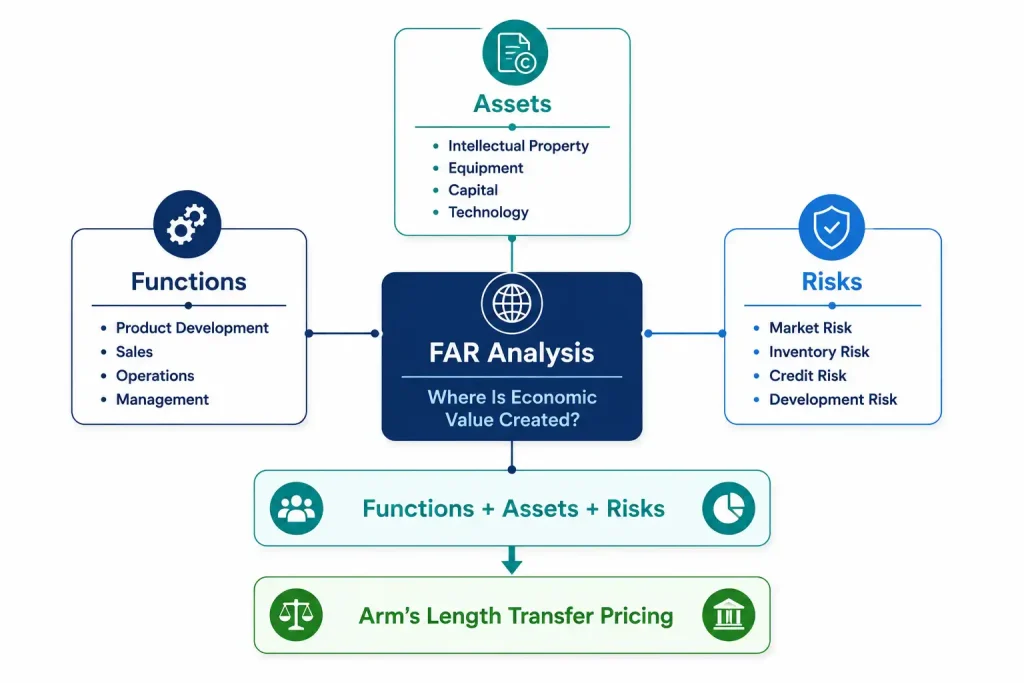
Transfer pricing is never static. Functions relocate, products evolve, and margins shift, so a policy defensible last year may not survive this year. A disciplined practice is to revisit the FAR analysis and its documentation annually rather than treating it as a one-time filing exercise.
Documentation, Treasury, and Cash Flow Discipline
Contemporaneous documentation is required under IRC Section 6662(e) in the United States, and failing to produce it can trigger penalties of 20 to 40 percent on understatements. Most jurisdictions outside the United States follow the OECD’s three-tiered structure:
- A Master File containing high-level group information
- A Local File with entity-specific detail
- Country-by-Country Reporting for large multinationals
The administrative burden of preparing these across overlapping deadlines is real, and so is the payoff. Leading a global audit response as CFO of a Euronext Paris-listed gaming and digital entertainment company, with operations across the United States, France, the United Kingdom, Singapore, and South Korea, meant fielding cross-border scrutiny referencing filings from more than one tax authority at once. A centralized FAR profile and synchronized documentation standard, built after one audit, meant the next one arrived to a company already prepared.
Transfer pricing also has direct consequences for treasury. Poorly timed intercompany service charges can leave a subsidiary cash-negative even when the group as a whole is healthy, and thin-capitalization rules in many jurisdictions limit how easily that gap can be closed with an intercompany loan. In one turnaround reducing monthly burn from $800K to $200K, part of the fix was tying intercompany invoicing to project milestones rather than month-end accruals, since the cash mismatch was never a tax-side problem alone.
Digital Tax Reform and the Path Forward
The OECD’s Pillar One and Pillar Two initiatives are reshaping how multinationals think about the arm’s length principle by pushing taxation toward where economic activity genuinely occurs rather than where IP happens to be booked. Substance now matters more than structure. That means tracking headcount, contractual control, and decision-making authority, not just legal ownership. For a company expanding into new markets, the practical question becomes straightforward: where are decisions actually made, and who owns the customer relationship?
Three Key Takeaways
- The arm’s length principle only holds up when pricing reflects where functions, risks, and assets genuinely sit inside the organization, which means a functional analysis is not a compliance exercise but the foundation of a defensible transfer pricing position.
- Intercompany service and IP pricing decisions have direct operational consequences for cash flow and treasury management, so finance teams should synchronize invoicing cycles and payment timing with the underlying transfer pricing policy rather than treating the two as separate workstreams.
- Transfer pricing documentation and audit readiness compound over time, and companies that revisit their FAR analysis annually and maintain a centralized, well-organized Master File and Local File tend to move through cross-border audits with far less friction than those treating documentation as a once-a-year filing obligation.
Disclaimer: This article is intended for informational purposes only and does not constitute legal, tax, or accounting advice. You should consult your own tax advisor or counsel for advice tailored to your specific situation.
Hindol Datta is a four-time CFO and senior finance executive with over 25 years of leadership experience across cybersecurity, SaaS, gaming, logistics, digital marketing, medical devices, consumer products, and nonprofit organizations. He has led more than $120M in fundraising and over $150M in M&A transactions while building the financial and operational systems that let complex businesses scale with confidence. He is the author of seven books in the Systems CFO Series and holds active CPA, CMA, and CIA credentials.
AI-assisted insights, supplemented by 25 years of finance leadership experience.