
Executive Summary
Antitrust review has stopped functioning as a compliance checkbox somewhere near the back of a deal timeline. It now anchors transaction strategy, shaping how parties structure deals, how quickly they close, and whether they close at all. Alongside antitrust review, foreign investment review has expanded well beyond its original mandate. The Committee on Foreign Investment in the United States is the most visible example. Its reach now extends to data, infrastructure, and critical technology of almost any kind.
This article lays out a practitioner framework for treating antitrust review and foreign investment review as financial planning problems. Not purely legal ones. It covers how to model concentration risk before parties make a filing. It also covers how to recognize CFIUS triggers early enough to plan around them. And it covers how to build pre-transaction discipline and stakeholder communication. And it covers the financial reporting practices that keep a deal on track when regulators take a closer look.
Antitrust Review: The New Normal of Enforcement
Antitrust authorities across major jurisdictions have grown more assertive. Their scope and appetite have both expanded. U.S. regulators, the Federal Trade Commission and Department of Justice, no longer confine their analysis to market share. Neither do the European Commission or China’s State Administration for Market Regulation. They now look at competitive behavior, data control, and the broader ecosystem effects of a transaction. A deal can attract antitrust review even when the combined entity holds only a modest position in its traditional market.
A Series C acquisition of a healthtech firm illustrates the point well. Combined market share sat below the thresholds that typically draw scrutiny. Yet the target’s control over a large, unique patient data set raised vertical integration concerns at the Federal Trade Commission. Proceeding required a consent decree. That decree preserved data interoperability for third parties and limited how the company could use the acquired metadata internally. That resolution added six months to the timeline but preserved the deal’s value and avoided a forced divestiture.
That experience reflects a broader pattern across buy-side due diligence engagements. Surfacing regulatory exposure early, alongside more conventional quality-of-earnings work, has repeatedly changed how parties structure a transaction before it ever reaches a signing table.
Modeling Concentration and Second Request Risk
CFOs cannot afford to treat antitrust review as something that happens after parties sign the term sheet. Effective regulatory diligence models concentration and behavioral risk in parallel with financial diligence, using a small set of recurring metrics:
- Herfindahl-Hirschman Index calculations run pre- and post-deal, with antitrust counsel looped in automatically whenever the index shifts by more than 200 points
- Overlap analysis by geography and product line, mapped against each regulator’s historical enforcement pattern
- Likelihood of a second request and its timing implications for working capital and deal certainty
A recurring practice across deals above $100M, or those touching sensitive sectors such as fintech, healthtech, or energy, is to run a formal regulatory war game before parties sign the deal rather than after a filing draws unwanted attention. Regulators have moved past pure market share analysis and now ask whether a transaction stifles innovation, concentrates control over a data ecosystem, or affects labor markets, and financial modeling has to keep pace with that broader lens.
Foreign Investment Review and CFIUS: National Security Meets Capital Flow
Foreign investment review has become the second major gating item in cross-border transactions. In the United States, CFIUS evaluates deals for national security risk, and comparable bodies now operate in the United Kingdom through its Investment Security Unit, in Germany through the BMWK, and across a growing list of other jurisdictions. The scope of CFIUS jurisdiction that once narrowly applied to defense contractors and aerospace targets has broadened considerably, and CFOs should now assume that any product touching data, infrastructure, or critical technology carries some degree of foreign investment review exposure.
A cross-border SaaS acquisition demonstrates how easily buyers can underestimate this exposure. The buyer’s parent company sat in a nation allied with the United States, which created a false sense of security, but the software processed data for subcontractors of the Department of Defense. That single fact triggered CFIUS jurisdiction and produced a ten-month review cycle, adding $2M in legal fees and disrupting deferred revenue recognition along the way. Because the timeline had not been modeled into the post-close integration plan, the integration schedule collapsed alongside it.
A similarly instructive pattern shows up in public-company cross-border M&A, where executing more than $100M in transactions across five countries required consolidated reporting under both IFRS and US GAAP and constant coordination across regulatory regimes that did not always move at the same pace.
Recognizing CFIUS Triggers Before They Surface
Common triggers for foreign investment review include foreign buyer involvement of almost any kind, exposure to critical technologies or infrastructure, and access to sensitive personal data, even when that access is incidental to the platform’s primary function. The lesson from the SaaS example above is that foreign investment risk deserves modeling as a core business scenario, not a legal afterthought handled by outside counsel in isolation.
Building a Pre-Transaction Regulatory Playbook
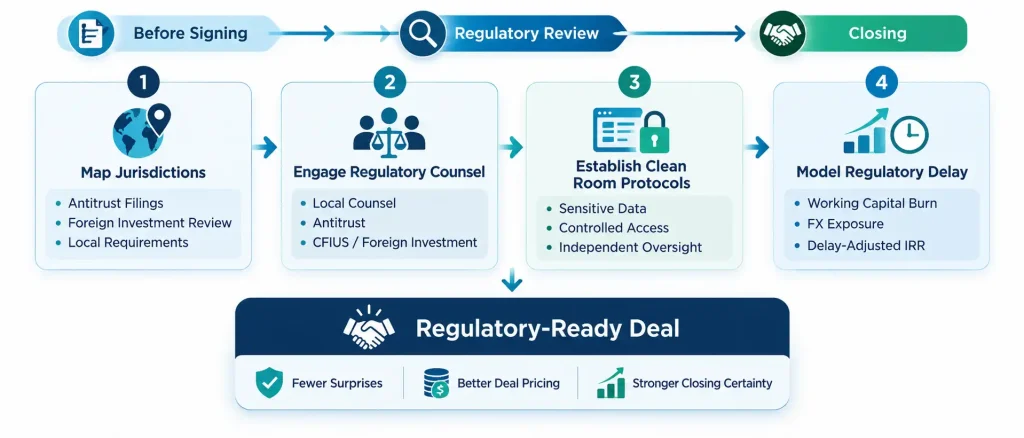
Early action remains the most reliable defense against both antitrust review delay and foreign investment review surprise. A pre-transaction regulatory playbook typically includes the following steps, run in parallel with financial diligence rather than after it:
- Mapping every jurisdiction where a filing may be required, including state-level antitrust statutes that can operate alongside federal review
- Engaging local counsel in each relevant jurisdiction well before signing
- Preparing clean room protocols for sensitive data access during diligence, monitored by an independent third party
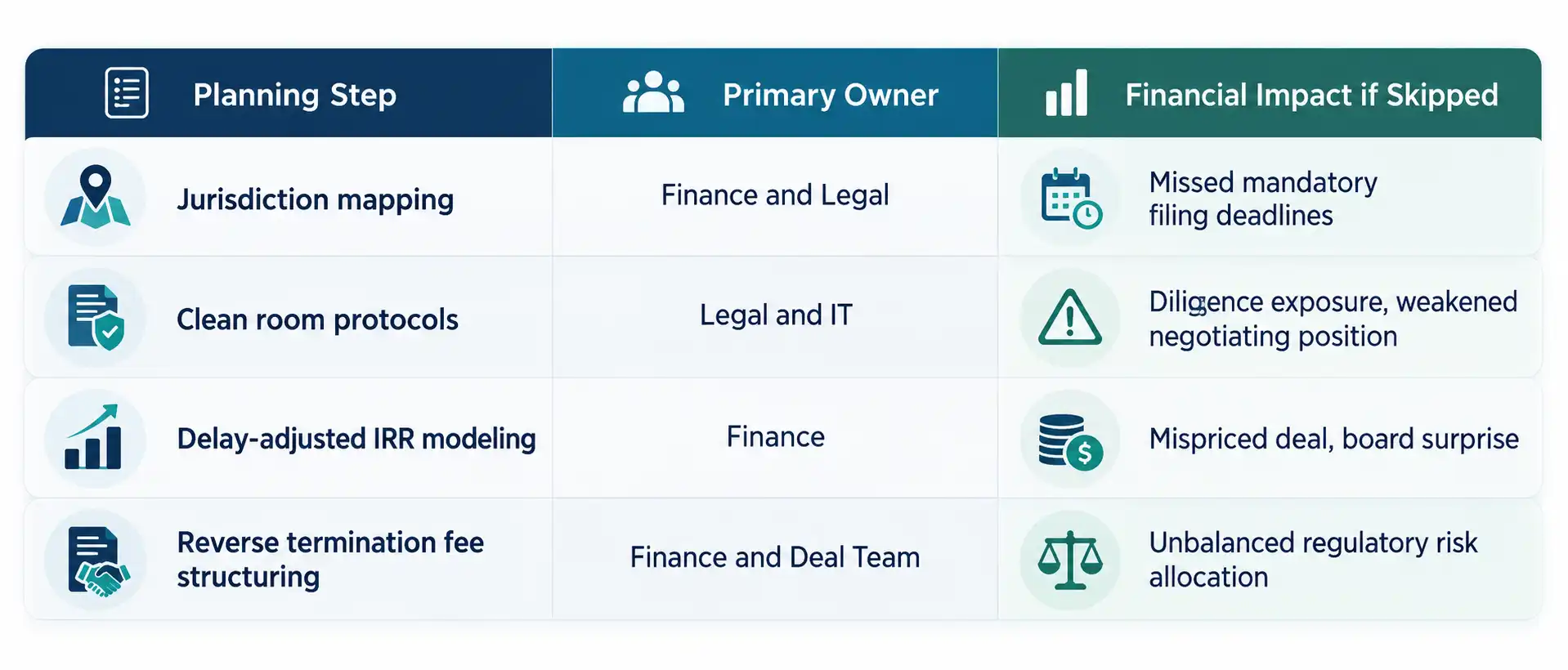
- Modeling the cost of delay, including working capital burn and foreign exchange exposure, and feeding that into a delay-adjusted internal rate of return metric for board materials
A semiconductor transaction offers a useful illustration of risk-sharing done well. The parties pre-negotiated a $25M reverse termination fee tied to regulatory outcomes, payable if approval was not secured within twelve months. The structure aligned buyer and seller incentives, signaled confidence in the deal’s underlying logic, and gave both sides a clear mechanism for absorbing regulatory delay rather than litigating over it after the fact.
Managing Stakeholders Through Extended Reviews
Investors, employees, and customers need reassurance during a drawn-out antitrust review or foreign investment review, and the communication plan deserves as much preparation as the filings themselves. Tailored FAQ documents and investor memos should lay out the nature of the review underway, the expected timeline, and the contingency plans if the transaction is delayed or ultimately blocked. When a deal collapses under regulatory pressure, the communication plan must pivot immediately toward internal stabilization and external explanation, and finance leadership is typically the function best positioned to own that narrative given its visibility into the numbers behind the story.
Regulatory delay also carries direct financial reporting consequences. Deferred transaction costs, delayed synergies, and potential impairments all require modeling well before a deal stalls. In practice, an extended review can force a revaluation of earnout targets, an update to fair value assumptions, and a change in deferred tax treatment, each of which flows directly into quarterly forecasts and investor guidance. Antitrust review and foreign investment review, in this sense, are not solely legal categories. They are GAAP issues as much as they are regulatory ones.
Three Key Takeaways
- Antitrust review no longer tracks market share alone, so CFOs should build recurring HHI and overlap analysis into deal diligence rather than waiting for counsel to flag concentration risk after a filing is drafted.
- Foreign investment review, particularly through CFIUS, now reaches far beyond defense and aerospace targets, and any transaction touching data, infrastructure, or critical technology deserves an early jurisdictional assessment regardless of how benign the buyer’s nationality appears.
- Treating regulatory review as a financial planning exercise, complete with delay-adjusted IRR modeling, reverse termination fee structuring, and a rehearsed stakeholder communication plan, converts a source of deal risk into a source of negotiating leverage and preserved valuation.
Disclaimer: This article is intended for informational purposes only and does not constitute legal, tax, or accounting advice. You should consult your own tax advisor or counsel for advice tailored to your specific situation.
Hindol Datta is a four-time CFO and senior finance executive with over 25 years of leadership experience across cybersecurity, SaaS, gaming, logistics, digital marketing, medical devices, consumer products, and nonprofit organizations. He has led more than $120M in fundraising and over $150M in M&A transactions while building the financial and operational systems that let complex businesses scale with confidence. He is the author of seven books in the Systems CFO Series and holds active CPA, CMA, and CIA credentials.
AI-assisted insights, supplemented by 25 years of finance leadership experience.