
Executive Summary
An AI maturity model gives boards and finance leaders a shared language for a question most organizations have not actually answered: not whether the company uses artificial intelligence, but whether it is structurally, operationally, and culturally ready to depend on it. Readiness has little to do with how many tools a company has bought or how many GPT-branded features a vendor has bolted onto its product. Instead, readiness comes down to how well an organization can absorb intelligence into decision-making without generating chaos, compliance exposure, or organizational drag.
This article lays out a five-level AI maturity model built from work inside finance functions across cybersecurity, gaming, consumer products, education, and AI governance technology itself. It also outlines the board questions that belong at each level and five concrete steps any leadership team can take this quarter to move up the curve.
AI Readiness Is a Leadership Question, not a Technology One
AI now touches sales forecasting, legal review, product design, and investor communications, which means capital allocators cannot treat it as an IT line item. CFOs and boards are stewards of capital, risk, and strategic priority, and AI cuts across all three at once. Deployed carelessly, it introduces regulatory exposure, data privacy risk, and operational fragility that surface months later, usually during diligence or audit. Deployed with discipline, it becomes leverage: faster cycle times, sharper forecasts, and a credible signal to investors that leadership understands what it is building.
An AI maturity model exists precisely to make that distinction visible before it becomes expensive. It encompasses data architecture, decision velocity, the trust model between leadership and the tools it deploys, governance posture, and the organization’s cultural willingness to change how people do the work. None of that is a side conversation. It belongs in the same board cycle as security audits and financial reviews.
The Five-Level AI Maturity Model
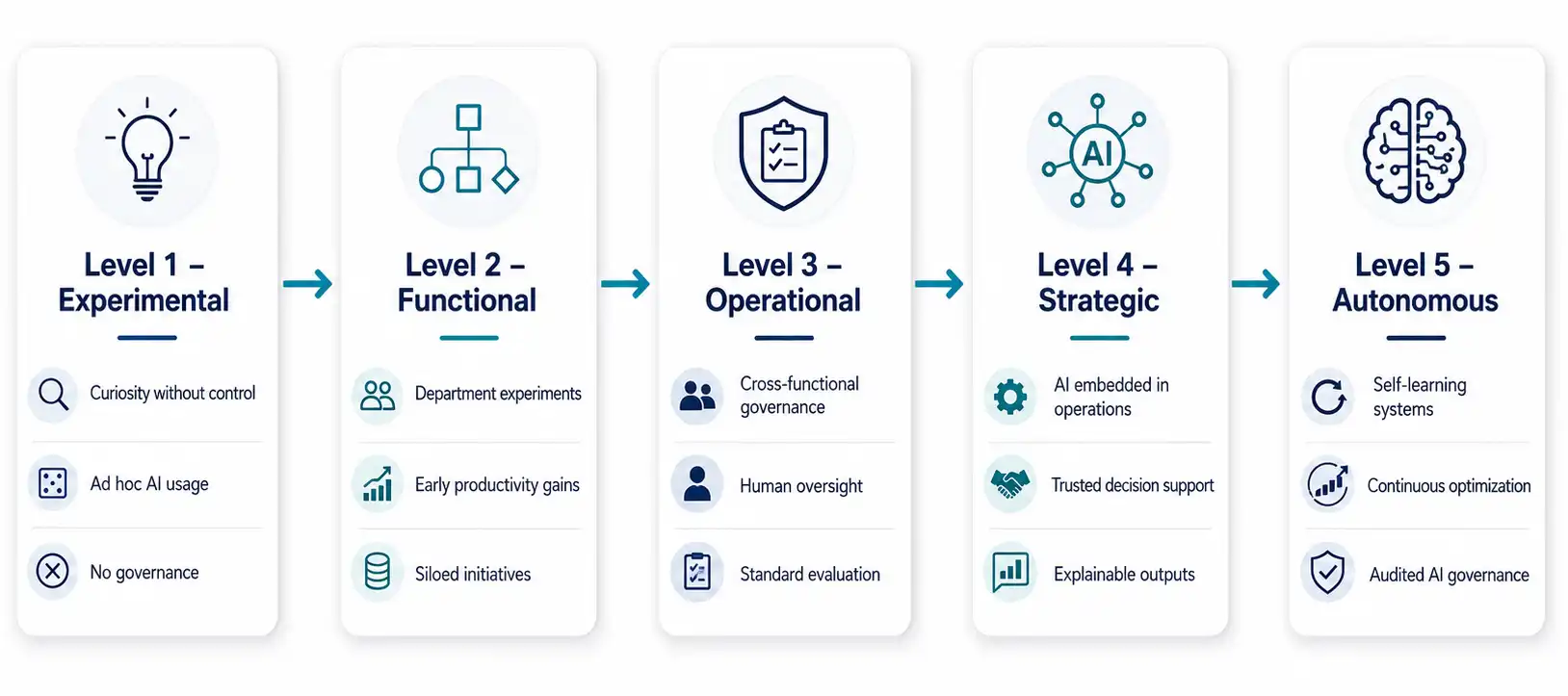
Level 1: Experimental – Curiosity Without Control
Most early-stage companies begin here. A few teams have started using a chatbot or a code assistant, marketing may be drafting posts with generative tools, and sales might be summarizing call notes, but there is no enterprise strategy, no oversight, and no shared vocabulary for what “using AI” even means.
- Ad hoc usage of generative AI tools across teams
- No documentation of how outputs get used downstream
- No internal controls around data privacy
- No designated AI point person or governance lead
Board questions: Who is currently using AI tools, and how? Are any customer-facing materials being AI-generated? Has security reviewed any of these tools?
Level 2: Functional – Early Wins, Siloed Initiatives
Departments begin operationalizing AI inside specific workflows. Finance may use it for variance analysis, legal might experiment with contract summarization, but initiatives stay isolated, with no cross-functional alignment on ethics, auditability, or accountability.
- Department-level experiments with inconsistent results
- AI embedded inside SaaS products, never evaluated by IT or compliance
- Early productivity gains that nobody is tracking systematically
Board questions: Have we identified which teams are operationalizing AI? Are we tracking time saved or value created? Do we have usage policies or exception-handling protocols?
Level 3: Operational – Strategy with Guardrails
This is the first level at which a company becomes genuinely AI-aware. A cross-functional governance structure exists, often led by the CFO, COO, or CTO. Use cases get prioritized by value, data access, and risk, metrics are tracked, and AI becomes a lever rather than a novelty.
Inside a pre-Series A AI governance and assurance platform, finance leadership rebuilt the function from nothing to run AI-first: the team redesigned modeling, reporting, and diligence processes around AI tooling with a lean footprint, which compressed the time between a board question and a defensible answer. That is what Level 3 looks like from the inside, not a policy document but a working rhythm.
- Cross-functional AI governance committee with real authority
- Standardized evaluation criteria for new AI tools
- Human-in-the-loop policies for outputs that touch customers, capital, or compliance
Board questions: What are our top five AI-enabled workflows? Who owns AI governance, and what authority do they actually hold? Are we logging overrides, errors, and retraining events?
Level 4: Strategic – Embedded, Trusted, Auditable
AI stops being a project and becomes part of the operating fabric. Every function embeds AI agents with role clarity and confidence thresholds, teams document and explain the outputs, and AI-generated insight routinely shapes business decisions rather than merely supplementing them.
A high-growth cybersecurity and identity access management company with roughly $30M in ARR reached a version of this state by building a forecasting engine and capacity model from scratch, holding actuals within plus or minus 5% of forecast for 8 consecutive quarters. That kind of consistency does not come from a tool purchase. It comes from embedding the discipline into how the business plans, month after month.
- Scenario planning that includes AI-driven simulations
- Decision logs capturing agent recommendations alongside human overrides
- Board materials that include AI performance metrics, not just AI announcements
Board questions: How often do AI agents influence strategic decisions? Have we benchmarked AI return on investment across departments? What transparency do we offer investors about AI usage?
Level 5: Autonomous – Self-Learning, Systemic, Audited
Very few companies have reached this stage, but it is where the most competitive organizations will land. Multi-agent architectures coordinate across finance, operations, and sales, automated systems close the feedback loops, and models frame the strategic questions that humans then debate and implement through adaptive playbooks. AI stops being a tool and becomes an organizational capability in its own right.
- Every AI decision is logged, explained, and improved through feedback
- Board-level visibility into agent performance, failure modes, and governance health
- Regulatory readiness functions as a strength rather than a last-minute scramble
Board questions: What is the AI decision hierarchy, and where are humans required versus optional? Is there an external audit trail for AI usage in regulated decisions? Is AI expanding leadership capacity, or hiding behind complexity that nobody has tested?
Mapping AI Maturity to Capital Strategy
An AI maturity model is not primarily a cost-reduction exercise. It is a clarity exercise. Companies at higher maturity levels make faster decisions, test more hypotheses, and allocate capital with more conviction, because they are not relying on intuition alone. They are testing assumptions at scale and can show their work when a board or an investor asks how a number was produced.
A Euronext Paris-listed gaming and digital entertainment company demonstrated a version of this discipline at scale by creating a single, unified definition of revenue across every subsidiary, rolling out enterprise financial systems firmwide and materially cutting statutory reporting cycles under both IFRS and US GAAP. A $127M global consumer products company applied the same logic operationally, using demand planning and SKU rationalization to more than double inventory turns from three times to seven times and release capital that had been sitting trapped in the supply chain. Neither result came from an AI tool alone. Both came from treating maturity, financial or algorithmic, as something to be engineered rather than assumed.
Capital allocation should reflect AI maturity directly. Teams with strong AI integration earn more autonomy, faster funding, and tighter governance, while teams still experimenting get design support paired with real constraint. Boards should request quarterly AI maturity updates on the same cadence as security audits and financial reviews. That single habit signals discipline and tends to attract smarter capital.
Five Steps to Move Up the AI Maturity Curve
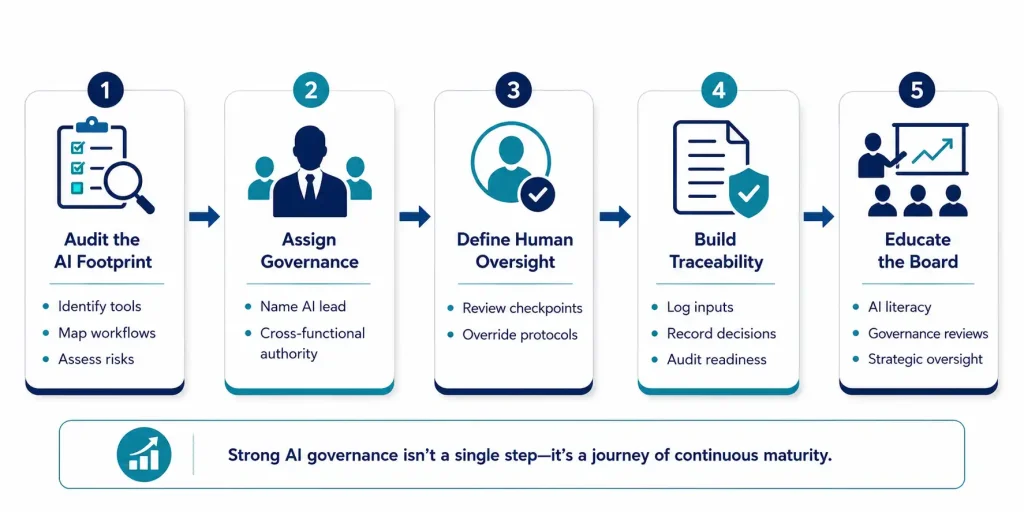
- Audit the AI footprint. Survey every current use case across departments and identify tools, workflows, risks, and gaps before building anything new on top of an unclear base.
- Name an AI governance lead. This should be someone with cross-functional authority, not a title buried inside IT with no mandate to enforce anything.
- Establish human-in-the-loop rules. Define precisely which decisions require human review and document the override protocol so it survives staff turnover.
- Invest in traceability. Every AI output should be explainable, with inputs, logic paths, and final actions captured well enough to withstand an audit or a hard board question.
- Educate the board. AI literacy at the board level is not optional at this point. Schedule briefings, share real use cases, and invite scrutiny rather than deflecting it.
An education and research institution’s board and audit committee structure offers a useful analogy here: a credible narrative only holds up when the reporting behind a capital raise is disciplined enough to survive scrutiny. The same standard now applies to the AI governance narratives boards and investors expect from leadership today.
Three Key Takeaways
- AI readiness is an enterprise condition, not a technology purchase, and an AI maturity model gives boards a structured way to locate where the organization actually stands rather than where a pitch deck claims it stands.
- Progress through the five levels of the AI maturity model tracks directly with governance discipline: the organizations that document overrides, log agent decisions, and assign real ownership move faster and with less risk than those simply buying more tools.
- Capital allocation should be tied to AI maturity, with autonomy and funding flowing toward teams that can demonstrate traceability and human-in-the-loop discipline, while experimentation elsewhere gets support paired with clear constraint.
Disclaimer: This article is intended for informational purposes only and does not constitute legal, tax, or accounting advice. You should consult your own tax advisor or counsel for advice tailored to your specific situation.
Hindol Datta is a four-time CFO and senior finance executive with over 25 years of leadership experience across cybersecurity, SaaS, gaming, logistics, digital marketing, medical devices, consumer products, and nonprofit organizations. He has led more than $120M in fundraising and over $150M in M&A transactions while building the financial and operational systems that let complex businesses scale with confidence. He is the author of seven books in the Systems CFO Series and holds active CPA, CMA, and CIA credentials.
AI-assisted insights, supplemented by 25 years of finance leadership experience.