
Executive Summary
Artificial intelligence is quietly reshaping how finance functions operate, not by replacing judgment but by sharpening it. Drawing on more than twenty-five years leading finance organizations across cybersecurity, SaaS, gaming, logistics, digital marketing, medical devices, and nonprofit sectors, this article examines how predictive analytics, forecasting models, and intelligent systems are becoming the connective tissue of execution. It explores how finance leaders can use these tools to accelerate hiring decisions, strengthen pricing discipline, model churn risk, and preserve capital during periods of scarcity. The goal is not automation for its own sake. It is decision velocity grounded in evidence. For CFOs and senior executives navigating growth stages from Series A through Series D and beyond, the lesson is consistent. The organizations that treat finance as an intelligence layer, rather than a reporting function, move faster and with greater confidence.
The Quiet Shift Toward Intelligent Finance
For most of my career, finance operated as a backward-looking discipline. We closed books, reconciled ledgers, and explained variances after the fact. Over the past decade, that posture has changed. Artificial intelligence in corporate finance is no longer a futuristic concept discussed at conferences. It has become part of the daily mechanics of forecasting, pricing, and capital allocation. Having led finance transformations across cybersecurity, software, gaming, logistics, and nonprofit organizations, I have watched this shift unfold from the inside, and I have come to believe it represents one of the most consequential changes in how finance creates value.
The temptation with any new technology is to treat it as a replacement for expertise. That is a mistake. Predictive models do not remove the need for judgment. They remove the noise that clouds it. When I helped design a multi-entity global finance architecture spanning three countries at a cybersecurity company, the real breakthrough was not the software itself. It was the discipline of asking which signals actually reduced decision uncertainty. That question, more than any tool, defines whether artificial intelligence strengthens a finance organization or simply adds complexity to it.
Where Predictive Analytics Changes Execution
Hiring and Capacity Planning
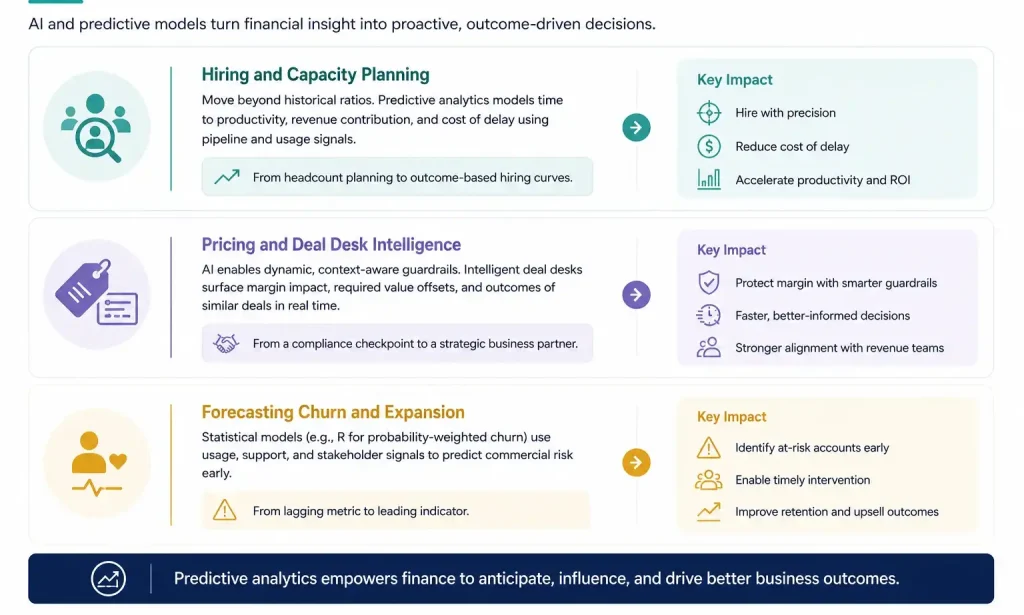
Workforce planning has traditionally been treated as a spreadsheet exercise built on historical headcount ratios. Predictive analytics changes that equation entirely. Instead of asking whether the budget allows for a hire, finance can model time to productivity. It can also weigh expected revenue contribution and the cost of delay.
Early in my career, I reduced monthly burn from eight hundred thousand dollars to two hundred thousand dollars. This happened at a marketing technology company. That discipline of modeling every dollar against expected outcome became second nature.
That same discipline is now enhanced by machine learning models that ingest pipeline data and usage signals. It allows finance to recommend hiring curves with far greater precision than intuition alone could provide.
Pricing and Deal Desk Intelligence
Pricing has long sat at the intersection of sales ambition and financial discipline. Artificial intelligence allows finance to move beyond static discount thresholds toward dynamic, context aware guardrails. Rather than issuing a flat denial when a seller requests an exception, an intelligent deal desk can surface the margin impact in real time. It can also show the required offsetting value and historical outcomes of similar deals.
This transforms the deal desk from a compliance checkpoint into a genuine business partner. It is one that helps revenue teams make faster and better informed decisions.
Forecasting Churn and Expansion
Customer success has traditionally been viewed as a retention function rather than a financial one. Applying statistical modeling, including tools such as R for probability weighted churn analysis, allows finance to treat customer health as a leading indicator rather than a lagging metric. Usage density, support escalation patterns, and stakeholder breadth become inputs into a model that predicts commercial risk before it materializes. When finance teams build these models well, finance can flag at risk accounts before customer success teams see the warning signs in their own dashboards, allowing intervention while there is still time to change the outcome.
Lessons From Building Finance Organizations Across Sectors
Every industry teaches a different lesson about how artificial intelligence should be applied to financial decision making.
In the gaming sector, overseeing more than one hundred million dollars in acquisitions required rapid, model driven due diligence across multiple studios with different revenue structures. Automated consolidation and forecasting tools made it possible to evaluate targets with speed rather than sacrificing rigor for pace.
In logistics and supply chain operations, predictive analytics was applied to freight, warehousing, and last mile delivery data. This uncovered cost efficiencies that manual review would have missed entirely.
In digital marketing, one organization scaled from nine million dollars to one hundred and eighty million dollars in revenue. This depended on pipeline forecasting models that connected marketing spend directly to bookings probability. It gave leadership the confidence to invest ahead of demand.
In the nonprofit and mission driven education sector, I led a forty eight million dollar capital raise. This required forecasting models that could withstand board level scrutiny. The models also had to remain transparent to stakeholders who valued mission alignment as much as financial return.
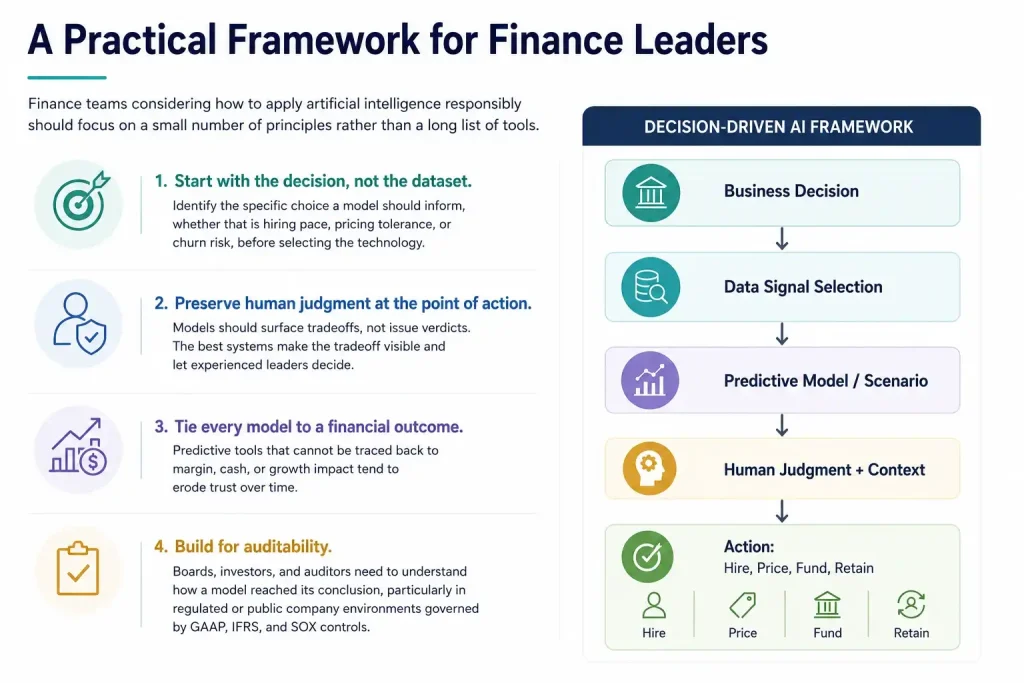
Across more than one hundred and twenty million dollars in capital raised and one hundred and fifty million dollars in mergers and acquisitions, the constant has been the same. Artificial intelligence works best when it is built to answer a specific decision, not simply to generate more data.
Conclusion
Artificial intelligence in corporate finance is not a departure from the discipline that has always defined the function; it is an extension of it. The same instincts that have guided finance leaders for decades — clarity, discipline, and the pursuit of signal over noise — now have far more powerful tools at their disposal. Having built and led finance organizations across cybersecurity, SaaS, gaming, logistics, digital marketing, medical devices, and nonprofit sectors, I have seen that the organizations which benefit most from these technologies never lose sight of their purpose. Predictive models do not replace the judgment of an experienced finance leader; they sharpen it, accelerate it, and extend its reach across an organization moving faster than any single team can track manually. For CFOs and senior executives, the opportunity is not to chase every new tool, but to build the intelligent, disciplined financial architecture that lets the rest of the organization move with confidence.
Disclaimer: This blog is intended for informational purposes only and does not constitute legal, tax, or accounting advice. You should consult your own tax advisor or counsel for advice tailored to your specific situation.
Hindol Datta is a seasoned finance executive with over 25 years of leadership experience across SaaS, cybersecurity, logistics, and digital marketing industries. He has served as CFO and VP of Finance in both public and private companies, leading $120M+ in fundraising and $150M+ in M&A transactions while driving predictive analytics and ERP transformations. Known for blending strategic foresight with operational discipline, he builds high-performing global finance organizations that enable scalable growth and data-driven decision-making.
AI-assisted insights, supplemented by 25 years of finance leadership experience.