
Executive Summary
Accounting for sales discounts is not a pricing footnote. Under ASC 606, a discount, rebate, or coupon changes the transaction price itself. That shift changes recognized revenue, gross margin, and the story a board or investor reads into the numbers. A ten percent discount on $10M in ARR is $1M in revenue. It either belongs on the income statement now, or it does not. Getting that determination wrong is one of the more common sources of restatements in growth-stage companies.
This guide walks through how ASC 606 treats discounts and allowances as part of the transaction price, and how to estimate variable consideration using the expected value or most likely amount method. It also covers how the constraint prevents overstatement, and how coupons and vouchers create separate performance obligations. It closes with the operational controls that keep discount accounting defensible through an audit or a diligence process.
Why Discounts Reshape the Transaction Price
A discount that looks like a minor commercial concession at the deal level compounds quickly at the portfolio level. Under ASC 606, sales discounts and allowances reduce the transaction price and, by extension, reduce the revenue a company recognizes as it satisfies the performance obligation. That places discounts in the same category of consequence as revenue timing and cost recognition, not beneath it.
A recurring pattern in venture-backed SaaS businesses is an aggressive end-of-quarter discount push. It pulls bookings forward while quietly eroding economic margin. The accounting failure that tends to follow is treating the discount as a separate rebate liability. It should instead fold into the transaction price at inception. That error surfaces during audit and forces a restated income statement. The commercial tactic and the accounting treatment have to move together, or the finance function inherits a problem it did not create.
Estimating Variable Consideration: Expected Value vs. Most Likely Amount
ASC 606 requires that the transaction price include variable consideration, and it offers two estimation methods. The expected value method sums probability-weighted outcomes across a range of scenarios, and the most likely amount method selects the single most probable outcome. Rebates, volume discounts, and performance-based incentives all fall inside this framework unless the constraint limits them.
Consider a contract with a $100K license fee and a possible $20K success bonus carrying an 80% probability of payout. Under expected value, the transaction price would include $110K, recognized over the license term. A cybersecurity and identity access management company scaling toward $30M in ARR generally has enough contract history to justify expected value modeling with confidence; the most likely amount method often suits an early-stage company with limited data and simple pricing better, since forcing probability-weighted precision onto three data points produces false accuracy rather than insight.
Applying the Constraint So Revenue Does Not Overstate
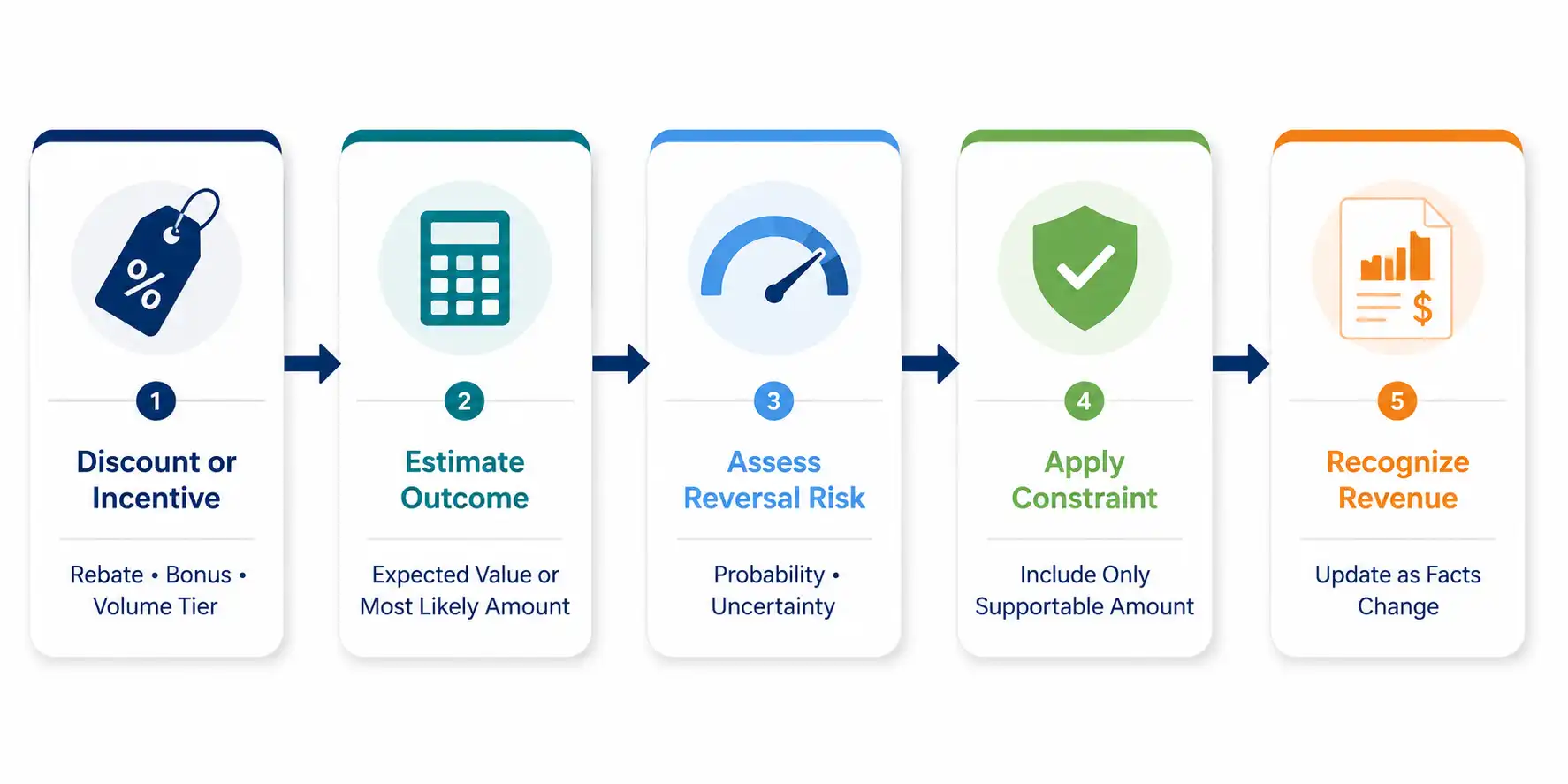
The constraint is the mechanism that keeps optimistic estimates out of the income statement: a company may recognize variable consideration only to the extent it is probable that a significant reversal will not occur once the uncertainty resolves.
Take an enterprise subscription with a 15% scale-up rebate triggered by usage exceeding a threshold at year-end, where the company estimates a 70% probability of hitting that threshold but will not know the outcome until month twelve. The constraint may permit recognition of only the portion unlikely to reverse, perhaps 10% rather than the full estimate, paired with a sensitivity disclosure showing the upside case. In a multi-country consumer products business selling through DTC, Amazon, and wholesale channels, return-driven variable consideration behaves the same way: a company invoices goods shipped under a sale-or-return arrangement at the full amount, but the true transaction price stays unknown until the return window closes, and the company should reduce revenue using historical return rates rather than recognize it at the gross invoice value.
Allocating Discounts Across Performance Obligations
Not every discount follows the same treatment, and the allocation mechanics matter as much as the estimation method.
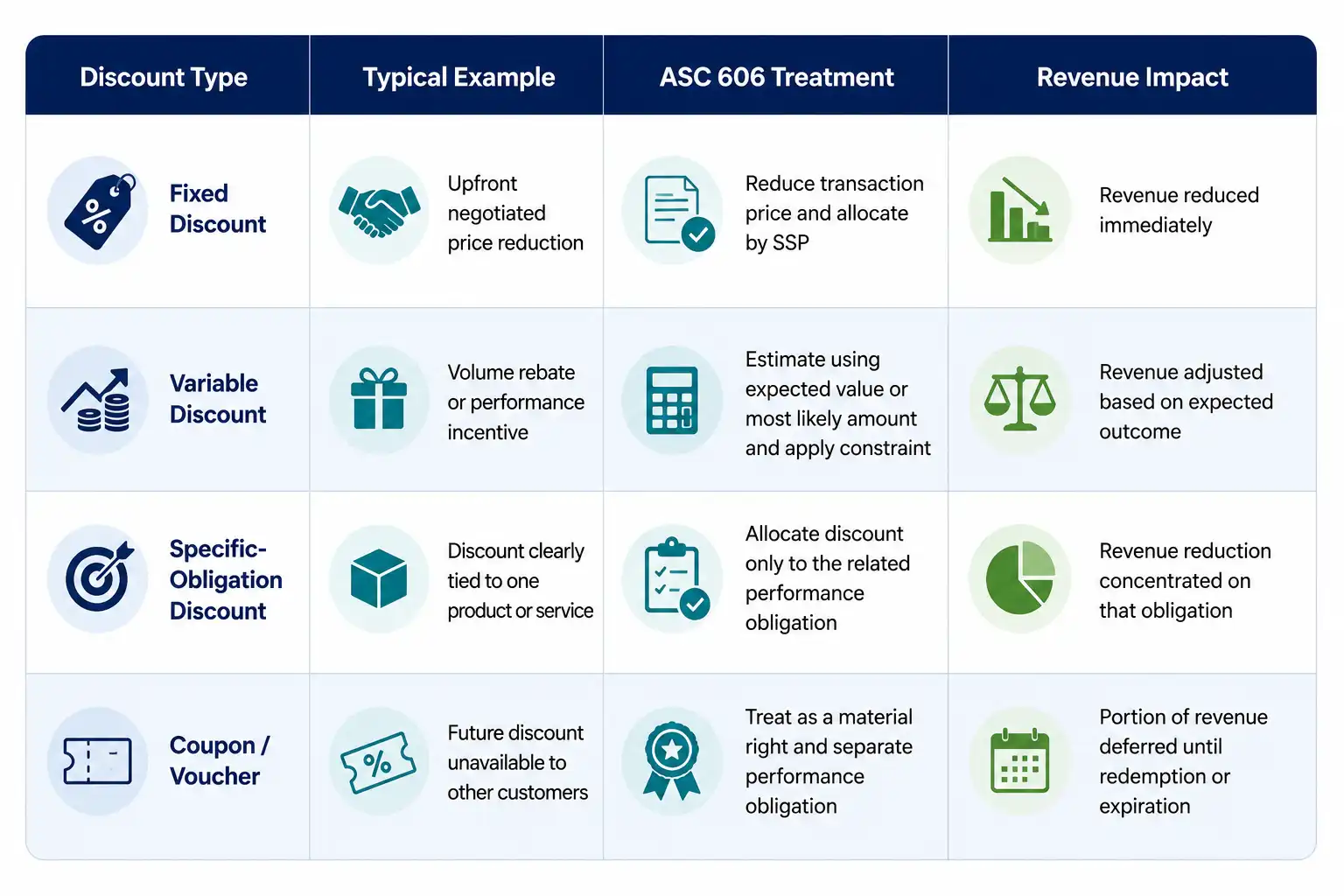
Fixed, upfront discounts
A discount known at signing reduces the transaction price immediately, and a company allocates it proportionally across performance obligations by standalone selling price (SSP). A $15 discount on a bundle of Item A ($30 SSP), Item B ($70 SSP), and Item C ($50 SSP), against a total SSP of $150, allocates as follows:
| Item | SSP | Allocation Formula | Allocated Discount | Net Revenue |
| A | $30 | (30/150) × $15 | $3 | $27 |
| B | $70 | (70/150) × $15 | $7 | $63 |
| C | $50 | (50/150) × $15 | $5 | $45 |
Discounts tied to a specific obligation
When objective evidence shows a discount relates only to certain items in a bundle, a company allocates the discount entirely to those items rather than spreading it proportionally.
Threshold-based and variable discounts
A volume rebate, such as 5% off once spend crosses $100K, is variable consideration under ASC 606-10-32-7 and follows the expected value or most likely amount method, constrained as appropriate. A typical journal entry at initial sale, assuming a $100 sale with a $5 estimated discount liability, looks like this:
Dr Accounts Receivable ……… $95
Dr Variable Consideration (contra-revenue) .. $5
Cr Revenue ………………………. $100
Estimates are updated in the period the underlying facts change, not retroactively smoothed across prior periods.
Accounting for Coupons and Vouchers as Material Rights
Accounting for coupons follows a different path than a simple price reduction. A coupon or voucher that entitles a customer to a future discount not otherwise available, such as 40% off up to $100 on a future purchase, represents a material right and creates a separate performance obligation rather than reducing the current transaction price outright.
The standalone selling price of that right is estimated based on probability-weighted redemption, and revenue is deferred proportionally. If a voucher carries an SSP of $12 against a $100 item sale, $89 is allocated to the item and $11 to the voucher, with the voucher revenue recognized upon redemption or expiration. A telecom carrier issuing service vouchers after activation, or a SaaS provider offering tiered per-seat pricing with a volume discount above 2,000 seats, both apply this same logic: estimate uptake, apply expected value, and recognize revenue as usage or redemption actually occurs rather than at the moment the coupon is issued.
Building the Controls That Make Discount Accounting Defensible
Getting the accounting right on paper is a different exercise from getting it right in a live system with sales, billing, and revenue operations all touching the same contract. A workable control environment generally needs to:
- Capture discount type at the point of sale (volume, prompt-pay, promotional rebate) with linked eligibility tracking
- Model expected value or most likely amount logic directly inside the revenue recognition engine, not in a spreadsheet reconciled after close
- Apply constraint-driven checks that block recognition before the relevant milestone or probability threshold is met
- Route discount estimates through a review with delivery or fulfillment teams before books close
Contract signed → Discount type identified → Fixed or variable? → [Fixed: allocate by SSP] / [Variable: estimate via expected value or most likely amount] → Apply constraint → Recognize as performance obligation is satisfied → Update estimate each period
A revenue recognition framework built directly into an ERP and CRM, with discount logic enforced through CPQ rules rather than manual exception handling, tends to survive acquisition diligence with far fewer adjustments than one assembled after the fact. In a mission-driven organization managing variable funding under both earned-revenue and philanthropic conditions, the same discipline applies to concessions and matching commitments, which behave like variable consideration even outside a traditional commercial contract.
Disclosure and the Board Conversation
ASC 606-10-50-20 requires disclosure of the methods, inputs, and assumptions behind variable consideration, along with quantification of contract liabilities and their effects. Discount strategy deserves a place in board reporting rather than living solely inside a sales operations dashboard, since a rolling 12-month discount model, updated monthly, is what allows a board or investor to separate a deliberate market-penetration strategy from margin erosion that crept in unnoticed. Both can look identical in a single quarter’s numbers; only the trend line and the underlying assumptions tell the difference.
Three Key Takeaways
- Every discount, rebate, or coupon program should be classified as fixed, variable, or a material right before a single dollar of revenue is booked, because the classification determines both the estimation method and the allocation mechanics that follow.
- The constraint exists to protect against significant reversals, and applying it well requires contemporaneous documentation of the probability assessment, not a retroactive justification built after an auditor asks the question.
- Discount accounting holds up under scrutiny only when it is engineered into the systems that originate the transaction, meaning CRM, CPQ, and the revenue recognition engine, rather than reconciled manually at the end of each close cycle.
Disclaimer: This article is intended for informational purposes only and does not constitute legal, tax, or accounting advice. You should consult your own tax advisor or counsel for advice tailored to your specific situation.
Hindol Datta is a four-time CFO and senior finance executive with over 25 years of leadership experience across cybersecurity, SaaS, gaming, logistics, digital marketing, medical devices, consumer products, and nonprofit organizations. He has led more than $120M in fundraising and over $150M in M&A transactions while building the financial and operational systems that let complex businesses scale with confidence. He is the author of seven books in the Systems CFO Series and holds active CPA, CMA, and CIA credentials.
AI-assisted insights, supplemented by 25 years of finance leadership experience.