
Executive Summary
Accounting for contingent liabilities is one of the few areas of financial reporting where the ledger cannot save you. There is no invoice to reconcile. No system of record tells you whether a lawsuit filed three weeks before year end belongs on the balance sheet. It might just as easily belong in a footnote. ASC 450 gives finance leaders a framework, built on the twin tests of probability and estimability. That framework only works when finance operates it with discipline and honest legal input. It also demands a willingness to record bad news before the market forces the issue.
This guide walks through the mechanics of accounting for contingencies under ASC 450. It covers how the probable, reasonably possible, and remote categories function in practice. It also looks at how insurance recoveries complicate the timing of relief, and where companies most often stumble. The goal is not to replace legal judgment or audit guidance. It is to give finance leaders a working model for accounting for contingent liabilities that holds up under audit scrutiny and, more importantly, under the scrutiny of a board that expects the truth before it reads about the exposure elsewhere.
What ASC 450 Actually Asks of Management
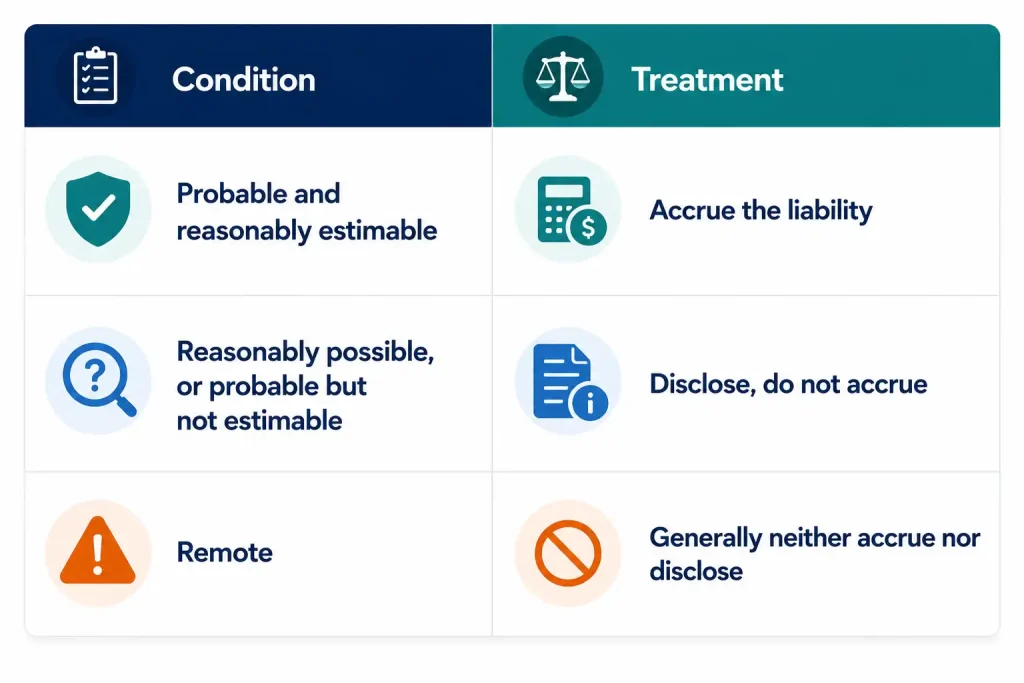
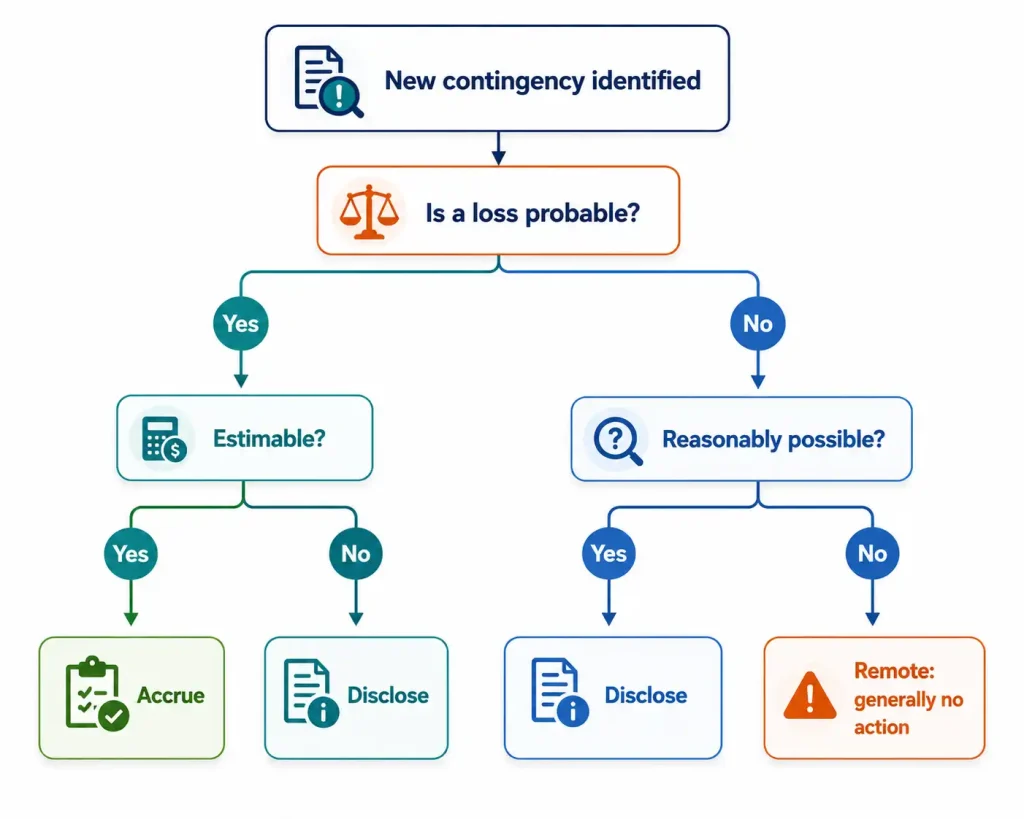
ASC 450 rests on a simple premise. Companies should reflect known risks in their financial statements once those risks cross a threshold of likelihood and measurability, and they should resist the temptation to either bury a real exposure or manufacture certainty where none exists. The standard sorts loss contingencies into three categories: probable, reasonably possible, and remote. A loss that is both probable and reasonably estimable requires an accrual, meaning it hits the balance sheet as a liability and the income statement as an expense. A loss that is reasonably possible, or one that is probable but not yet estimable, requires disclosure rather than accrual. Remote losses generally require neither treatment, with a handful of exceptions for certain guarantees and high-risk legal exposures.
That decision tree reads cleanly on paper. In a live legal matter, facts shift week to week. Claims get amended. New evidence surfaces. Outside counsel, worried about prejudicing a defense, resists calling anything probable even when the internal read of the case says otherwise. That hesitation surfaces in nearly every legal review, and the job of the finance leader in that room is not to overrule the lawyer but to translate the legal assessment into a financial reporting judgment that management, not counsel, is ultimately responsible for making.
The Two Tests: Probability and Estimability
Two tests drive every accrual decision. Probability asks whether the loss is likely to occur, a threshold most practitioners treat as somewhere above a 70 to 75 percent likelihood, informed by legal merits, jurisdictional tendencies, and the stage of the matter rather than by a formal statistical model. Estimability asks whether a reasonable estimate can be developed, and the standard does not require precision. A defensible range is enough, with the low end accrued when no point within that range is a better estimate than any other.
Consider a breach-of-contract claim seeking $10M in damages. If counsel views the case as probable and supports a $1M exposure, that amount belongs on the books. If the exposure is probable but ranges from $1M to $5M with no better point estimate available, the low end gets accrued and the full range gets disclosed. In a cybersecurity and identity access management company navigating acquisition diligence, this exact discipline, an accurate contingency register reviewed every quarter rather than assembled the week before a data room opened, was part of what let the deal move on schedule instead of stalling on unresolved reserve questions.
When Legal Counsel Hesitates
Reliance on legal counsel is where accounting for contingencies most often breaks down. Attorneys are trained to advocate, not to characterize cases for financial reporting purposes, and a written acknowledgment that a claim is probable can feel, to counsel, like handing the plaintiff a gift. Auditors nonetheless expect legal input, typically through formal legal letters, and the finance function has to manage that tension without asking counsel to compromise the defense. Framing the request as a litigation risk assessment for reporting purposes, rather than as a legal admission, tends to open the conversation. Companies routinely delay an accrual for two or three quarters because counsel will not use the word probable, only to take a sudden, material charge the moment a settlement is signed, and that pattern does more damage to credibility with the audit committee than an earlier, smaller accrual ever would have.
Insurance Recoveries and the Matching Problem
Insurance makes the picture harder, not easier. ASC 450 requires that a recovery be recognized only once it is realizable, which in practice means the insurer has acknowledged coverage and has not contested the claim, and the company has a defensible basis for the recovery amount. Owning a policy is not the same as having a recognizable asset. This creates a timing mismatch: the liability accrues in one quarter, and the offsetting recovery, if it comes at all, lands in a later one. In a $127M global consumer products business with a supply chain running through China and Vietnam, vendor and logistics disputes surfaced with some regularity, and the instinct to net the expected insurance recovery against the exposure had to be resisted every time until the carrier had actually confirmed coverage in writing. The standard’s caution here reflects a real pattern: insurers delay, dispute, and occasionally deny.
Operationalizing Accounting for Contingent Liabilities
Putting ASC 450 into practice takes more than a technical memo written once a year. It requires a process, coordinated across legal, finance, operations, and internal audit, that runs every quarter regardless of whether anything material has changed.
A workable process generally includes:
- A contingency register, updated quarterly, covering every matter above a defined materiality threshold
- Written legal input for each significant matter, ideally through formal audit letters
- Documented management judgment on probability and estimability, independent of counsel’s characterization
- A quarterly board or audit committee update on material exposures, even those requiring no accrual
- A disclosure review that checks consistency across financial statement footnotes, risk factors, and earnings call language
The decision flow itself can be summarized simply:
In a Euronext Paris-listed gaming and digital entertainment company operating across five countries, this kind of structured, repeatable process was what allowed the S-1 and IPO-readiness work to move alongside Big Four auditors without contingency judgments becoming a last-minute scramble. The register existed before the bankers ever asked for it.
Common Pitfalls in Accounting for Contingencies
A handful of patterns recur across almost every audit finding or restatement involving ASC 450:
- Delaying accrual because counsel will not say the word probable, when the standard assigns that judgment to management
- Treating estimability as a demand for precision rather than a reasonable, well-documented range
- Running the contingency process off verbal updates instead of a centralized, reviewed register
- Assuming an insurance policy guarantees recovery before the carrier has confirmed coverage in writing
- Writing disclosures either so vague they alarm no one or so specific they compromise the legal position
Three Key Takeaways
- Accounting for contingent liabilities under ASC 450 is a management judgment, not a legal one, and finance leaders who treat counsel’s caution as the final word tend to accrue too late and too suddenly, which damages credibility more than an earlier, smaller number ever would.
- Estimability does not require a precise figure. A well-supported range, with the low end accrued and the full range disclosed, satisfies the standard and holds up under audit review far better than silence while waiting for a settlement number.
- Insurance recoverability should never be assumed. Recognize the liability on its own timeline and let the recovery follow only once the carrier has confirmed coverage in writing, even when that creates a temporary mismatch on the income statement.
Disclaimer: This article is intended for informational purposes only and does not constitute legal, tax, or accounting advice. You should consult your own tax advisor or counsel for advice tailored to your specific situation.
Hindol Datta is a four-time CFO and senior finance executive with over 25 years of leadership experience across cybersecurity, SaaS, gaming, logistics, digital marketing, medical devices, consumer products, and nonprofit organizations. He has led more than $120M in fundraising and over $150M in M&A transactions while building the financial and operational systems that let complex businesses scale with confidence. He is the author of seven books in the Systems CFO Series and holds active CPA, CMA, and CIA credentials.
AI-assisted insights, supplemented by 25 years of finance leadership experience.