
Executive Summary
A 338(h)(10) election ranks among the more consequential tools in corporate acquisitions. It lets a qualifying stock purchase count as an asset purchase for federal tax purposes. When the conditions line up, the election delivers a step-up in the tax basis of the acquired assets. Over time, that translates into larger depreciation and amortization deductions and real cash flow benefits for the buyer. The catch is that qualification depends on affiliation status, consolidated filing history, and ownership thresholds. These are easy to assume and easy to get wrong.
This article walks through how the election works. It also covers what buyers and sellers must validate before relying on it, and where state tax conformity introduces complexity. It also covers how the choice interacts with purchase accounting and the fallback provision found in Section 336(e). Finance leaders have run acquisitions across technology, consumer products, and public company M&A environments. They tend to arrive at the same conclusion: the election rewards preparation and punishes assumption.
How a 338(h)(10) Election Works
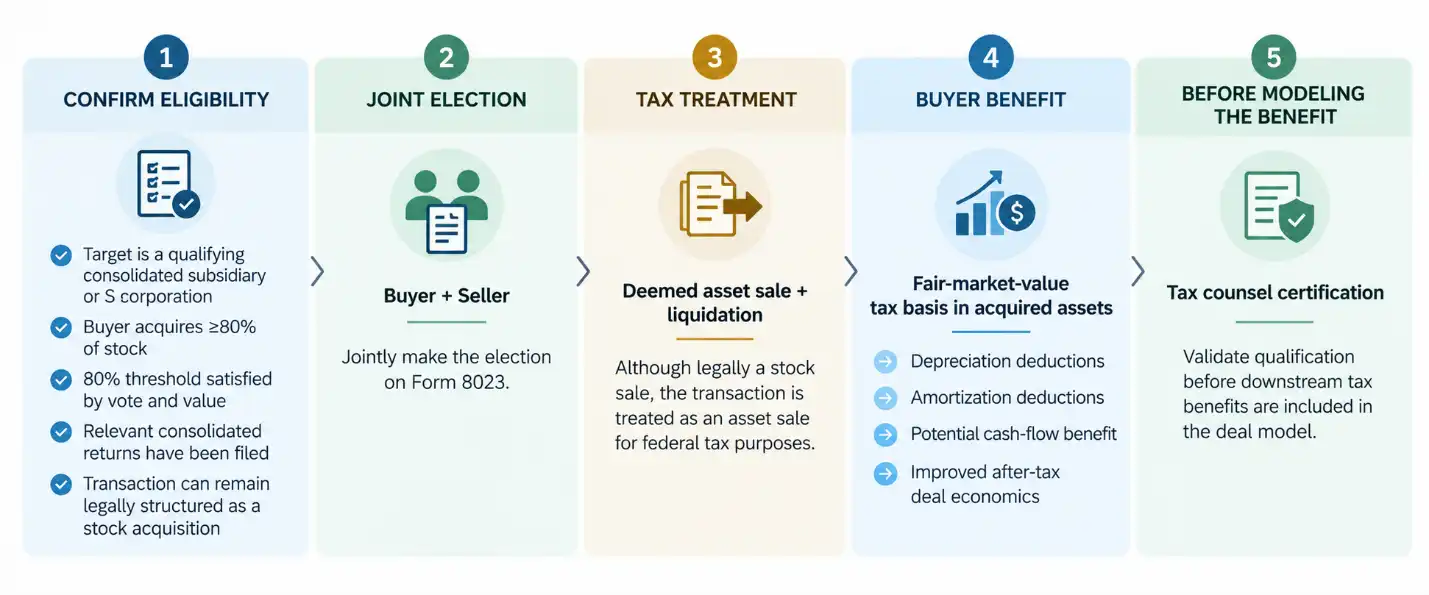
The mechanics are simpler than the compliance around them. A purchasing corporation must acquire at least 80 percent of the target’s stock. The target must be either a subsidiary within a consolidated group or an S corporation. Both parties, buyer and seller, must jointly agree to the election on Form 8023.
Once made, the election treats the transaction as if the target sold all of its assets and then liquidated. Legally, though, the deal remains a stock sale. That distinction matters more than it sounds. Because the sale is a stock transaction under state law, contracts, licenses, and employee relationships transfer smoothly. True asset deals often face change-of-control friction that this structure avoids. Yet for federal tax purposes, the buyer receives a fair market value basis in the acquired assets. That opens the door to accelerated depreciation and amortization schedules that a straight stock purchase would never allow.
Consider a $60M acquisition of a wholly owned subsidiary in the cybersecurity software space. Here, a 338(h)(10) election produced a basis step-up in developed technology and customer contracts. That step-up yielded $15M in tax savings across five years and lifted deal IRR by 130 basis points. That kind of return can determine whether a transaction clears an internal hurdle rate in the first place.
Affiliation Tests and Eligibility Requirements
The single most common mistake in evaluating a 338(h)(10) election is assuming eligibility exists because the target looks like a subsidiary on an organization chart. Buyers must validate group status rather than assume it. A standalone C corporation or an LLC does not qualify unless it sits inside a broader consolidated structure, and even a genuine subsidiary can be disqualified if the parent has stopped filing consolidated returns.
That scenario is not hypothetical. In one deal involving a global consumer products company, the target’s legal entity chart showed it as a subsidiary, yet the parent had not filed consolidated returns for five years. That single fact disqualified the 338(h)(10) path entirely and forced a pivot to a 336(e) structure, bringing different economics and state tax complications that the deal team had not modeled.
Before building any tax benefit into a model, buyers should confirm the following.
- Consolidated return filings for the parent group over the relevant lookback period
- The 80 percent ownership threshold, measured by both vote and value
- Whether the transaction is structured, and can legally remain, a stock acquisition rather than an asset purchase
Tax counsel should certify this qualification in writing before deal teams model any downstream benefit. That memo is not a formality, it is the foundation the rest of the analysis rests on.
State Tax Conformity and the Bifurcated Basis Problem
Federal treatment under a 338(h)(10) election does not automatically follow at the state level. Several states decline to conform to the federal step-up, which produces a bifurcated basis regime where the same asset carries different tax values depending on jurisdiction.
During a multi-state transaction connected to public company gaming and digital entertainment operations, the federal election produced favorable amortization, yet three key states declined to recognize the step-up. The result was a requirement to maintain dual fixed asset ledgers and reconcile deferred tax asset and deferred tax liability impacts throughout the close audit cycle. The administrative overhead was not trivial, and in some jurisdictions it meaningfully narrowed the net advantage of the election. Any model built on federal tax benefits alone will overstate the deal’s true after-tax return.
Financial Reporting and Purchase Accounting Implications
The election reshapes the opening balance sheet. Under GAAP, assets must be revalued, deferred taxes recalculated, and goodwill recomputed to reflect the deemed asset sale rather than a simple stock acquisition with residual goodwill. Misalignment between the tax model and the purchase accounting entries is one of the more avoidable but common failure points in post-close reporting.
One transaction closed with a 338(h)(10) election in place, but the opening balance sheet assumptions were never synchronized with the deferred tax schedule. The result was a restatement six months after close and a set of audit findings that were entirely preventable. Since then, the standard practice has been to require joint review of tax elections, accounting entries, and auditor alignment at least 30 days before closing, not after.
Negotiating Seller Cooperation
Because the seller must consent to the election, and because doing so can trigger immediate gain recognition on the seller’s side, cooperation is often a negotiated point rather than a given. Gross-up clauses and purchase price adjustments are the usual mechanism for closing that gap. In one deal, an additional $2M was offered to the seller to offset the tax impact of the election, a trade that made sense because the projected benefit to the buyer exceeded $8M over five years.
338(h)(10) Election Versus a 336(e) Election
When the affiliation test fails, Section 336(e) can serve as a fallback, though it is a narrower and less well tested tool. The table below summarizes the practical differences.
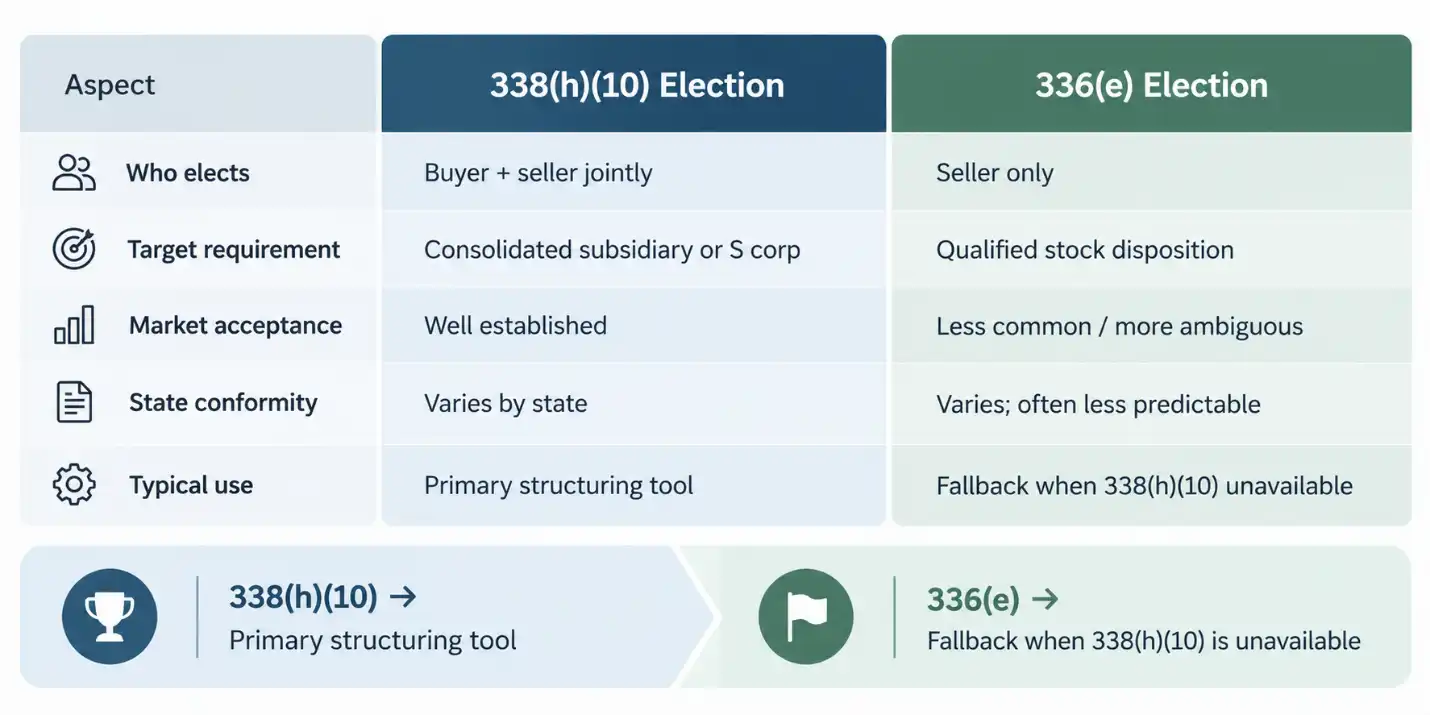
Because of the added ambiguity, 336(e) tends to function as a tool of last resort rather than a first choice, used when a 338(h)(10) election is definitively unavailable.
The Strategic Value Beyond the Immediate Tax Benefit
The advantage of the election is not confined to the depreciation schedule. It also creates optionality in deal structuring, supports cleaner asset-level documentation, and can reduce post-close audit exposure. In competitive bid processes, particularly in private equity and corporate carve-out situations, a more tax-efficient structure can be the difference between winning and losing a deal. A 338(h)(10) model has been used to outbid a competitor by $3M while still clearing after-tax return targets, which is the practical payoff of structuring discipline done early rather than retrofitted after signing.
Three Key Takeaways
- A 338(h)(10) election can materially improve deal economics through a tax basis step-up, but the benefit only exists if group affiliation, consolidated filing history, and the 80 percent ownership threshold are validated before the model is built, not after.
- State tax conformity is inconsistent, and a federal benefit can be significantly diluted by dual ledger requirements and administrative overhead in states that do not recognize the step-up, so state-level modeling deserves the same rigor as the federal analysis.
- The election is as much a governance discipline as a tax strategy, requiring synchronized review across tax, accounting, and legal teams well before close, since misalignment between the tax election and purchase accounting has produced avoidable restatements in real transactions.
Disclaimer: This article is intended for informational purposes only and does not constitute legal, tax, or accounting advice. You should consult your own tax advisor or counsel for advice tailored to your specific situation.
Hindol Datta is a four-time CFO and senior finance executive with over 25 years of leadership experience across cybersecurity, SaaS, gaming, logistics, digital marketing, medical devices, consumer products, and nonprofit organizations. He has led more than $120M in fundraising and over $150M in M&A transactions while building the financial and operational systems that let complex businesses scale with confidence. He is the author of seven books in the Systems CFO Series and holds active CPA, CMA, and CIA credentials.
AI-assisted insights, supplemented by 25 years of finance leadership experience.