What Your AI Risk Data Is Not Telling You: A Lesson from Abraham Wald By Hindol Datta, CPA, CIA (Certified Internal Auditor) | Fractional CFO | AI Governance Advisor byadminMay 13, 2026
Your AI Is No Longer Insured. By Hindol Datta, CPA | Fractional CFO Trustmodel. AI | AI Governance Advisor byadminMay 7, 2026
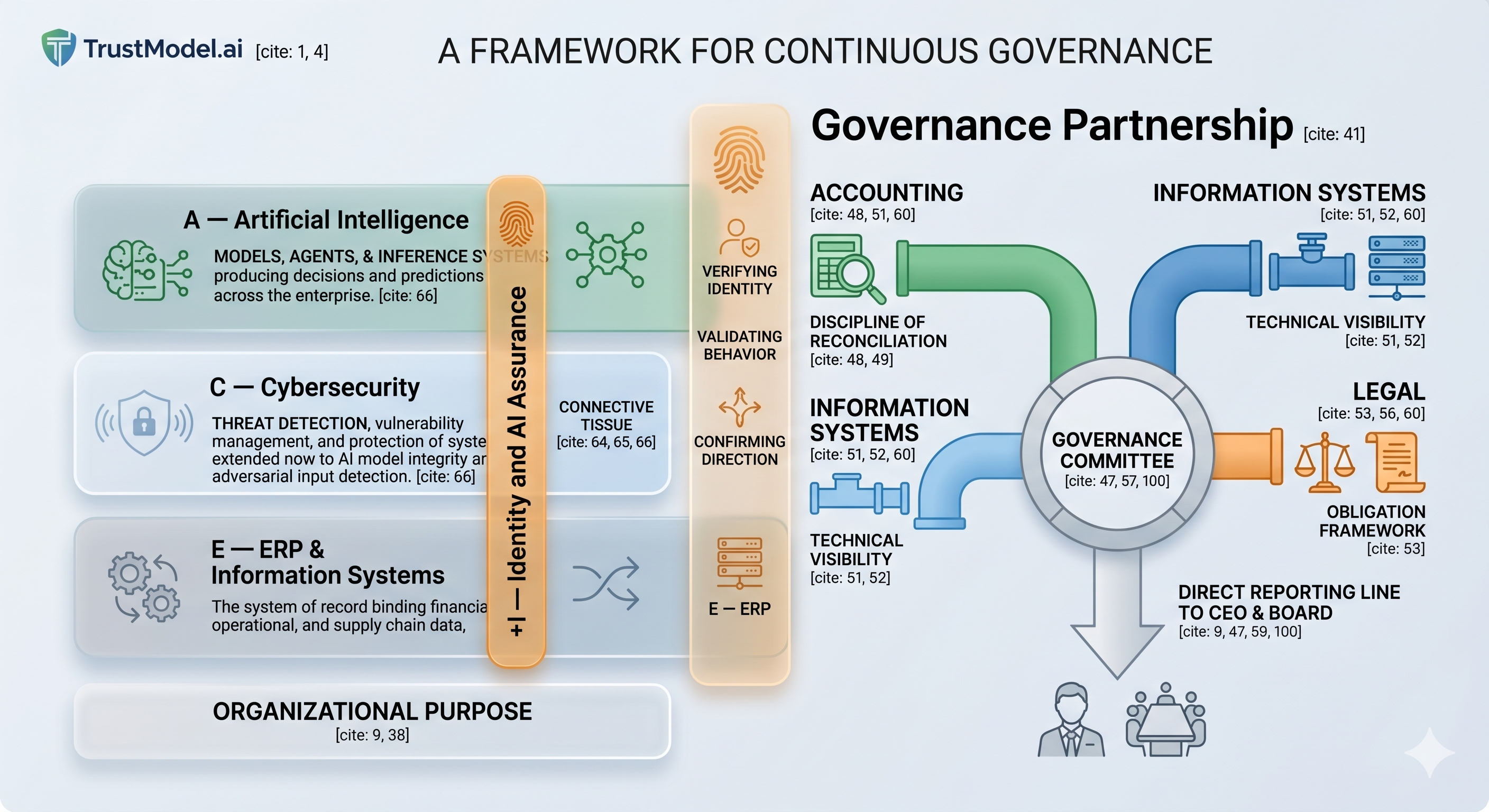
Against Drift: The Case for IAM and AI Assurance as Organizational Imperatives A Framework for Continuous Governance Across AI, Cybersecurity, and ERP byadminMay 7, 2026
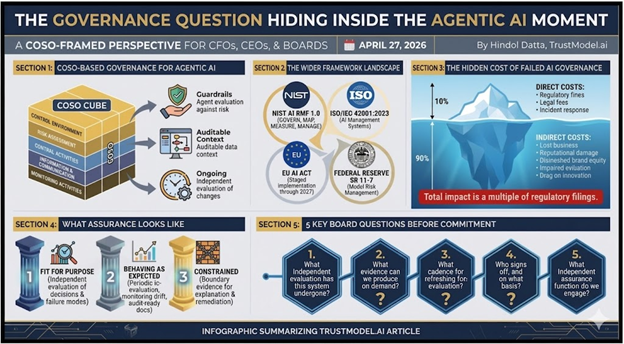
The Governance Question Hiding Inside the Agentic AI Moment A COSO-framed perspective for CFOs, CEOs, and Boards, as Google Cloud Next 2026 puts autonomous systems on center stage byadminMay 4, 2026
Leadership & CultureDecember 26, 2025 Memo to the Board: How to Communicate Risk, Value and Vision as CFO There are few moments in a CFO’s calendar as consequential as preparing a memo or briefing for the board. It is not a mere update. It is a test of alignment, a presentation of stewardship, and a declaration of what lies ahead. In those few pages or that brief presentation, the board expects not just numbers but understanding, not just performance but direction, and not just statements of risk but interpretations of what those risks mean. A well-constructed board communication is not defensive, nor overly optimistic. It is clear-eyed, analytical, and above all, rooted in judgment. The role of the CFO in board communications is unique. It is to be the translator between operations and oversight, the link between the past and the possible. The CEO paints the vision, but it is the CFO who gives it weight, explaining how it will be funded, how it will return value, and what could go wrong along the way. Throughout my twenty-five years leading finance across cybersecurity, SaaS, manufacturing, logistics, and gaming, I have learned that this burden cannot be outsourced. It is part of the trust we inherit when the title changes to Chief Financial Officer.
Leadership & CultureDecember 26, 2025 Building Financial Resilience in Uncertain Times When the world breaks, it does not send a calendar invite. It does not whisper warnings in the boardroom or give your spreadsheet the courtesy of a gentle correction. It shatters assumptions. Quietly, then all at once. The patterns stop behaving. Cash stops flowing like it used to. Models that seemed so carefully constructed begin to falter under the weight of newly introduced unknowns. And just like that, resilience stops being a corporate buzzword and becomes the difference between breathing and bleeding. Finance, by its nature, is a discipline of foresight. But the kind of foresight that matters most is not about predicting the exact timing of a downturn or the specific domino that will fall next. It is about preparing so thoroughly, so structurally, that when the domino tips, whether it is a pandemic, a war, a banking seizure, or a once-in-a-century interest rate shock, the organization does not collapse inwards. Instead, it absorbs the blow, rights its balance, and sometimes even finds the hidden path forward faster than its competitors. Throughout my twenty-five years leading finance across cybersecurity, SaaS, manufacturing, logistics, and gaming, I have learned that resilience is not built in a single quarter’s earnings. It is built quietly over years, in the choices most do not notice until the headlines arrive. The way working capital is managed when times are flush. The discipline to preserve liquidity even when capital is cheap and abundant. The wisdom to avoid excess leverage, even when equity markets are forgiving.
Leadership & CultureDecember 24, 2025 Balancing Culture and Cost: A Leader’s Guide In difficult times, it is easy for a company to react by slashing costs indiscriminately, raising eyebrows among employees, unsettling investors, and dimming the light of innovation. Decisions born from panic rarely result in sustainable improvements. True leadership demands something rarer: the wisdom to balance prudence and principle, to remove excess without damaging the spirit, to honor the human side of business even as we strengthen its financial spine. Cost reduction is a necessary tool for long-term value creation. It is not an admission of defeat but a commitment to discipline. Yet when wielded carelessly, cost cuts can fracture trust, erode morale, and stunt growth. The fundamental challenge for any CFO or CEO is to distinguish between costs that are dilutive drains and those that are strategic investments, then remove the former while preserving the latter. This is not just a finance exercise. It is a values exercise. Throughout my twenty-five years leading finance across cybersecurity, SaaS, manufacturing, logistics, and gaming, I have learned that intelligent cost reduction is neither simplistic nor cruel. It requires clarity of purpose, rigor in process, and above all, respect for the people who bring the strategy to life.
Leadership & CultureNovember 19, 2025 Building Trust with Lenders: A CFO’s Guide Laying the Groundwork Before the Storm
Leadership & CultureNovember 19, 2025 Why CFOs Should Earn Bank Trust Early Building the Foundation of Trust
Leadership & CultureNovember 19, 2025 Mastering the Language of Credit for Founders Part I: From Equity Fluency to Credit Literacy
Leadership & CultureOctober 14, 2025 Upskilling Finance Teams: Embrace Data and Strategy “The chains of habit are too light to be felt until they are too heavy to be broken.” – Warren Buffett
Leadership & CultureOctober 14, 2025 How Strategic CFOs Drive Sustainable Growth and Change When people ask me what the most critical relationship in a company truly is, I always say it’s the one between the CEO and the CFO. And I don’t say that lightly. Over three decades of helping
Leadership & CultureOctober 14, 2025 The CFO’s Guide to Simplifying Business Complexity The best companies don’t always win because of bold strategies or perfect products. They win because they know how to keep things simple. Great CFOs understand this better than anyone. While business
Leadership & CultureOctober 14, 2025 The Quant CFO: A Playbook for Predictive Finance In the world of capital markets, the quant has long held a unique position: an architect of probabilistic models, a hunter of quant data in noise, and a master of statistical arbitrage. For those wondering what quant finance is, it is essentially the discipline of applying mathematical and statistical methods to financial markets, a field that has shaped trading and investment strategies for decades. In the corporate finance world, the CFO has traditionally played a different role: steward of the balance sheet, master of compliance, allocator of capital, and translator of strategy into financial terms. But in an age of quant finance, machine intelligence, real-time data, and nonlinear risk, these roles are beginning to converge often enabled by finance automation and finance process automation that bridge the gap between quantitative precision and strategic leadership.