What Your AI Risk Data Is Not Telling You: A Lesson from Abraham Wald By Hindol Datta, CPA, CIA (Certified Internal Auditor) | Fractional CFO | AI Governance Advisor byadminMay 13, 2026
Your AI Is No Longer Insured. By Hindol Datta, CPA | Fractional CFO Trustmodel. AI | AI Governance Advisor byadminMay 7, 2026
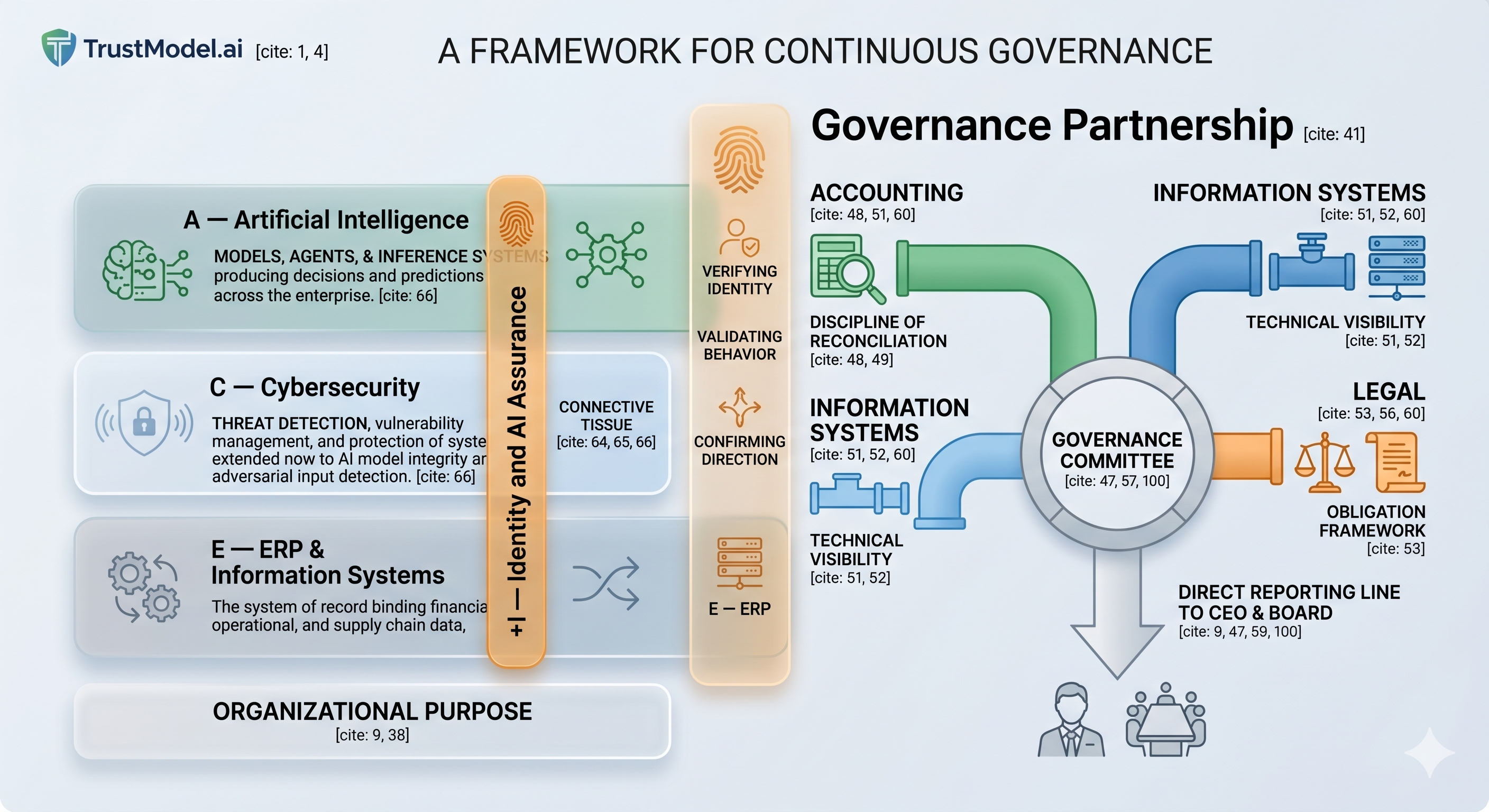
Against Drift: The Case for IAM and AI Assurance as Organizational Imperatives A Framework for Continuous Governance Across AI, Cybersecurity, and ERP byadminMay 7, 2026
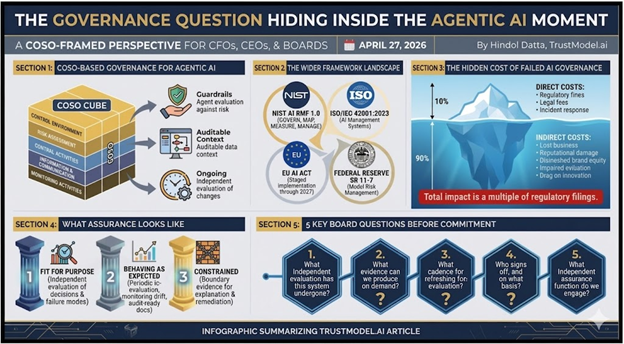
The Governance Question Hiding Inside the Agentic AI Moment A COSO-framed perspective for CFOs, CEOs, and Boards, as Google Cloud Next 2026 puts autonomous systems on center stage byadminMay 4, 2026
GovernanceJanuary 12, 2026 Behind Closed Doors: How Great CFOs Manage Up to Powerful Boards Reporting into the boardroom is both a privilege and a test. The greatest CFOs do more than present numbers. They shape perspective, build trust, and serve as the board’s most indispensable partner. Behind closed doors, with powerful directors watching, the CFO’s role is not only to inform but to persuade, to anticipate, and to align. Throughout my twenty-five years leading finance across cybersecurity, SaaS, manufacturing, logistics, and gaming, I have learned that this is the crucible in which board-CFO relationships are forged, and in which financial stewardship meets strategic partnership. At its core, managing up is about credibility. Directors expect financial truth told frankly and consistently. Great CFOs earn credibility through precision, transparency, and rigor. They present not only audited results but the story behind the story. They highlight why trends matter, what drivers are moving margins, where risk lies in capital allocation. They do not merely reassure. They illuminate. They recognize that numbers without context are noise, and context without accountability is empty rhetoric. Boardrooms are built on confidence. CFOs provide it.
GovernanceJanuary 12, 2026 The Two Hats of the Boardroom: When to Govern, When to Get Out of the Way The modern boardroom is not a single room with a singular role. It is a dynamic space where directors wear two fundamentally different hats. One is the hat of governance including compliance, oversight, and protection. The other is the hat of enablement including support, strategy, and acceleration. The strongest boards do not choose one or the other. They master the ability to shift between the two with timing, clarity, and conviction. Throughout my twenty-five years leading finance across cybersecurity, SaaS, manufacturing, logistics, and gaming, I have learned that the failure to do so is not academic. It is consequential. Boards that govern when they should support suffocate initiative. Boards that support when they should govern compromise accountability. In both cases, the enterprise suffers. Understanding this duality begins with recognizing that the role of the board is not fixed. It is situational. It evolves with the cycle of the business, the confidence in management, the level of uncertainty, and the magnitude of decisions at hand. Directors must be fluent not only in the responsibilities of governance but in the judgment of when to exercise them.
GovernanceJanuary 9, 2026 Designing a Principle-Based Board: Clarity, Courage, and Collective Intelligence The modern board faces not only complexity but velocity. Strategic decisions are made amid incomplete information, accelerating disruption, and rising stakeholder pressure. The most dangerous response to this complexity is proceduralism, relying on checklists, timelines, and mechanical approvals to navigate judgment terrain. Throughout my twenty-five years leading finance across cybersecurity, SaaS, manufacturing, logistics, and gaming, I have learned that the antidote is not more process. It is principle. Boards that operate on shared, articulated principles rather than ad hoc reactions make faster, better, and more coherent decisions. They become consistent without becoming rigid. They become decisive without becoming dogmatic. They govern not by precedent but by purpose.
GovernanceJanuary 9, 2026 Boards Have a Job: CFOs Pay the Price When They Forget It It is a truth that should be self-evident but often is not: boards have a job. They are not ceremonial observers. They are not goodwill ambassadors. They are fiduciaries, bound not only by statute but by consequence. When they fulfill their obligations with rigor, alignment, and discipline, value is protected, risks are contained, and leadership is kept honest. When they do not, the cost is measured in value erosion, strategic drift, and sometimes in irreversible damage to reputation or solvency. Throughout my twenty-five years leading finance across cybersecurity, SaaS, manufacturing, logistics, and gaming, I have learned that fiduciary duty is not an abstraction. It consists of specific obligations that are enforceable, practical, and measurable. Directors must act with care, loyalty, and obedience to the enterprise’s mission and strategic continuity. They must oversee management, scrutinize material risks, ensure regulatory compliance, and serve the long-term interests of shareholders and stakeholders. These are not philosophical suggestions. They are enforceable standards. Yet in too many boardrooms, these duties are reframed as a checklist or worse, reduced to vague references in governance manuals.
GovernanceJanuary 8, 2026 How to Build a Board That Thinks Like Owners, Not Spectators The architecture of a boardroom is often weighed down by convention. Chairs are filled with accomplished individuals whose résumés glimmer with achievement. They bring perspective and prestige. Yet too many sit quietly as if in an audience, nodding politely rather than engaging. The distinction between spectators and owners matters. Boards that think like owners transcend their formal role. They confront complexity with curiosity, stretch assumptions with rigor, and shape outcomes with conviction. Throughout my twenty-five years leading finance across cybersecurity, SaaS, manufacturing, logistics, and gaming, I have learned that to nurture such a board requires intention and design. It begins with a mindset. Spectators view themselves as independent overseers, featuring from the perimeter. They ask questions. They listen. They approve or delay, but they seldom challenge. Owners lean in. They take stakes, mentally and financially. They insist on shared accountability. They make it personal. They carry the fate of the enterprise as if it were their own, aligning long-term prosperity with their own. This posture is not naive optimism. It is disciplined, humble, and unafraid of hard truths.
GovernanceJanuary 6, 2026 The Cap Table Balancing Act: Dilution, Incentives, and Exit Strategy There is a special kind of quiet that fills a room when the cap table goes up on the screen. It is not the silence of confusion but the silence of consequence. Founders lean in. Investors watch closely. And operators, those who helped build the company from zero to now, hold their breath. Because unlike income statements or burn rates or net promoter scores, the cap table does not deal in potential. It deals in outcomes. Throughout my twenty-five years leading finance across cybersecurity, SaaS, manufacturing, logistics, and gaming, I have learned that the capitalization table is not just a record of who owns what. It is the living heartbeat of a company’s financial DNA. It tells you where power resides, how aligned incentives are, and what tomorrow’s headline will say if a term sheet turns into a transaction. Managing a cap table is not about spreadsheets. It is about stewardship. Because every decision that affects dilution, ownership, or incentive design changes the psychology of the people who build, fund, and eventually exit the business. Cap table management, done right, is part arithmetic, part game theory, and part long-range forecasting.
GovernanceJanuary 1, 2026 Modernizing SOX: The CFO’s Blueprint for Trust If you were to assemble a list of the least glamorous aspects of the CFO’s remit, Sarbanes-Oxley compliance would likely rank near the top. It evokes images of checklists, control matrices, quarterly certifications, and audit fatigue. For many finance leaders, it is a necessary burden, an expense to be endured for the privilege of remaining publicly traded. Yet beneath the surface of this regulatory obligation lies a quiet opportunity. Throughout my twenty-five years leading finance across cybersecurity, SaaS, manufacturing, logistics, and gaming, I have learned that when SOX is approached not as a defensive perimeter but as an operational asset, it becomes something far more powerful: a blueprint for trust. The smartest CFOs do not view SOX as a cage. They see it as a chassis. A structure upon which to build durable controls, scale responsibly, and most critically, turn compliance into confidence. And the lever to unlock that potential is technology. Not just automation for the sake of efficiency, but thoughtful integration of tools that raise visibility, reduce risk, and enable faster, smarter decisions.
GovernanceOctober 17, 2025 AI Regulation Strategies: Insights for CFOs and Boards Every wave of technological innovation leaves behind a regulatory undertow. Generative AI, with its power to reason, simulate, and generate human-like outputs at scale, has already triggered a
GovernanceOctober 17, 2025 Stewardship: The Core of Effective Financial Leadership Stewardship often masquerades behind a fog of financial controls, policy manuals, and governance frameworks. To many, it arrives clad in the robes of internal audit, contract compliance, and periodic
GovernanceOctober 17, 2025 Building Trust in Finance: The CFO’s Role Trust Begins Where Transparency Meets Context I did not begin my journey in finance to become a mere compliance steward. Like many in this field, I started with spreadsheets and statements,