What Your AI Risk Data Is Not Telling You: A Lesson from Abraham Wald By Hindol Datta, CPA, CIA (Certified Internal Auditor) | Fractional CFO | AI Governance Advisor byadminMay 13, 2026
Your AI Is No Longer Insured. By Hindol Datta, CPA | Fractional CFO Trustmodel. AI | AI Governance Advisor byadminMay 7, 2026
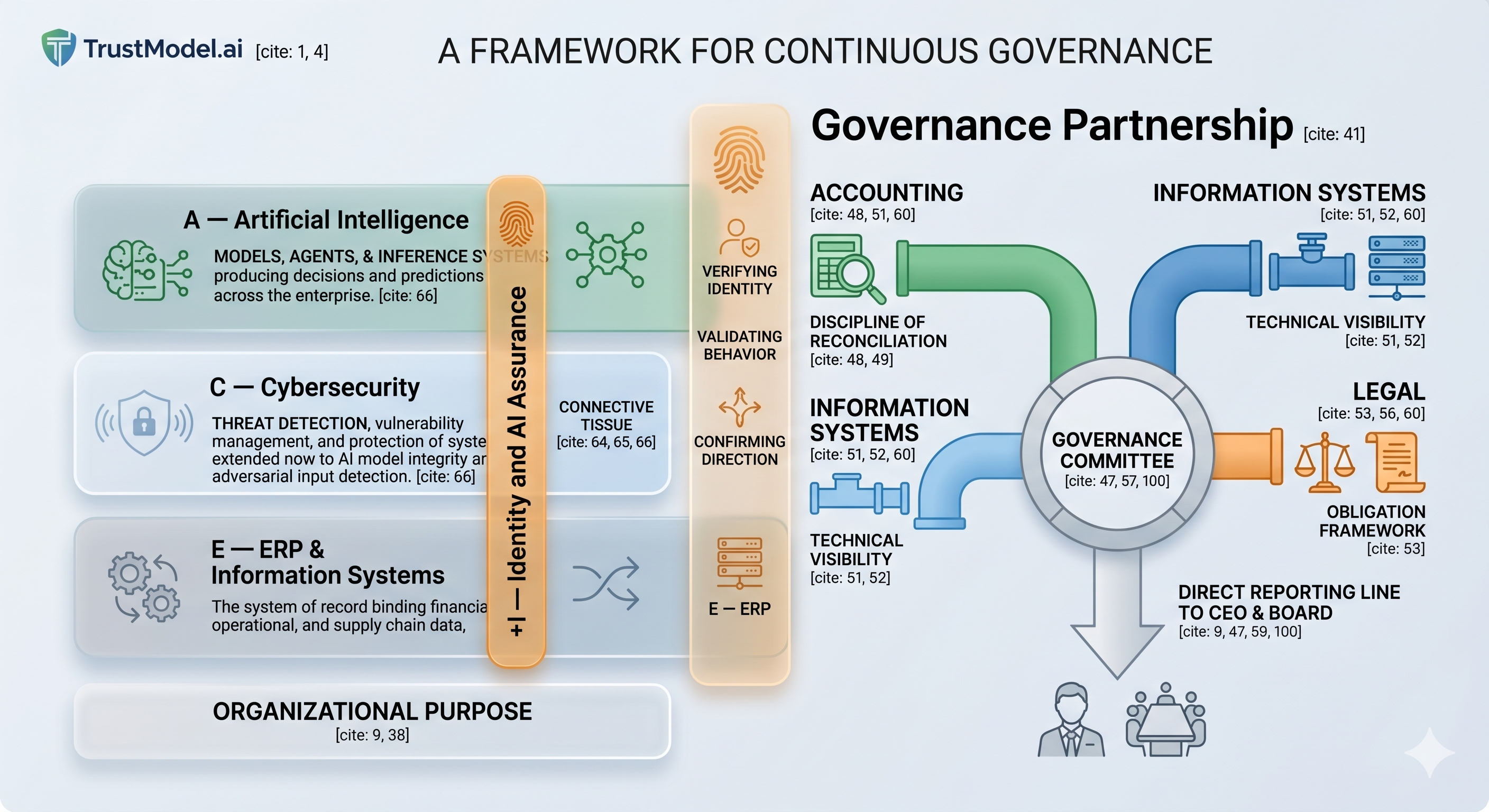
Against Drift: The Case for IAM and AI Assurance as Organizational Imperatives A Framework for Continuous Governance Across AI, Cybersecurity, and ERP byadminMay 7, 2026
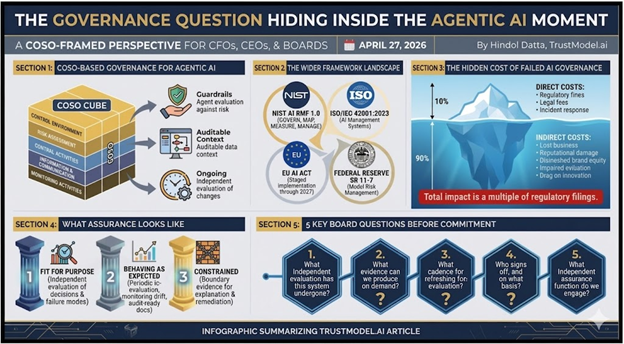
The Governance Question Hiding Inside the Agentic AI Moment A COSO-framed perspective for CFOs, CEOs, and Boards, as Google Cloud Next 2026 puts autonomous systems on center stage byadminMay 4, 2026
GovernanceJanuary 21, 2026 Getting Board Buy-In on Exits: When Capital, Legacy, and Judgment Collide Deciding to exit a business is not simply a financial decision. It is inherently emotional. Boards must balance devotion to legacy, loyalty to leadership, and strategic discipline. When they align, exits can accelerate value and preserve reputation. When they do not, they linger in cognitive dissonance, delay exit timing, and erode returns. Throughout my twenty-five years leading finance across cybersecurity, SaaS, manufacturing, logistics, and gaming, I have learned that getting board buy-in requires reframing exits not as endings but as strategic transitions, anchored in data, alignment, and shared purpose. The tension arises because boards are populated by stewards of the past and strategists for the future. Long-serving members hold attachments to brands, teams, and legacy. Newer directors push results, discipline, and growth trajectory. So when a company confronts a potential exit including divestiture, carve-out, or full sale, a conversation ensues over more than value. It becomes a conversation over identity.
GovernanceJanuary 21, 2026 Crisis Reveals Character: How Strong Boards Lead When Everything Breaks Black swans arrive unannounced and demand judgment under chaos. Whether a geopolitical shock, a pandemic, a cyber breach, or regulatory meltdown, they test not only strategy but integrity. In those moments, board performance peaks or collapses. The markers are clear: resilience, clarity, alignment, and courage. Throughout my twenty-five years leading finance across cybersecurity, SaaS, manufacturing, logistics, and gaming, I have learned that those qualities are not accidental. Boards that navigate black swans with integrity do so because they have built the muscle long before crisis arrives. Great boards begin by anticipating adversity, not to forecast the unpredictable but to build preparedness. They cultivate scenario fluency, stress-test their operating assumptions, and embed crisis readiness into governance. When black swans hit, they do not scramble. They respond.
GovernanceJanuary 20, 2026 Governance vs. Control: The Real Consequences of Dual-Class Share Structures Dual-class share structures offer the seductive promise of founder control without the friction of shareholder interference. Designed ostensibly to protect visionary leadership from short-term market pressures, these structures are increasingly common in tech and growth-stage enterprises. Yet beneath their appeal lies a deeper governance paradox: the illusion that control equates to alignment. When founders retain disproportionate voting rights, standard checks and balances begin to erode. Independent board oversight becomes advisory rather than determinative. Investor engagement morphs into compliance rather than collaboration. The first casualty of this asymmetry is accountability. Without governance rigor that is self-imposed through independent audits, open communication, and real accountability frameworks, dual-class structures risk becoming licenses for entrenchment. For CFOs navigating these dynamics, the challenge is not to abolish dual-class shares but to architect structures where their benefits are earned through discipline, not assumed through entitlement.
GovernanceJanuary 20, 2026 Boards Should Be Evaluated Too: Creating Feedback Loops at the Top Board effectiveness is a paradox. Taken for granted when performance sails, overlooked until failure arises. Leadership discussions focus on what management delivers but rarely on how the board governs itself. Yet the board’s function is foundational to enterprise resilience. Throughout my twenty-five years leading finance across cybersecurity, SaaS, manufacturing, logistics, and gaming, I have learned that when boards assess themselves with rigor, they model continuous improvement, restore strategic alignment, and demonstrate stewardship to stakeholders. When they do not, blind spots proliferate, conflicts fester unspoken, and strategic drift becomes inevitable. The logic is simple: if boards guide strategy, monitor risk, and shape culture, then they themselves must be subject to scrutiny. Directors evaluate management. Why should they not evaluate their own contribution? Yet too often, board evaluations are checklist exercises, outsourced and hurriedly filed. The result is blind faith in governance. Without honest feedback, boards drift into groupthink or token oversight. Suboptimal habits calcify. Decisions lose coherence across cycles.
GovernanceJanuary 19, 2026 Bringing Rigor to the Investment Committee: Designing an Investment Framework That Outlasts People Investment decisions in high-growth companies often mirror personality dynamics rather than strategic coherence, creating fragility when leadership transitions occur. The strategic CFO must transform investment committees from informal consensus mechanisms into formalized frameworks that embed discipline without paralyzing creativity. This transformation requires establishing clear investment intent that defines what kinds of bets the organization makes, institutionalizing structured processes with consistent proposal templates and uniform evaluation rubrics, and embedding accountability through post-investment reviews that treat every allocation as a closed-loop learning experiment. The framework must balance simplicity with depth, being accessible to functional leaders while satisfying board scrutiny. Success depends on navigating organizational resistance through communication and inclusion, building capability through training, and ensuring sustainability through codification and succession planning. The ultimate test of an investment framework is whether it survives its creators, requiring written charters, documented rubrics, and performance dashboards. When designed well, the investment committee becomes more than a meeting; it becomes an institutional mindset that teaches the organization to think in trade-offs, value risk-weighted returns, and respect capital across quarters, cycles, and generations of leadership.
GovernanceJanuary 19, 2026 When Founders and Boards Disagree: A CFO’s Guide to Reframing the Argument In the space where founders and boards intersect, tension is inevitable. Founders breathe purpose, urgency, and risk appetite. Boards offer perspective, prudence, and process. The CFO stands at the pivot, responsible for translating ambition into disciplined execution. Throughout my twenty-five years leading finance across cybersecurity, SaaS, manufacturing, logistics, and gaming, I have learned that when differences surface, the CFO must reframe the discussion in a way that respects conviction without sacrificing accountability. The challenge is not to take sides. It is to transform disagreement into structured dialogue, anchored in shared mission, supported by transparent evidence, and delivered with credibility. This begins with recognizing the types of disagreement that arise. Some are philosophical, a founder prioritizing moonshot ahead of margins. Others are operational but fueled by strategic misalignment: prioritizing breakthrough product versus scaling profitable channels. Cure follows diagnosis. And the first task for any CFO is to name the disagreement clearly. Without this clarity, debate drifts to defensiveness. Stakeholders talk past each other. Trust frays. Vision becomes fuzzy.
GovernanceJanuary 14, 2026 You Don’t Exit a Business—You Exit Into One: Designing an Exit Investors Respect Most exits are framed as endings. Press releases speak of transitions, liquidity, and new chapters. But the best CFOs know better. Exits are not conclusions. They are entry points into the next capital structure, the next governance model, the next rhythm of accountability. Throughout my twenty-five years leading finance across cybersecurity, SaaS, manufacturing, logistics, and gaming, I have learned that to exit well is to architect that next structure with precision. To exit poorly is to be folded, not evolved. Investors do not respect exits that feel like escape. They respect exits that feel like culmination. The distinction is subtle but critical. In one, the company is leaving a problem behind. In the other, it is stepping into a design.
GovernanceJanuary 14, 2026 Time to Refresh: How to Recruit (and Retire) Board Members with Grace and Grit Every board faces an inflection point: the moment when renewal becomes not only advisable but essential. Boards mature, strategies evolve, and external landscapes shift. What once was an advantage including long-standing knowledge, industry tenure, and institutional memory can calcify into inertia. Throughout my twenty-five years leading finance across cybersecurity, SaaS, manufacturing, logistics, and gaming, I have learned that the hardest work in governance is not building the board but refreshing it: with discernment, fairness, and resilience. It is where strategy meets people. Board renewal requires both hard discipline and soft touch. Recruitment brings rigor: creating purpose-driven role descriptions, defining capability gaps, and executing a search process that balances immediate need with long-term vision. Retirement demands courage: recognizing when service diminishes value, managing transitions with respect, and communicating change in ways that preserve relationships and reputation. Both are acts of stewardship.
GovernanceJanuary 13, 2026 From Vision to Value: Aligning Board Perspectives with Operational Strategy A board’s vision without operational alignment is aspiration without outcome. A management team’s execution without board perspective is momentum without meaning. The alignment between vision and value is not merely a communication issue. It is a structural necessity. Throughout my twenty-five years leading finance across cybersecurity, SaaS, manufacturing, logistics, and gaming, I have learned that when the boardroom’s intent fails to translate into day-to-day decisions, enterprises underperform not because of bad ideas but because of missed handoffs. Strategy becomes symbolic. Tactics become reactive. Accountability diffuses. What should be symphonic becomes fragmented. The board is charged with setting strategic direction, shaping fiduciary expectations, and holding leadership accountable for long-term enterprise value. But vision statements and investor narratives, unless translated into operational terms, remain rhetorical. The management team, in turn, is tasked with mobilizing people, processes, and capital to deliver. But without clear signal from the board on strategic priorities, they default to execution logic: meet the quarter, grow the line, protect the core. The distance grows. The board thinks long-term. The operators live short-cycle. And the gap between vision and value widens.
GovernanceJanuary 13, 2026 When Tensions Rise: 5 Methods for Resolving Boardroom Conflict Without Collateral Damage Tension in the boardroom is inevitable. Directors bring strong perspectives, guiding convictions, and stakes in the outcome. Yet how conflict is managed defines whether it fuels exploration or fractures trust, stalls strategy, and leaves collateral damage in its wake. Throughout my twenty-five years leading finance across cybersecurity, SaaS, manufacturing, logistics, and gaming, I have learned that when handled well, tension can surface hidden risks, strengthen decisions, and build collective resilience. When mishandled, it can cripple a board with hostility, reinforce silos, or allow dysfunction to fester. Resolution is not about minimizing conflict. It is about channeling it. The best boards harness tension for value. They do not avoid the hard conversations. They resolve them in ways that preserve relationships and accelerate outcomes.