
Executive Summary
There comes a moment in the life of every startup when growth begins to strain its original architecture. What was once a tight circle of founders who operated by instinct becomes a larger organism demanding systems, scale, and structure. The shift is both exhilarating and painful. For the founder, it feels like standing on a shoreline where waves of evolution challenge role and identity. Some moments call for asserting leadership. Others demand surrender. Knowing when to push back and when to step back becomes the central emotional and structural test of the journey. The early days are defined by improvisation, with roles being fluid and decisions fast. But success introduces complexity. Product lines expand. Teams double, then triple. Informal systems break. The founder who thrived in ambiguity must now lead through clarity. This tension is not a failure but a sign of growth. However, if not addressed, it becomes corrosive. The skills required to start a company differ from those needed to scale it. Evolution starts with asking the right questions: What does the company need now? Where am I most effective? Where am I in the way?
The Evolution of Founder Role
The early days of a startup are defined by improvisation. Roles are fluid. Decisions are fast. Founders wear multiple hats. They talk to customers, write code, hire the first employees, and pitch investors. There is no process because there is no time for process. What matters is momentum. But over time, success introduces complexity. Product lines expand. Customers become more demanding. Teams double, then triple. Suddenly, informal systems break. What once worked now creates friction. The founder who thrived in ambiguity must now lead through clarity.
This is where tension begins. The founder may feel that the company is moving too slowly, that decision-making is overly cautious, that new hires do not understand the original spark. Meanwhile, the team may feel that the founder is holding onto too much, that priorities shift too often, that emotional intensity is destabilizing. This tension is not a failure. It is a sign of growth. But if not addressed, it becomes corrosive.
Self-Awareness as Foundation
The first step is awareness. Founders must recognize that their role is changing. This is not a judgment. It is a fact. The skills required to start a company are different from those needed to scale it. That does not mean founders should leave. But it means they must evolve. And evolution starts with asking the right questions:
- What does the company need now?
- Where am I most effective?
- Where am I in the way?
One founder I worked with during my tenure leading finance at organizations ranging from SaaS platforms to digital entertainment companies had built a remarkable technical product. He was a visionary and a motivator. But as the company approached its Series B, operational gaps became clear. Customer support was inconsistent. Financial reporting lagged. Hiring was reactive. The founder resisted bringing in senior operators. He feared they would dilute the culture. But without experienced leaders, the company would stall.
We spent weeks in conversation. I modeled what the next twelve months would look like with and without the hires. We talked through his fears. Eventually, he agreed to bring on a COO and a head of finance. The change was not easy. But within three months, the company was operating with more rhythm. The founder still led product and culture. But he was no longer drowning in decisions he did not want to make. He had stepped back in some areas to push forward in others.
Choosing Where Control Creates Value
This is the delicate balance. Founders do not need to give up control. But they must choose where their control creates value. In the early stages, being involved in every detail can be a strength. In later stages, it becomes a bottleneck. The founder must shift from doer to enabler, from decision maker to decision framework provider. This is not about losing power. It is about amplifying impact.
When to push back:
- When the board suggests a hire that would undermine culture
- When investors push for short-term revenue at the expense of product integrity
- When a key partner is distracted by metrics that do not reflect the company’s mission
In these moments, the founder must speak up. Their role is to protect the core, to remind the company of its reason for being. This is where emotional clarity matters. Pushback is not about ego. It is about stewardship.
But not every challenge is a battle to fight. Sometimes, the founder must step back to allow others to lead. This can mean bringing in a new CEO, moving to an executive chairman role, or simply focusing on product while others run operations. These choices are deeply personal. They require humility. They also require trust that the company is bigger than any one individual, that the mission will endure.
From Founder to Team Builder
One of the hardest transitions is from founder to team builder. Early teams form around the founder. They are inspired by proximity. But as the company scales, that proximity fades. The founder can no longer know every person. Influence must now flow through systems, through values, through leaders who can translate vision into execution. This requires letting go not of control, but of centrality.
I remember working with a founder during my time at BeyondID who resisted layering. He feared that adding managers would create bureaucracy, that it would slow things down. But the result was the opposite. Without structure, decisions bounced around. Employees were confused about priorities. Performance reviews were inconsistent. We eventually introduced a simple org structure with clear roles, defined goals, and regular check-ins. Within months, morale improved. Velocity returned. The founder remained the north star. But now others helped navigate.
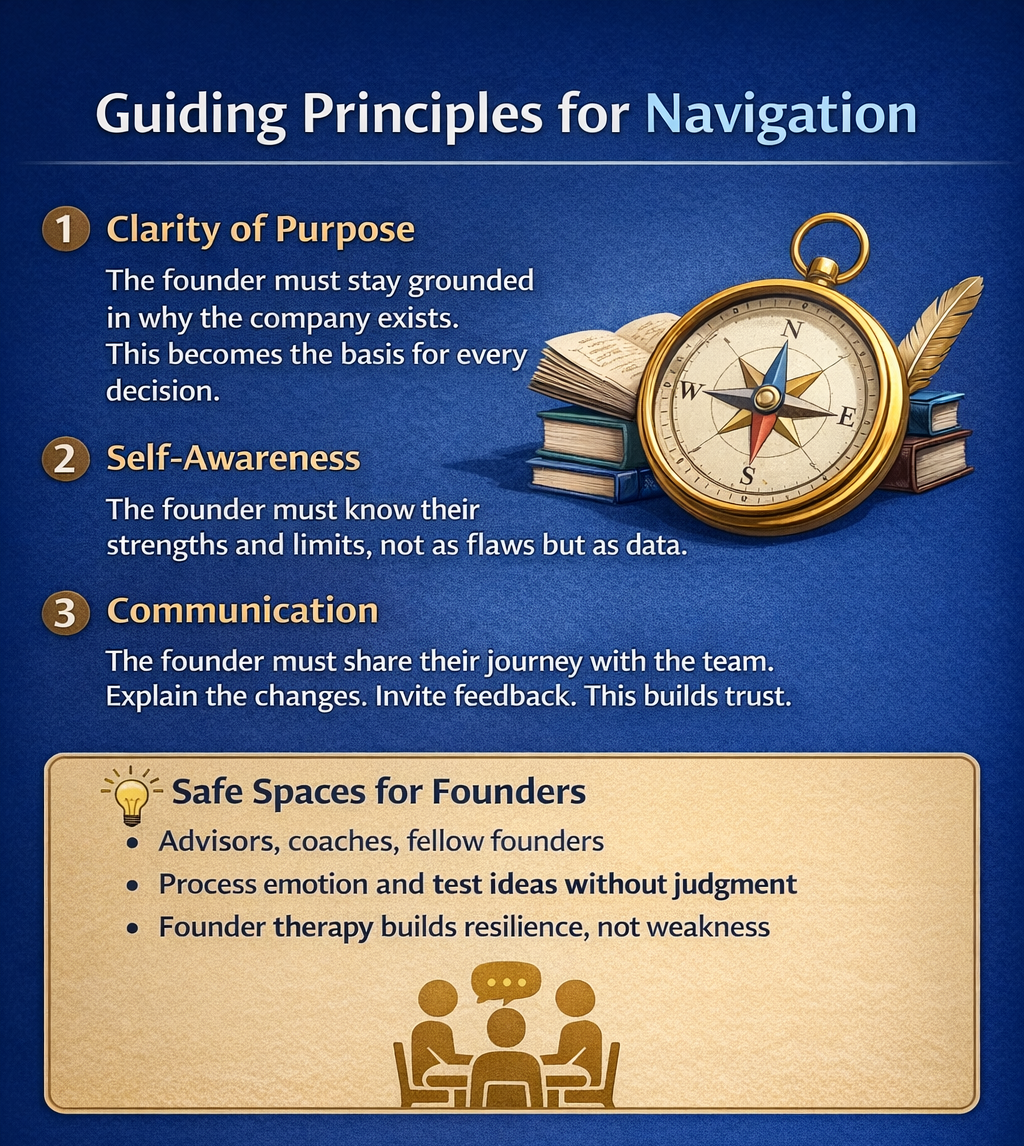
Guiding Principles for Navigation
There is no one right answer to the push back or step back question. It is a constant calibration. But there are principles:
At times, stepping back may mean stepping out. Some founders choose to leave after a certain stage. They recognize that their energy is best suited to creation, not operation. Others stay but redefine their role. What matters is intentionality. Passive drift leads to tension. Active choice leads to alignment.
Conclusion
The journey of a founder is filled with paradoxes. To lead is to let go. To protect is to invite change. To be strong is to be vulnerable. Knowing when to push back and when to step back is not a formula. It is a practice, a set of reflections, a commitment to the company’s future beyond the founder’s ego. When done well, this transition does not diminish the founder. It honors them. It reflects their wisdom. And it ensures that the company they built continues to grow, evolve, and serve. That is the legacy of thoughtful leadership: not just surviving change, but shaping it with grace.
Disclaimer: This blog is intended for informational purposes only and does not constitute legal, tax, or accounting advice. You should consult your own tax advisor or counsel for advice tailored to your specific situation.
Hindol Datta is a seasoned finance executive with over 25 years of leadership experience across SaaS, cybersecurity, logistics, and digital marketing industries. He has served as CFO and VP of Finance in both public and private companies, leading $120M+ in fundraising and $150M+ in M&A transactions while driving predictive analytics and ERP transformations. Known for blending strategic foresight with operational discipline, he builds high-performing global finance organizations that enable scalable growth and data-driven decision-making.
AI-assisted insights, supplemented by 25 years of finance leadership experience.