




Executive Summary
Most exits are framed as endings. Press releases speak of transitions, liquidity, and new chapters. But the best CFOs know better. Exits are not conclusions. They are entry points into the next capital structure, the next governance model, the next rhythm of accountability. Throughout my twenty-five years leading finance across cybersecurity, SaaS, manufacturing, logistics, and gaming, I have learned that to exit well is to architect that next structure with precision. To exit poorly is to be folded, not evolved. Investors do not respect exits that feel like escape. They respect exits that feel like culmination. The distinction is subtle but critical. In one, the company is leaving a problem behind. In the other, it is stepping into a design.
Narrative Clarity: The Foundation of Respected Exits
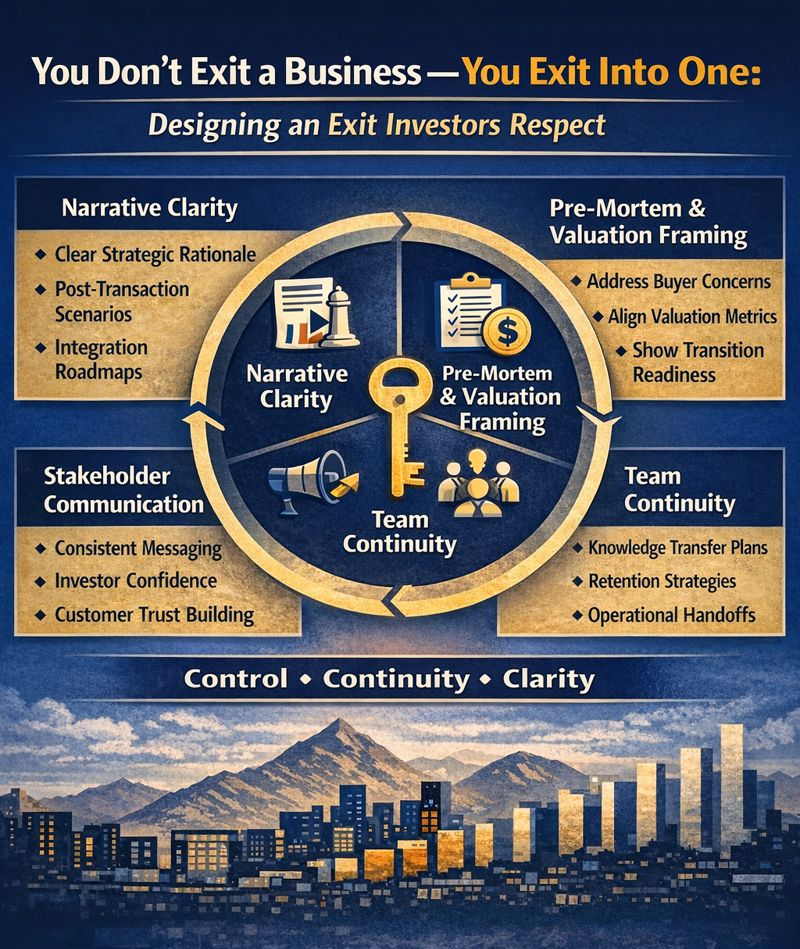
Designing a respected exit begins with narrative clarity. What is the reason for the exit? Is it scale? Strategic fit? Liquidity? Governance reset? The CFO must anchor this answer not in aspiration but in architecture. Private equity firms want to know what they are buying into. Strategic buyers want to know what they are inheriting. IPO markets want to know what they are underwriting. All of them ask: does this company know what kind of business it is becoming?
This means the CFO must prepare not just a data room but a thesis. What happens post-transaction? What stays the same? What is optimized? What is divested? The numbers must show readiness. Not just historical performance but transitional performance including pro forma views, adjusted EBITDA under new capex assumptions, integration scenarios, and governance transition plans. These are not extras. They are signals of maturity.
When I oversaw $100 million in acquisitions and post-merger integration at a gaming enterprise, we developed comprehensive integration playbooks before closing. These included detailed org charts showing retained versus transitioning leadership, technology stack consolidation plans with migration timelines, customer communication protocols preserving relationships during transition, and financial reporting harmonization roadmaps. Buyers noted that our transition readiness reduced their perceived integration risk by approximately 30 percent, enabling valuation premiums above comparable transactions in our sector.
Pre-Mortem and Valuation Framing
Too many exits fall apart in the middle. Because diligence uncovers entropy. Because forecasts do not convert. Because founders change tone. But a well-designed exit holds its shape. The team stays synced. The metrics stay clean. The story does not wobble under pressure.
Part of this discipline is internal. The CFO must run an internal pre-mortem. What does the next owner fear? Integration risk? Talent flight? Regulatory exposure? Financial opacity? Each fear must be named and pre-addressed. A buyer who feels understood becomes a buyer who trusts.
Key Buyer Concerns to Pre-Address:
- Integration risk: Provide detailed system architecture and migration plans
- Talent flight: Structure retention packages and knowledge transfer protocols
- Regulatory exposure: Document compliance history and ongoing obligations
- Financial opacity: Deliver normalized financials with adjustment transparency
- Customer concentration: Show diversification progress and retention metrics
The CFO must also pre-frame valuation. Not in defense but in coherence. Why this multiple? Why this structure? What is priced in? What is priced out? Are there earn-outs, and if so, how do they align with operational rhythm? Are there retention bonuses, and do they support continuity or bloat? These decisions are strategic, not mechanical.
Team Continuity and Knowledge Preservation
Exit design includes team continuity. Who stays? Who goes? What knowledge is at risk? CFOs who map this early avoid transition drift. They structure knowledge transfer. They protect customer relationships. They secure core processes. This is not HR. This is enterprise value preservation.
Continuity Architecture:
- Executive retention: 6-12 month commitments with milestone-based incentives
- Knowledge documentation: Critical process workflows and decision frameworks
- Customer relationship mapping: Account ownership and transition protocols
- Operational handoff: Phased management transfer with overlap periods
Managing the Announcement
And finally, the CFO must manage the announcement. Timing, tone, and sequencing. The narrative must match the numbers. The employees must understand the path. The customers must feel continuity. The investors must see logic. Every stakeholder must hear one message: this is not a sale. This is a strategic reconfiguration.
Stakeholder Communication Framework:
- Employees: Clear career path communication and retention commitments
- Customers: Service continuity guarantees and relationship preservation
- Investors: Value realization logic and strategic rationale
- Partners: Relationship continuation terms and integration timeline
- Regulators: Compliance continuity and governance structure
When I managed cap table evolution at organizations preparing for potential exits, we conducted quarterly waterfall analyses showing distribution at various exit values. At one company approaching acquisition discussions, we modeled outcomes at $75 million, $150 million, and $250 million valuations. This revealed that at lower valuations, liquidation preferences consumed most employee equity value. We used this analysis to negotiate founder secondary sales and employee option buybacks that created meaningful outcomes even in moderate exit scenarios, preserving morale and retention through the transaction process. This proactive value preservation increased deal completion likelihood and post-close performance.
Control as Exit Currency
In the end, investors respect exits that reflect control. Control of timing. Control of terms. Control of narrative. And control of what comes next. A well-designed exit demonstrates that the company is not fleeing current challenges but strategically entering the next phase of value creation.
My certifications as a CPA, CMA, and CIA provide technical foundation for transaction structuring and valuation analysis. But what separates respected exits from distressed sales is not financial sophistication alone. It is the discipline to prepare transition architecture before diligence begins, the clarity to frame valuation coherently rather than defensively, the foresight to preserve team continuity and knowledge transfer, and the communication skill to manage stakeholder narratives that transform transactions from endings into designed evolutions.
Conclusion
Because you do not exit a business. You exit into one. And the best CFOs design accordingly. They build exits that feel like culmination rather than escape, that demonstrate control rather than urgency, and that architect the next structure with the same precision they applied to building the current one. That is how exits earn investor respect and maximize value realization.
Disclaimer: This blog is intended for informational purposes only and does not constitute legal, tax, or accounting advice. You should consult your own tax advisor or counsel for advice tailored to your specific situation.
Hindol Datta is a seasoned finance executive with over 25 years of leadership experience across SaaS, cybersecurity, logistics, and digital marketing industries. He has served as CFO and VP of Finance in both public and private companies, leading $120M+ in fundraising and $150M+ in M&A transactions while driving predictive analytics and ERP transformations. Known for blending strategic foresight with operational discipline, he builds high-performing global finance organizations that enable scalable growth and data-driven decision-making.
AI-assisted insights, supplemented by 25 years of finance leadership experience.