




A CFO’s Decision Framework for Scaling Without Losing Control
In business, scale is a blessing and a burden. On one hand, you gain leverage including more volume, more reach, and more negotiating power. On the other, you invite complexity including more teams, more systems, and more nuance. Throughout my twenty-five years leading finance across cybersecurity, SaaS, manufacturing, logistics, and gaming, I have learned that for CFOs, nowhere is this tension more evident than in the perennial question: should we centralize or decentralize? It is the shared services dilemma. And it is as old as the first back office. Every growing enterprise eventually hits a fork in the road. As functions multiply including finance, procurement, HR, and IT, the temptation grows to consolidate. Consolidation promises efficiency, consistency, and control. But done wrong, it breeds bureaucracy, distance, and bottlenecks. The opposite approach, fragmentation, favors speed, autonomy, and customization. But it can lead to waste, redundancy, and a lack of strategic cohesion. There is no universal answer. But there is a way to think about it.
The Case for Centralization
Centralization is often the CFO’s first instinct and for good reason. Cost savings provide the most immediate benefit through operational efficiency. Consolidating accounts payable, payroll, reporting, or procurement under one roof creates economies of scale. Instead of having five teams doing the same job across regions, you have one standardized process and one trained team. Control and compliance allow tighter internal controls. When all payments flow through one process, it is easier to detect fraud, enforce approvals, and manage audit trails.
Data consistency improves when reporting becomes cleaner. You control the definitions. Annual recurring revenue means the same thing in Singapore as in San Francisco. Your dashboards do not need footnotes or caveats based on business unit quirks. Talent leverage allows investment in better tools, analytics, and leadership when you are not duplicating effort.
When I designed multi-entity global finance architecture spanning the United States, India, and Nepal, we centralized core accounting, treasury, and tax compliance functions. This allowed us to maintain consistent policies, reduce transfer pricing complexity, and leverage specialized expertise that individual entities could not afford independently.
The Case for Fragmentation
Despite the allure of efficiency, centralization has a dark side: rigidity. Businesses do not all move at the same pace. Functions embedded in product, sales, or regional operations often feel that central services are slow, disconnected, or optimized for headquarters, not for them. Speed and autonomy enable product teams with their own analyst or finance business partner to make decisions faster. Customization recognizes that not every part of the business has the same needs. A global SaaS team does not manage contracts the same way a hardware subsidiary does.
Empowerment and ownership mean localized teams often feel more accountable when they own their numbers. Innovation happens at the edge. Decentralized functions experiment more. If one region builds a better collections process, it can later be adopted enterprise-wide.
A Practical Decision Framework: What to Centralize, What to Hybridize, What to Embed
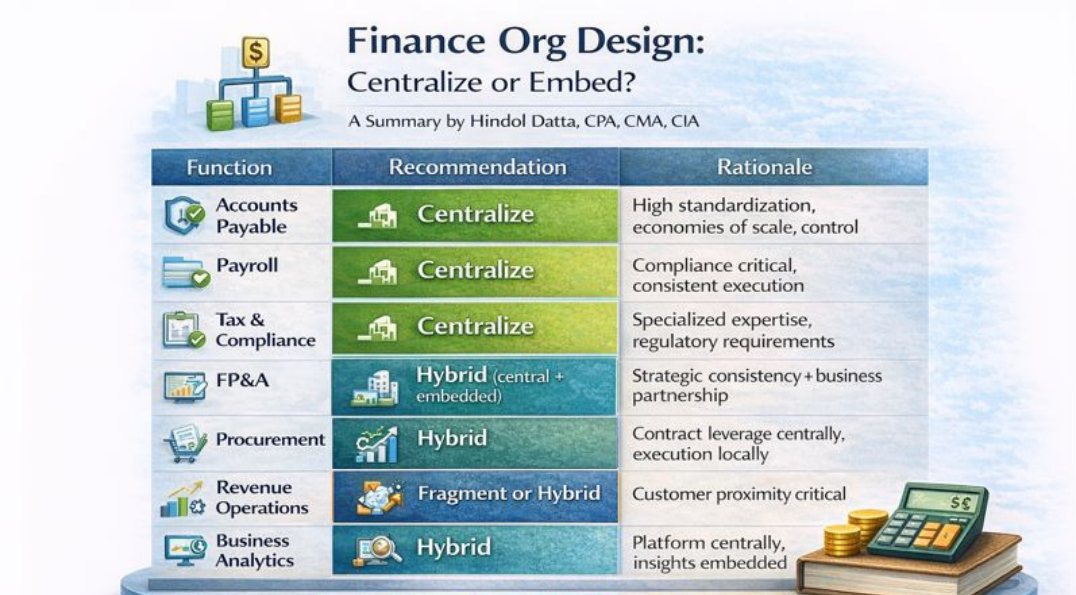
When I built enterprise KPI frameworks using MicroStrategy, Domo, and Power BI, we used a hybrid model. Core platform administration and metric definitions were centralized to ensure consistency. But each business unit had embedded analysts who understood their specific drivers and could provide real-time insights without waiting for central team availability.
Designing Shared Services That Actually Work
If you do centralize, it is not enough to consolidate. You have to design for service. Great shared service functions establish clear service level agreements and KPIs, adopt an internal customer mindset treating internal teams as clients, enable technology with automation that scales, create feedback loops to evolve processes, and maintain financial transparency in cost allocations.
When I managed global finance for a $120 million logistics organization, we centralized core finance functions but maintained embedded business partners in operations. This hybrid model provided centralized control for compliance and reporting while enabling responsive support for operational decisions.
Conclusion: The CFO’s Real Responsibility
As CFO, your job is not to pick centralization or fragmentation. It is to design the system that serves the business. That means constantly reevaluating whether shared functions enable growth or slow it, whether fragmentation drives agility or creates chaos, and where the hidden costs in process, morale, or reputation exist. Centralize after processes have been standardized. Fragment only when local complexity demands it. The goal of finance is not to be big. It is to be right.
Disclaimer: This blog is intended for informational purposes only and does not constitute legal, tax, or accounting advice. You should consult your own tax advisor or counsel for advice tailored to your specific situation.
Hindol Datta is a seasoned finance executive with over 25 years of leadership experience across SaaS, cybersecurity, logistics, and digital marketing industries. He has served as CFO and VP of Finance in both public and private companies, leading $120M+ in fundraising and $150M+ in M&A transactions while driving predictive analytics and ERP transformations. Known for blending strategic foresight with operational discipline, he builds high-performing global finance organizations that enable scalable growth and data-driven decision-making.
AI-assisted insights, supplemented by 25 years of finance leadership experience.