




Executive Summary
Tension in the boardroom is inevitable. Directors bring strong perspectives, guiding convictions, and stakes in the outcome. Yet how conflict is managed defines whether it fuels exploration or fractures trust, stalls strategy, and leaves collateral damage in its wake. Throughout my twenty-five years leading finance across cybersecurity, SaaS, manufacturing, logistics, and gaming, I have learned that when handled well, tension can surface hidden risks, strengthen decisions, and build collective resilience. When mishandled, it can cripple a board with hostility, reinforce silos, or allow dysfunction to fester. Resolution is not about minimizing conflict. It is about channeling it. The best boards harness tension for value. They do not avoid the hard conversations. They resolve them in ways that preserve relationships and accelerate outcomes.
Five Methods for Conflict Resolution
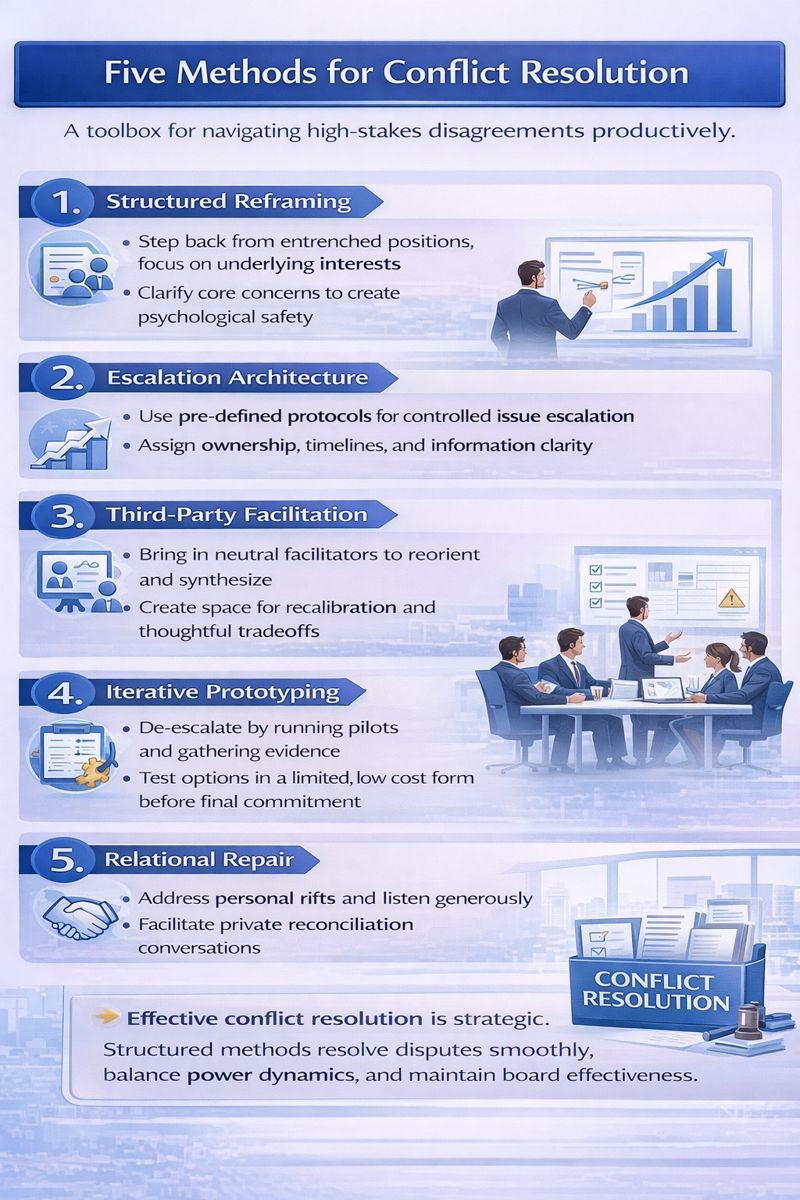
Resolving high-stakes disagreements requires a reliable toolkit. The five methods, structured reframing, escalation architecture, third-party facilitation, iterative prototyping, and relational repair, are not sequential steps. They are situational tools, deployable as needed, and together form a durable conflict resolution framework. Applying these tools deliberately prevents conflict from becoming dysfunction.
Method 1: Structured Reframing
Conflict often intensifies when discussions shift from interests to positions. Directors fixate on defending their stance rather than understanding what truly matters. Reframing interrupts this inertia. It involves stepping back, redefining the problem, and focusing on underpinning interests. A director may argue vehemently for preserving margin, another may counter with growth priorities. Reframing invites them to explore the underlying motivation: are they protecting capital discipline, safeguarding stakeholder trust, or maintaining operational continuity?
Structured reframing begins at the chair’s table. The chair can say let us pause, what are the core concerns here, are we debating expense control, risk tolerance, or strategic credibility. Once clarified, the conversation shifts from debate to exploration. A global industrial board used this technique when locked in a debate over investment pace. Rather than choose sides, they defined both sets of concerns. They reframed the discussion as how do we preserve returns while enabling scale. This question reframing opened new possibilities. It created both-and thinking.
More than just good sense, reframing builds psychological safety. It signals that conflict is not personal, and that disagreement can be de-escalated without surrender. It fosters curiosity, not contention. Directors feel seen. They feel heard. And they feel anchored in shared purpose.
Method 2: Escalation Architecture
What happens when reframing fails to resolve conflict? That is when escalation architecture matters. This method is not about trading blows up the hierarchy. It is about predefined escalation protocols that allow issues to be elevated deliberately. Escalation architecture should be codified in the board charter or committee rules. It defines levels of escalation from informal negotiation to executive session to special committee review. It assigns ownership, timelines, and information scope at each level.
Consider a financial services board debating risk appetite after a compliance violation. When debate extended past scheduled time, the escalation protocol triggered. The chair convened an executive session with the chief compliance officer and lead director. The board paused the strategic discussion until the committee could review gravity and remedial plans. Within a week, the committee delivered a disciplined proposal. The strength of escalation architecture is proportionality. It prevents premature collapse into authority and premature paralysis.
When I led board reporting at a gaming enterprise where I oversaw $100 million in acquisitions and post-merger integration, we established escalation protocols for material disagreements. When the board debated aggressive international expansion versus consolidating existing markets, the escalation framework provided clear steps: first executive session with CFO and CEO presenting scenario analysis, then special committee review if unresolved, finally external advisory engagement if needed. This structure prevented personal conflict from derailing strategic decisions.
Method 3: Third-Party Facilitation
When internal voices cannot break through entrenched disagreement, bringing in an external facilitator creates space for recalibration. These professionals are structured listeners. They help diagnose root friction, reorient discussion, and introduce shared language for complex tradeoffs. One consumer enterprise faced escalating tension between two influential board members over a proposed divestiture. The chair brought in a governance facilitator for a two-session offsite. The facilitator interviewed each director, synthesized concerns anonymously, and shaped a structured dialogue around future scenarios. The result was not consensus. It was progress. The board did not bury conflict. They repurposed it.
Method 4: Iterative Prototyping
This approach treats conflict as a design problem rather than a battle of will. Instead of forcing binary decisions, the board agrees to test options in limited form. They run pilots. They build proofs. They simulate decisions before final commitment. Prototyping de-escalates because it lowers the cost of disagreement. One technology firm’s board was divided on platform expansion strategy. The CFO suggested a six-month capital allocation test, splitting spend between both paths with real-time ROI tracking. When results emerged, the evidence, not ideology, resolved the tension. Iteration trumped debate.
Method 5: Relational Repair
This is the hardest. It is deployed when conflict has become personal. When directors no longer listen generously. When meetings are tense not from content but tone. Repair starts with acknowledgment. Someone, often the chair, must name the rift. They must invite one-on-one conversations. They must encourage truth-telling. One healthcare board saw personal tension between the audit chair and a new investor director undermine multiple sessions. The lead director initiated private conversations, facilitated a joint session, and focused on shared purpose. Ground rules were established. Gradually, trust returned. The board’s effectiveness was restored not because personalities changed but because priorities aligned.
My certifications as a CPA, CMA, and CIA emphasize governance and risk management. But what separates functional boards from dysfunctional ones is not technical expertise. It is the ability to channel conflict productively through structured methods, escalation discipline, external facilitation when needed, iterative decision-making, and relationship repair when trust erodes.
Conclusion
These five methods form a boardroom conflict resolution arsenal. Not all will be needed at once. But knowing when and how to deploy them separates boards that merely survive conflict from those that grow through it. Great boards do not fear tension. They normalize it. They create structures that allow challenge without chaos. A board that never argues is not healthy. It is silent. A board that argues constantly is not effective. It is fragmented. The optimal board challenges each other with integrity, disagrees with respect, and aligns with discipline. Conflict resolution in the boardroom is not about technique alone. It is about tone, timing, and trust.
Disclaimer: This blog is intended for informational purposes only and does not constitute legal, tax, or accounting advice. You should consult your own tax advisor or counsel for advice tailored to your specific situation.
Hindol Datta is a seasoned finance executive with over 25 years of leadership experience across SaaS, cybersecurity, logistics, and digital marketing industries. He has served as CFO and VP of Finance in both public and private companies, leading $120M+ in fundraising and $150M+ in M&A transactions while driving predictive analytics and ERP transformations. Known for blending strategic foresight with operational discipline, he builds high-performing global finance organizations that enable scalable growth and data-driven decision-making.
AI-assisted insights, supplemented by 25 years of finance leadership experience.