




Executive Summary
Private equity does not guess. It models. It deconstructs. It prices every risk, calibrates every return. When PE firms walk into a room, they do not look for charisma. They look for clarity. Throughout my twenty-five years leading finance across cybersecurity, SaaS, manufacturing, logistics, and gaming, I have learned that their thesis is built on control, precision, and replicability. And their questions, though direct, are never random. Every inquiry maps to a fundamental truth: how much risk are we buying and how fast can we compound it? For CFOs, this means one thing: control your metrics before PE controls the narrative. In the world of institutional capital, data is not detail. It is destiny.
Ten Essential Metrics for PE Readiness
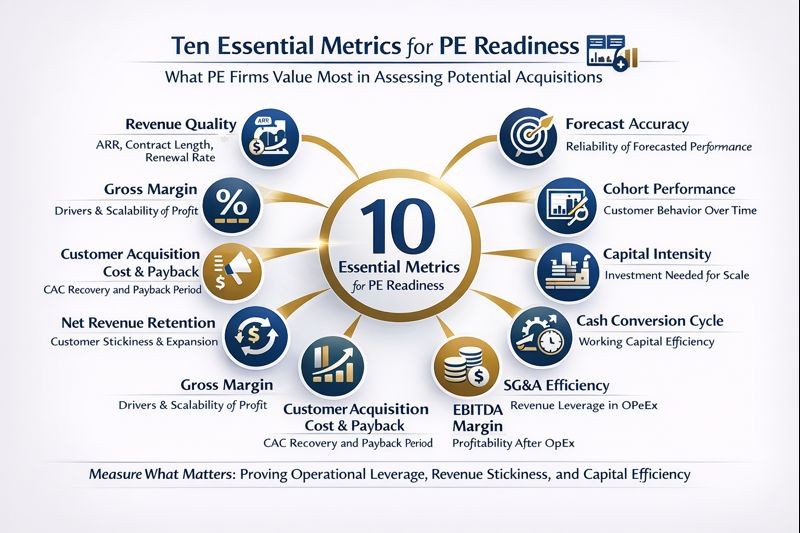
There are ten metrics, not exhaustive but essential, that PE firms expect not just in spreadsheets but in conviction. These metrics tell the story of operating leverage, pricing power, capital discipline, and scalable governance.
1. Revenue Quality
Not just topline but its texture. PE cares about ARR versus project revenue. Contract length, renewal rate, churn. How much of your future is already bought? They want revenue that repeats, compounds, and does not leave when one customer changes their mind.
2. Gross Margin
PE firms do not just read the number. They read its drivers. Are margins expanding or flat? What lever moves them including pricing, volume, cost of goods, mix? High gross margin with low scalability is a red flag. Moderate gross margin with clear levers is an opportunity.
3. Customer Acquisition Cost and Payback
PE wants to know how long it takes to recover your marketing dollar. They model CAC payback against churn, against LTV, against market velocity. They want short loops. They want capital that comes back quickly because the faster it returns, the faster it redeploys.
4. Net Revenue Retention
The real measure of product-market fit. If customers stay and spend more, the product works. If they churn or downgrade, the story falls apart. NRR above 110 percent is proof. Below 90 percent is pain. PE models growth without new sales. They want the machine to feed itself.
5. SG&A Efficiency
What percent of revenue does it take to run the business? They want SG&A that scales slower than revenue. That shows leverage. PE firms do not buy overhead. They buy throughput. Every dollar in SG&A must show a dollar-and-change in return.
6. Cash Conversion Cycle
Not just how much cash you burn but how fast you collect. Working capital is a thesis. Can you turn inventory into receivables quickly? Can you delay payables without consequence? PE firms love negative working capital. It funds growth without dilution.
7. EBITDA Margin
This is not GAAP purity. It is operational truth. PE firms price off EBITDA. They look for unlevered free cash flow. They model interest, taxes, depreciation as financial levers. But they want to know: how much does it really cost to run this business?
8. Capital Intensity
How much investment does scale require? PE wants low capex, high ROIC. They avoid models that need heavy fixed investment to grow. Every dollar out is a dollar not compounding. They want returns not just fast but asset-light.
9. Cohort Performance
How do customers behave over time? Do they expand? Do they shrink? What is the shape of a cohort at month six, twelve, twenty-four? PE firms buy patterns. Cohort stability shows predictability. Predictability shows maturity.
10. Forecast Accuracy
PE firms know models are guesses. But they want disciplined guesses. If a CFO misses every quarter, credibility dies. Forecast accuracy is a proxy for operational control. It shows internal accountability.
When I built enterprise KPI frameworks using MicroStrategy, Domo, and Power BI, we designed PE-ready dashboards tracking these exact metrics. For a potential acquisition target, we maintained real-time visibility into ARR composition, gross margin drivers by product line, CAC payback by channel, NRR cohorts, SG&A as percentage of revenue, days sales outstanding, EBITDA bridge analysis, capex to revenue ratios, customer expansion patterns, and forecast versus actual variance. This metric discipline transformed PE diligence from interrogation into partnership discussion.
Conclusion
These ten metrics do not guarantee a deal. But they frame the conversation. They create gravity. They shift the dynamic from seller to peer. The CFO who owns these metrics deeply, confidently, and in narrative form walks into the PE meeting with posture. Because in private equity, the deal is not won in the room. It is won in the data.
Disclaimer: This blog is intended for informational purposes only and does not constitute legal, tax, or accounting advice. You should consult your own tax advisor or counsel for advice tailored to your specific situation.
Hindol Datta is a seasoned finance executive with over 25 years of leadership experience across SaaS, cybersecurity, logistics, and digital marketing industries. He has served as CFO and VP of Finance in both public and private companies, leading $120M+ in fundraising and $150M+ in M&A transactions while driving predictive analytics and ERP transformations. Known for blending strategic foresight with operational discipline, he builds high-performing global finance organizations that enable scalable growth and data-driven decision-making.
AI-assisted insights, supplemented by 25 years of finance leadership experience.