




Executive Summary
For generations, leadership was treated as elusive, something that resists quantification. We said it cannot be measured, only felt. Yet we now stand in an age where the invisible has become legible. Data science extends its reach into leadership. With each interaction recorded, each decision logged, each outcome analyzed, we ask: can leadership be measured, or is it only mirrored? The evidence suggests that behavior leaves a signature, something patternable and traceable in its impact. The leadership we once identified by gut now leaves behind data in calendar density, email latency, Slack threads, performance reviews, and team churn rates. Data becomes a mirror that allows leaders to see whether their direct reports actually speak more over time or whether alignment scores reflect their clarity. The true power is not to score or rank but to awaken self-awareness, illuminating the space between how we see ourselves and how our presence is experienced. Data science enables observation of micro-behaviors for elevation, not surveillance. Communication frequency, network centrality, and sentiment shifts become proxies that form a developmental map. Leadership pipelines often fray because they are reactive. A system that tracks potential early allows for intentional development. Data becomes a companion to mentorship, surfacing the overlooked. The mentor who uses data to understand will expand.
Can Leadership Be Measured or Only Mirrored?
For generations, leadership was treated as elusive, something that resists quantification. And yet we now stand in an age where the invisible has become legible. Data science extends its reach into leadership. With each interaction recorded, each decision logged, each outcome analyzed, we ask: can leadership be measured, or is it only mirrored?
This is not a question of reducing the soul of command into a metric. It is whether behavior leaves a signature, something patternable, traceable, and repeatable in its impact. The evidence suggests it does.
The leadership we once identified by gut, the ability to steady a team, to bridge silos, to defuse tension, now leaves behind data points in calendar density, email latency, Slack threads, performance review themes, and team churn rates. Not one of these alone tells a story. But together, over time, they hum.
From that hum emerges mirroring with fidelity. Data becomes a mirror rendered with the grace of accumulated observation. A leader who believes they empower others can now see whether their direct reports actually speak more over time. A leader who prides themselves on clarity can see whether alignment scores reflect that story.
Leadership Signals and Their Data Sources
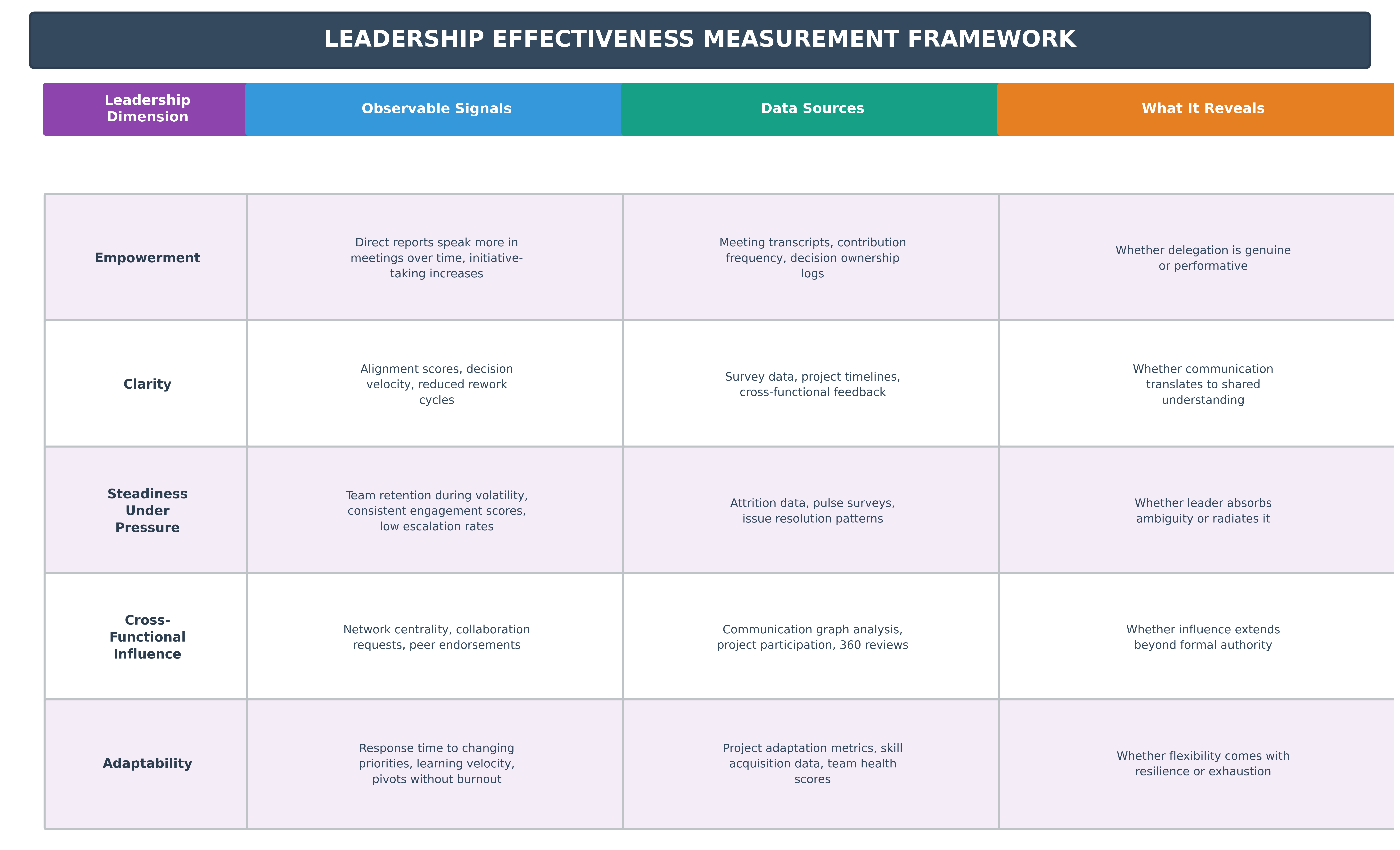
This table maps five core leadership dimensions to their observable behavioral signals and data sources. Each dimension reveals not just what leaders intend but how their presence is actually experienced. The value lies in providing leaders with a faithful mirror of their impact, enabling self-awareness and targeted development.
To bring data into leadership is to risk hubris. The spreadsheet does not feel. It knows nothing of that look across the table, of the subtext in a resignation letter, of the hesitation before a reply. Leadership is laced with ambiguity. Data thrives on clarity. But what if the art lies not in what we count but in how we listen to what we count?
Consider a company facing strategic flux. One executive consistently absorbs ambiguity and steadies their team even as priorities shift. Another radiates urgency but leaves behind a trail of burnout. Before, these contrasts might be whispered in hallway confidences or surfaced belatedly in attrition data. Today, the patterns, retention by team, engagement scores, decision velocity, offer early signals. Not conclusions. But invitations.
In my own tenure, I recall analyzing feedback loops in product teams. One leader’s team consistently outperformed in delivery, yet internal surveys revealed an erosion of psychological safety. The leader was stunned, believing sincerely that they had fostered transparency. But the data showed a trend: feedback flowed upward only under duress, and lateral collaboration had withered. It was not a judgment. It was a mirror. And in that mirror, something remarkable happened: the leader changed.
This is the true power of data in leadership. Not to score, not to rank, but to awaken. To awaken self-awareness. To illuminate the space between how we see ourselves and how our presence is experienced.
Discovering Leadership Before It Arrives
In quiet corners of organizations, talent waits, not dormant but undiscovered. For generations, we relied on accident or anecdote to find it. Leadership, we were taught, reveals itself in performance. Only then did we bestow the label: potential. It was retrospective.
But we now live in a time when the rearview mirror is no longer sufficient. The cycles of change are too fast for us to wait. Can we detect leadership before it declares itself? Can we, through data, trace the future presence of command? The answer is yes, not with certitude but with signal, subtle and cumulative.
Potential is the shadow of something not yet visible. It hides in the margins. A question asked at just the right moment. A teammate quietly supported in a way that shifts an outcome. These are tendencies. And tendencies, when observed across time, become patterns. Patterns are the grammar of data.
We no longer require visible results to begin inferring capacity. We can examine how individuals engage with complexity, how they respond to ambiguity, how they contribute when the spotlight is elsewhere. A junior analyst who connects disparate ideas. A program manager who anticipates risk. A marketing associate whose questions reframe strategy. These acts are early signs of leadership’s infrastructure.
Data science enables observation of these micro-behaviors for elevation, not surveillance. Communication frequency, network centrality, and sentiment shifts are proxies that, when overlaid with context, form a developmental map.
In one enterprise I advised, we layered performance reviews, collaboration data, and project delivery timelines with behavioral analytics. We studied how individuals learned, responded to feedback, and improved in rhythm with others. Among those flagged were two employees who had not yet managed teams. But the data showed they had been consistently requested by peers for problem-solving, had higher cross-functional feedback scores, and adapted to ambiguity without needing escalation. When given the opportunity, they thrived, not because they were preordained to lead but because they had long been practicing its precursors.
This is the shift. The redefinition of potential, not as charisma or pedigree but as the slow, consistent practice of capacity. To see it early is not to accelerate indiscriminately but to nurture precisely.
Data as Clarification, Not Reduction
We live in a time of metrics, and yet we traffic in mysteries. Leadership sits at the heart of this tension. For generations, it was defined by feel, by instinct, by charisma. And now we are told it can be measured. There are dashboards, behavioral algorithms, metadata from meetings. And all of it leads to a forked path: does this data help us see a leader more clearly, or does it reduce something sacred into a diagram?
At first, it feels like desecration. Leadership was never meant to be analyzed like a supply chain. It breathes, it falters, it possesses contradictions. And yet, what if data does not need to capture everything? What if, in the hands of the thoughtful, it does not flatten leadership but frames it?
Data is neither savior nor villain. It is reflection. It orders what we know and reveals what we miss. Its role is not to pronounce truth but to suggest contours. And contours, if traced carefully, deepen understanding.
Imagine a leader known for steadiness. She is measured, composed. But her team’s feedback reveals inconsistency, deadlines missed, stress unmanaged. Her calendar data shows little one-on-one time, and email response times lag during strategic flux. Without judgment, data asks: is the steadiness perceived or projected? Such inquiry invites. It tells a fuller story.
This is what data allows. It allows the multiple layers of a leader to be seen, not as contradictions but as composites. A good leader can be generous and overextended, decisive and brittle. These are not flaws but patterns. In tracking these patterns over time, we begin to understand not just what a leader does but how they do it and who they are becoming.
The leaders who will flourish are those who engage that conversation curiously. They ask: why does my engagement score dip after strategy meetings? Why do new team members report less clarity than tenured ones? These are not questions of vanity. They are questions of responsibility. Leadership is about effect. And effect can be made visible through data. But to see clearly, we must remember the narrative. Numbers require interpretation. And interpretation requires context.
Mentorship in the Algorithmic Age
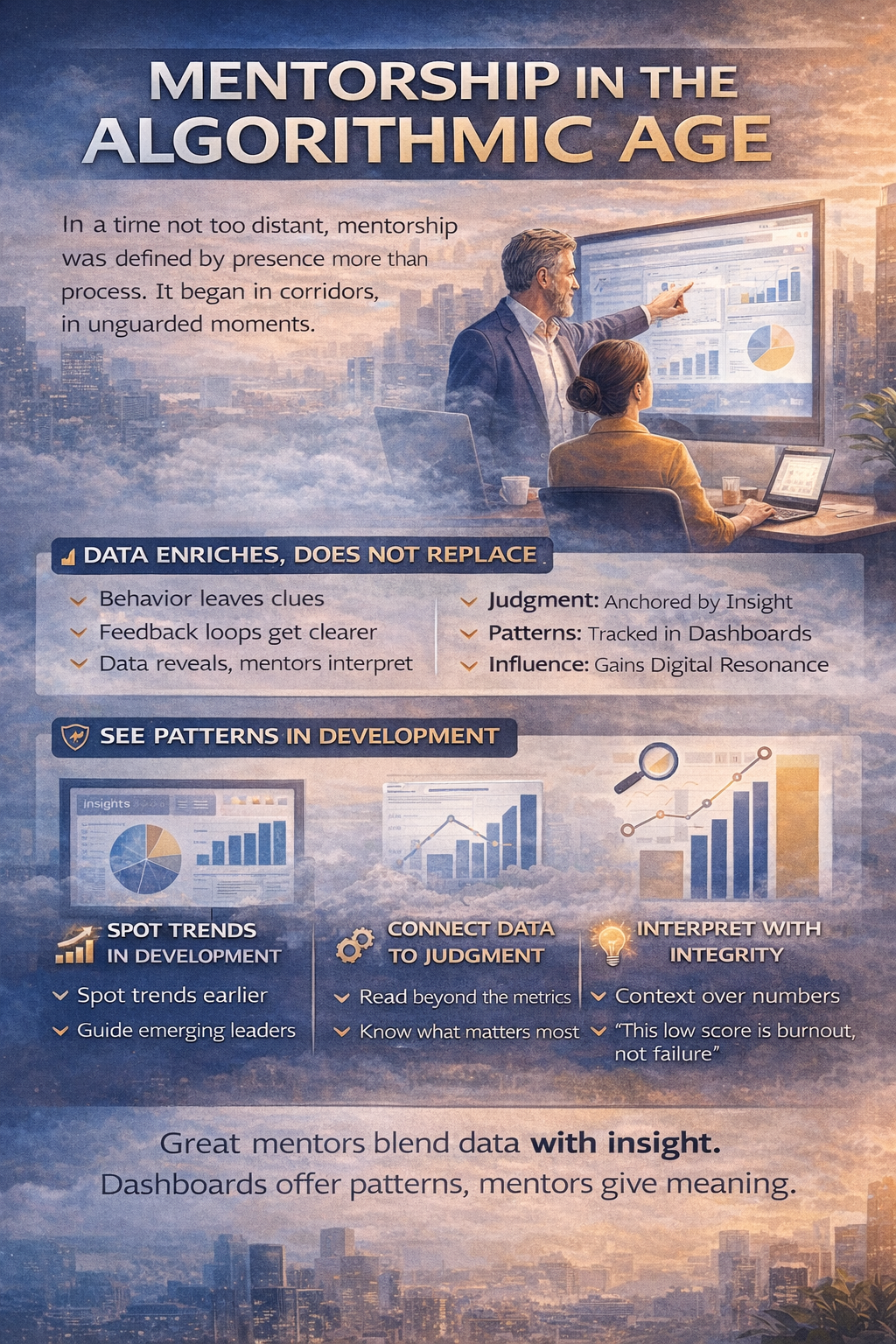
In a time not too distant, mentorship was defined by presence more than process. It began in corridors, in unguarded moments. It was a quiet apprenticeship passed through attention. Legacy was personal, the slow burn of memory.
And yet now, the mentor is joined by the dashboard. Leadership development can be enhanced through data. Behavior leaves a trail, feedback loops can be digitized, performance can be visualized. What becomes of the mentor in this world?
The mentor is not displaced. They are transformed. They become not just a steward of judgment but an interpreter of insight. Data is not self-explanatory. It does not know how to coach, does not feel the tempo of transformation. These things still belong to the mentor.
What data provides is revelation. It allows the mentor to see more, to notice sooner, to pattern what might otherwise have appeared anecdotal. Consider a rising leader whose feedback reveals consistent strength in conflict resolution. The mentor, informed by this data, can guide that person specifically, anchoring development in behaviors already proven to resonate.
The art of mentorship is no longer confined to memory. It is enriched by insight. Legacy now leaves behind fingerprints. Dashboards can show not just how a leader performed but how their teams grew, how retention changed, how engagement lifted. A mentor’s influence, once ephemeral, now leaves a digital resonance.
The role of the mentor is not only to develop others but to teach them how to read themselves. To read their patterns, their progress, their friction. For while metrics may offer patterns, it is still the mentor who gives them meaning. Who knows when to say, this score is low because the team is tired, not because you failed.
Mentorship in the age of data becomes an act of interpretation. And interpretation requires intimacy. No dashboard can substitute for the person who listens not only to words but to tone. Who sees not only a drop in engagement but the anxiety behind it.
The great mentors of this era will know how to ask not simply what did the data say but what does it mean, where might it be pointing. They will sit with contradictions. They will model integrity.
Conclusion
Leadership is not diminished by data. It is illuminated. Not because we have captured its essence in a chart but because we have given ourselves new ways to listen. To the team, to the organization, to ourselves.
Data, when used wisely, does not diminish the humanity of leadership. It amplifies it. It shows, without flattery, the curvature of impact. It reveals where intent meets friction. It traces the invisible architecture of trust.
For in the right hands, the hands of those who know that the measure of a leader lies not in how loudly they command but in how deeply they resonate, data becomes a tool of exquisite refinement. It allows us to see not just where a leader stands but how they move others. Not just what they decide but how those decisions ripple.
Leadership is not a mystery to be solved. It is a melody to be understood. And data, if tuned rightly, lets us hear the harmony or the dissonance with clarity once reserved for hindsight.
Disclaimer: This blog is intended for informational purposes only and does not constitute legal, tax, or accounting advice. You should consult your own tax advisor or counsel for advice tailored to your specific situation.
Hindol Datta is a seasoned finance executive with over 25 years of leadership experience across SaaS, cybersecurity, logistics, and digital marketing industries. He has served as CFO and VP of Finance in both public and private companies, leading $120M+ in fundraising and $150M+ in M&A transactions while driving predictive analytics and ERP transformations. Known for blending strategic foresight with operational discipline, he builds high-performing global finance organizations that enable scalable growth and data-driven decision-making.
AI-assisted insights, supplemented by 25 years of finance leadership experience.