



Executive Summary
In the architecture of corporate leadership, the relationship between the Chief Executive Officer and the Chief Financial Officer has often been portrayed as one of tension: a creative mind balanced by a cautious one, ambition met with arithmetic. The CEO dreams; the CFO interrogates. One looks outward to markets and missions; the other inward to margins and mechanics. But such caricatures, while dramatic, are increasingly outdated. In the modern enterprise, where transformation is not a singular initiative but a continuous mandate, the CEO-CFO dynamic is not about friction but about orchestration. And when well-aligned, it can form the most potent alliance in business leadership, a duet of vision and precision, of velocity and discipline. The most compelling transformations do not begin with a slide deck or an executive offsite. They begin when a CEO dares to ask, “What is next?” and a CFO responds, “Let us make it possible.”
Transformation as Structural Mandate
Transformation is neither episodic nor cosmetic. It is structural, cultural, and strategic. It redefines how value is created, how talent is engaged, and how organizations respond to a world in motion.
Throughout thirty years leading finance organizations across SaaS, digital marketing, gaming, and logistics, I have witnessed the evolution of the CFO role from steward of the past to co-architect of the future. Today’s CFO must navigate capital markets, geopolitical risks, ESG commitments, supply chain shocks, AI adoption, and business models in flux.
When a CEO envisions a move into new markets, it is the CFO who tests its return profile and considers the liquidity tradeoffs. When the strategy calls for innovation, the CFO helps structure a funding roadmap that avoids overextension. And when ambition exceeds the comfort zone, the CFO becomes not the brakes but the ballast.
From Constraint to Possibility
The most effective CFOs no longer see themselves as guardians of constraint but as designers of possibility. They help CEOs translate vision into executable, financially coherent programs. They challenge not to diminish but to refine.
At a digital marketing organization that scaled from nine million to one hundred eighty million in revenue while securing thirty-six million in growth capital, the CEO-CFO partnership proved essential. We translated aggressive growth ambitions into disciplined capital deployment, balancing market expansion with profitability milestones.
Conversely, the most effective CEOs welcome this engagement not as intrusion but as elevation. They recognize that a financially grounded transformation is more credible and more investable. A strategy without financial rhythm is a melody without meter: it may be beautiful, but it will not endure.
The Foundation: Trust and Transparency
This partnership is a function of trust. CEOs and CFOs must operate with radical transparency, frequent dialogue, and shared appetite for rigor. They must be able to say no without defensiveness and yes without hesitation. The most transformative companies are those where the CEO and CFO co-own not just the outcomes but the risks.
At one education nonprofit where I secured forty million in Series B funding, the executive partnership between CEO and CFO enabled us to navigate complex stakeholder expectations from venture philanthropists and board members. Each stakeholder group had different information priorities, yet the underlying message about organizational strategy needed to remain coherent.
In recent years, pandemic disruptions and accelerated digitalization have pushed this relationship to new frontiers. CEOs relied on CFOs to model new scenarios, manage liquidity, and invest with agility. What emerged was a new model of co-leadership, one where financial clarity did not constrain ambition but enabled it.
The CEO-CFO Partnership Framework
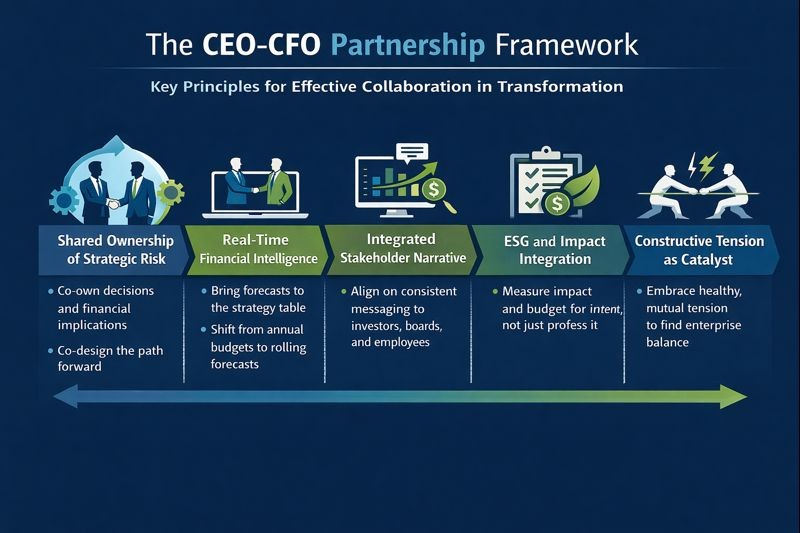
At organizations where I led FP&A and board reporting, the quality of CEO-CFO partnership consistently correlated with execution velocity and strategic coherence.
From Vision to Execution
This partnership manifests in practical shifts. CFOs bring scenario modeling to strategic planning sessions, enabling CEOs to evaluate multiple pathways with clear financial implications. CEOs invite CFOs into product roadmap discussions, ensuring that innovation investments align with capital availability. Both executives co-present to the board, demonstrating unified ownership of strategy and execution.
At a gaming enterprise where I led global financial planning and controllership for a multi-studio operation, the CEO-CFO partnership enabled us to balance creative ambition with financial discipline. Multi-year franchise investments required confidence in both artistic vision and economic returns.
At a professional services organization where I built enterprise KPI frameworks and reduced month-end close from seventeen days to under six days, the operational improvements freed finance leadership to engage more strategically with executive planning. The CFO role evolved from reporting historian to forward-looking strategist.
Conclusion
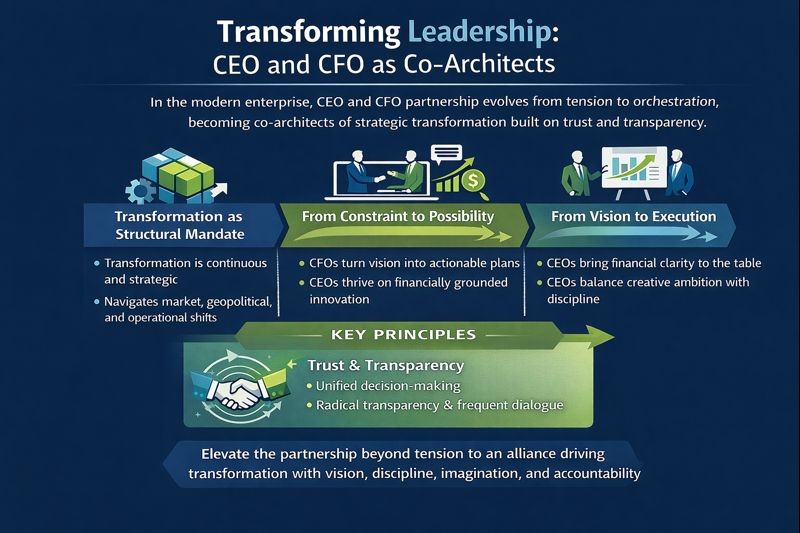
To elevate the CEO-CFO collaboration is not to blur roles but to enrich them. It is to recognize that transformation is not achieved by vision alone, nor by financial rigor in isolation. It is realized in the interdependence of those two forces: vision bold enough to stretch the organization and discipline grounded enough to sustain it.
In this regard, the future of transformation lies not in frameworks or technologies but in relationships. In dialogue. In shared context. In the moments when the CEO and CFO sit across from each other, not in opposition but in alignment, and ask not “can we afford this?” or “is this bold enough?” but rather, “how do we build something that lasts?”
That question, when asked together, becomes the beginning of something rare: transformation with velocity and depth, with creativity and control, with imagination and permanence. It is the art of collaboration and the soul of enduring leadership.
Disclaimer: This blog is intended for informational purposes only and does not constitute legal, tax, or accounting advice. You should consult your own tax advisor or counsel for advice tailored to your specific situation.
Hindol Datta is a seasoned finance executive with over 25 years of leadership experience across SaaS, cybersecurity, logistics, and digital marketing industries. He has served as CFO and VP of Finance in both public and private companies, leading $120M+ in fundraising and $150M+ in M&A transactions while driving predictive analytics and ERP transformations. Known for blending strategic foresight with operational discipline, he builds high-performing global finance organizations that enable scalable growth and data-driven decision-making.
AI-assisted insights, supplemented by 25 years of finance leadership experience.