



Executive Summary
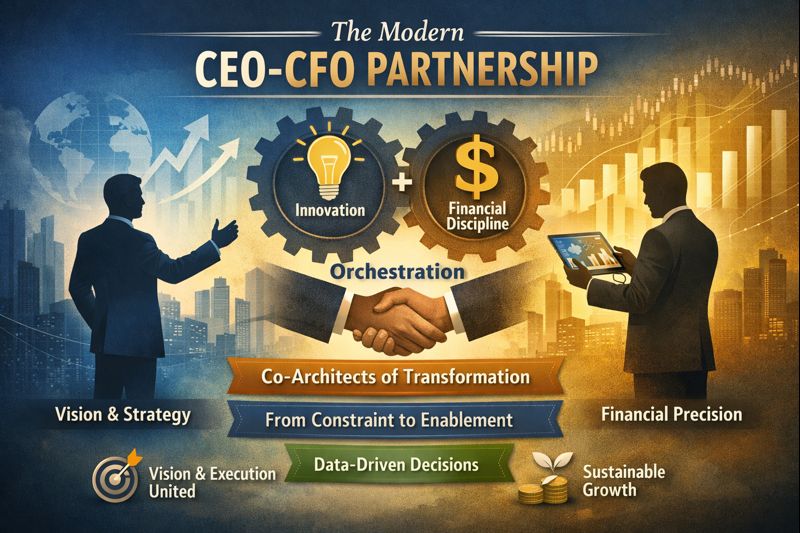
In the architecture of corporate leadership, the relationship between the Chief Executive Officer and the Chief Financial Officer has often been portrayed as one of tension, a creative mind balanced by a cautious one, ambition met with arithmetic. The CEO dreams, the CFO interrogates. One looks outward to markets and missions, the other inward to margins and mechanics. But such caricatures, while dramatic, are increasingly outdated. Throughout my twenty-five years leading finance across cybersecurity, SaaS, manufacturing, logistics, and gaming, I have learned that in the modern enterprise where transformation is continuous mandate, the CEO-CFO dynamic is not about friction. It is about orchestration. And when well-aligned, it can form the most potent alliance in business leadership, a duet of vision and precision, of velocity and discipline.
From Steward to Co-Architect
Transformation is neither episodic nor cosmetic. It is structural, cultural, and strategic. It redefines how value is created, how talent is engaged, and how organizations respond to a world in motion. And in this world, the CFO is no longer a steward of the past but a co-architect of the future.
For a long time, the CFO’s role was circumscribed by accounting cycles, regulatory rigor, and capital discipline. But today’s CFO must navigate capital markets, geopolitical risks, ESG commitments, supply chain shocks, AI adoption, and the economics of business models in flux. And no meaningful transformation can proceed without financial fluency woven into its design.
When a CEO envisions a move into new markets, it is the CFO who tests its return profile, calibrates its capital intensity, and considers the liquidity tradeoffs. When the strategy calls for innovation and investment, the CFO helps structure a funding roadmap that avoids overextension. And when ambition exceeds the comfort zone, the CFO becomes not the brakes but the ballast.
The most effective CFOs no longer see themselves as guardians of constraint but as designers of possibility. They help CEOs translate vision into executable, financially coherent programs. They challenge not to diminish but to refine. They bring order to uncertainty and shape options that would otherwise seem unattainable.
Conversely, the most effective CEOs welcome this engagement not as intrusion but as elevation. They recognize that a financially grounded transformation is more credible, more durable, and more investable. They understand that storytelling to investors, boards, and employees carries more weight when paired with conviction in the numbers.
When I improved month-end close from 17 days to under six days at a cybersecurity firm, the CEO-CFO partnership was critical. The CEO championed the transformation to the board and provided air cover for aggressive process redesign. I brought the financial architecture including automated controls, real-time dashboards, and revised close calendar. We co-presented progress monthly, with the CEO framing strategic benefits like faster decision-making and investor confidence while I demonstrated execution rigor through metrics. This collaboration converted what could have been a finance-only initiative into an enterprise transformation with CEO sponsorship and board visibility.
The Evolution of Partnership: From Constraint to Enablement
Traditional CFO Role:
- Guardian of constraint
- Retrospective reporting
- Cost control focus
- Annual budget cycles
- Static compliance
Modern CFO Role:
- Designer of possibility
- Anticipatory analytics
- Value creation focus
- Rolling forecasts
- Dynamic risk management
This evolving partnership is not merely one of professional compatibility. It is a function of trust. CEOs and CFOs must operate with radical transparency, frequent dialogue, and shared appetite for rigor. They must be able to say no without defensiveness and yes without hesitation. The most transformative companies are those where the CEO and CFO co-own not just the outcomes but the risks.
In recent years, the COVID-19 pandemic, inflation shocks, and accelerated digitalization pushed this relationship to new frontiers. Businesses pivoted rapidly. Supply chains were reimagined. Hybrid work challenged old norms. Throughout these disruptions, CEOs relied on CFOs to model new scenarios, manage liquidity, and invest with agility. What emerged was not just resilience but a new model of co-leadership where financial clarity did not constrain ambition but enabled it.
One sees this in the shift from annual budgets to rolling forecasts. From static reporting to real-time analytics. From cost control to value creation. When CFOs bring data to the strategy table not in retrospect but in anticipation, they shift the narrative. The CFO becomes not just a recorder of the story but a co-author.
The Strategic Dimensions
Moreover, in a landscape where ESG performance, stakeholder trust, and long-term value are paramount, the CFO’s voice is vital. Sustainability investments, workforce strategies, and governance practices are no longer side topics. They are central to transformation and their success depends on thoughtful financial framing. The CFO ensures that impact is not just stated but measured. That intent is not just professed but budgeted.
At its best, the CEO-CFO partnership fosters a culture where performance and purpose coexist. Where bold bets are backed by rigorous preparation. Where the story of the company is told not just in grand language but in clear, navigable metrics.
This is not to suggest the relationship is always smooth. Healthy tension remains essential. The CEO must sometimes push beyond what is comfortable. The CFO must at times insist on the integrity of the core. But it is in this tension, constructive, mutual, and respectful, that the enterprise finds its balance.
When I secured $40 million in Series B funding and an $8 million credit line, the CEO-CFO collaboration was instrumental. The CEO articulated the vision for scaled impact and market positioning. I built the financial narrative showing three-year model sustainability, capital deployment efficiency, and milestone-based disbursements. We jointly presented to investors with the CEO leading on mission and strategy while I anchored on unit economics and risk mitigation. Investors noted the strength of our partnership as a key confidence factor in their commitment.
Boards increasingly look for this dynamic when assessing executive leadership. Investors listen for it in earnings calls. Employees sense it in strategic rollouts. When the CEO and CFO are aligned, it shows. Messaging becomes consistent. Decisions feel intentional. Priorities hold. The company moves not in fragmented initiatives but in concerted momentum.
My certifications as a CPA, CMA, and CIA provide technical foundation for financial rigor. But what separates transformative CEO-CFO partnerships from transactional working relationships is not technical expertise alone. It is the trust to operate with radical transparency, the courage to say no when strategy exceeds capacity, the wisdom to say yes when ambition meets financial coherence, and the shared conviction that transformation requires both vision bold enough to stretch the organization and discipline grounded enough to sustain it.
Conclusion
To elevate the CEO-CFO collaboration is not to blur roles but to enrich them. It is to recognize that transformation is not achieved by vision alone nor by financial rigor in isolation. It is realized in the interdependence of those two forces. In this regard, the future of transformation lies not in frameworks or technologies but in relationships. In dialogue. In shared context. In the moments when the CEO and CFO sit across from each other not in opposition but in alignment and ask not can we afford this or is this bold enough but rather how do we build something that lasts. That question, when asked together, becomes the beginning of transformation with velocity and depth, with creativity and control, with imagination and permanence.
Disclaimer: This blog is intended for informational purposes only and does not constitute legal, tax, or accounting advice. You should consult your own tax advisor or counsel for advice tailored to your specific situation.
Hindol Datta is a seasoned finance executive with over 25 years of leadership experience across SaaS, cybersecurity, logistics, and digital marketing industries. He has served as CFO and VP of Finance in both public and private companies, leading $120M+ in fundraising and $150M+ in M&A transactions while driving predictive analytics and ERP transformations. Known for blending strategic foresight with operational discipline, he builds high-performing global finance organizations that enable scalable growth and data-driven decision-making.
AI-assisted insights, supplemented by 25 years of finance leadership experience.