



Executive Summary
The operating model of a company reflects its deepest assumptions about value: where it is created, how it is scaled, and which functions are necessary evils rather than strategic levers. For the better part of modern corporate history, functions like Finance, Legal, HR, and Procurement have been classified as cost centers. They are essential, yes. But they are typically viewed as enablers of the core business, not the core business itself. They defend margins, manage risk, ensure compliance. Rarely are they tasked with creating alpha. But that framing is quickly becoming obsolete. The rise of intelligent agents, AI-powered systems that act, reason, and learn across domains, now allows us to reconceive these support functions not as back-office overhead but as value centers, capable of shaping outcomes, not just reporting them. As someone who has spent three decades embedded in the architecture of finance and operations across SaaS, healthcare, logistics, gaming, and IT services, I can say with conviction: this is not just a shift in tooling but a shift in posture. The company that adopts AI agents to automate, accelerate, and elevate internal functions reclaims its cost centers as engines of insight, speed, and strategic leverage.
The Agent-Enabled Operating Model
We are now in a moment when CFOs, COOs, General Counsels, and CHROs must become designers of new operating models, ones where the first draft is written by an agent, the judgment is applied by a human, and the entire organization learns from every interaction.
AI agents do not simply execute workflows. They monitor, learn, propose, and adapt with a level of autonomy that creates a fundamentally new operating model where insight is continuous, decision cycles are compressed, and execution becomes more intelligent over time.
Finance: From Cost Center to Value Simulator
In Finance, the change begins at forecasting, planning, closing, and scenario analysis. Where financial planning and analysis once required armies of analysts and weeks of cycle time, AI agents can now run daily rolling forecasts, adjust for real-time inputs, and surface drivers behind deviation.
The close process is being replaced by agents that auto-classify journal entries, detect anomalies in real time, and prepare pre-close summaries every night. That is not just a faster close but a living system of financial truth.
At organizations where I reduced month-end close from seventeen days to under six days, we laid the groundwork for AI-augmented finance. One company redesigned its monthly close around a fleet of agents handling bank reconciliations, revenue schedule validation, and narrative commentary on gross margin movement.
The finance team shifted. Analysts became reviewers. Controllers became curators of trust. CFO bandwidth shifted from variance explanations to capital allocation discussions.
Legal: From Blocker to Transaction Enabler
Traditionally, legal departments scale risk management. More revenue, more contracts. More markets, more regulation. But AI agents can now ingest prior agreements, surface deviations from standard terms, propose redlines aligned with playbooks, and simulate counterparty negotiation tactics.
The lawyer becomes a strategic overseer, not a line editor. Instead of being overwhelmed by contract volume, they orchestrate a system that reviews, negotiates, and learns.
At a digital marketing organization that scaled from nine million to one hundred eighty million in revenue, an AI agent reduced contract turnaround time from twelve days to three. The redlines were eighty-five percent aligned with prior positions. When uncertain, the agent flagged risk with a confidence score. The legal function became a transaction enabler.
HR: From Reactive Cycles to Organizational Health Orchestrator
Human Resources, often trapped in reactive cycles of recruiting and compliance, is being remade. AI agents can now scan talent pipelines, match applicants with predicted team fit, summarize interview performance, and propose compensation bands based on internal equity and market data.
More importantly, they can monitor sentiment signals, flag burnout risk, or suggest interventions for team cohesion. The HR professional becomes an orchestrator of organizational health, armed with data, not drowning in forms.
At one education nonprofit, we embedded an agent into onboarding. The agent scheduled meetings, delivered documentation, and adapted the onboarding path based on the hire’s function and prior experience. That agent shaped culture from the first day.
Procurement: From Gatekeeper to Profit Recovery Engine
Procurement, long relegated to price negotiations and vendor onboarding, becomes predictive and preventive. With agents analyzing vendor performance, delivery timelines, contractual SLAs, and pricing benchmarks in real time, the procurement function can proactively recommend vendor diversification strategies and simulate the impact of renegotiations.
At a logistics organization managing one hundred twenty million in revenue, implementing advanced procurement analytics reduced logistics cost per unit by twenty-two percent. AI agents extended this by identifying patterns of overcharges hidden in subclauses. When procurement stops reacting and starts predicting, it becomes a profit recovery engine.
Agent-Enabled Transformation Framework
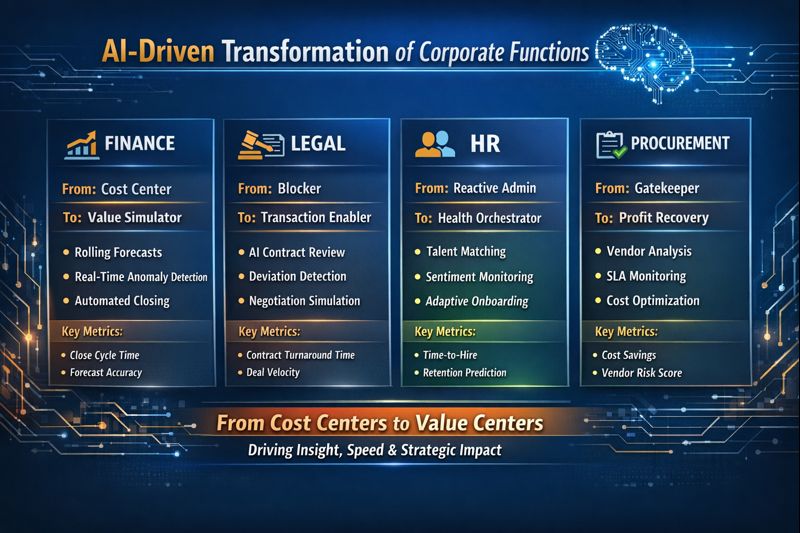
The following framework maps how AI agents transform traditional corporate functions:
| Function | Traditional Role | Agent-Enabled Capabilities | Value Shift | Key Metrics |
| Finance | Variance reporting, compliance, close process | Daily rolling forecasts, real-time anomaly detection, auto-classification, narrative generation | Cost center → Value simulator | Close cycle time, forecast accuracy, analyst productivity |
| Legal | Contract review, risk mitigation, compliance | Agreement ingestion, deviation detection, playbook-aligned redlines, negotiation simulation | Blocker → Transaction enabler | Contract turnaround time, redline accuracy, deal velocity |
| HR | Recruiting, onboarding, compliance documentation | Talent matching, interview summarization, sentiment monitoring, personalized onboarding | Reactive admin → Health orchestrator | Time-to-hire, retention prediction, cultural alignment score |
| Procurement | Vendor management, price negotiation, contract execution | Performance analysis, SLA monitoring, pricing benchmarks, renegotiation simulation | Gatekeeper → Profit recovery | Cost savings, vendor risk score, contract compliance rate |
The Cultural Shift Required
This new model requires a cultural shift. Leaders must learn to trust first drafts created by machines while remaining vigilant stewards of final outcomes. Teams must be trained not just to use AI but to collaborate with it, correct it, and shape its evolution.
Governance becomes paramount. But so does imagination. The opportunity is not to save ten percent on SG&A but to unlock ten times improvement in decision quality, speed, and strategic alignment.
Questions for the Boardroom
The boardroom must respond accordingly. Instead of asking “What is our AI strategy?” the question should be “Where in our operating model are humans still doing what agents could do better, faster, or cheaper?” and “How do we redeploy that human capacity toward innovation and market differentiation?”
If cost centers can be transformed into learning systems, where finance tells better stories, legal closes faster deals, HR scales culture, and procurement creates margin, then they no longer operate in the background but move to the foreground of value creation.
Conclusion
I have long believed that the most underappreciated competitive advantage in business is operational clarity: the ability to see, decide, and act with alignment. With AI agents embedded across the internal stack, that clarity is no longer a quarterly aspiration but a real-time operating principle. This is the moment for founders, CFOs, COOs, and functional heads to stop viewing the back office as a burden. It is now a canvas. And on that canvas, AI agents will not just automate tasks but redraw the enterprise itself.
Disclaimer: This blog is intended for informational purposes only and does not constitute legal, tax, or accounting advice. You should consult your own tax advisor or counsel for advice tailored to your specific situation.
Hindol Datta is a seasoned finance executive with over 25 years of leadership experience across SaaS, cybersecurity, logistics, and digital marketing industries. He has served as CFO and VP of Finance in both public and private companies, leading $120M+ in fundraising and $150M+ in M&A transactions while driving predictive analytics and ERP transformations. Known for blending strategic foresight with operational discipline, he builds high-performing global finance organizations that enable scalable growth and data-driven decision-making.
AI-assisted insights, supplemented by 25 years of finance leadership experience.