




Executive Summary
The relationship between management teams and boards of directors represents one of the most nuanced and consequential dynamics in corporate governance. What often begins as a collaborative partnership can evolve into a zone of tension as companies scale and stakes rise. These tensions typically manifest around critical decision points such as burn rate management, hiring velocity, strategic pivots, and merger and acquisition opportunities.
For chief executive officers and chief financial officers, the challenge extends beyond technical competence to encompass emotional intelligence, strategic communication, and the delicate art of building trust across different stakeholder perspectives. The board carries fiduciary responsibility and the weight of investment experience, while management navigates day-to-day market realities and operational complexities. When these perspectives diverge, misalignment emerges not necessarily from disagreement but from differences in information access, incentive structures, and temporal horizons.
Success in managing these tensions requires transparency, structured communication, scenario planning, and an unwavering commitment to trust-building through consistent execution and candor. The most effective leaders view board dynamics not as adversarial relationships to be managed but as strategic partnerships to be cultivated.
The Complexity of Board-Management Alignment
The fundamental architecture of corporate governance creates inherent tension by design. Boards exist to provide oversight, represent shareholder interests, and draw upon collective experience across multiple companies and market cycles. Management teams, conversely, live inside the operational reality of building businesses, managing talent, and responding to competitive dynamics. These roles complement each other in theory, but practical alignment proves elusive when information asymmetries, differing time horizons, and competing priorities come into play.
Having served as Chief Financial Officer across organizations ranging from high-growth SaaS platforms to global logistics enterprises, from digital entertainment studios to nonprofit educational institutions, I have witnessed firsthand how these tensions surface across vastly different contexts. Whether navigating board discussions at Singularity University following a $40 million Series B fundraise, or presenting multi-entity financial performance at BeyondID across operations spanning the United States, India, and Nepal, the underlying pattern remains consistent. Boards worry about sustainability and downside protection. Management sees opportunity and calculates acceptable risk. The space between these viewpoints defines the work of leadership.
The Burn Rate Conversation
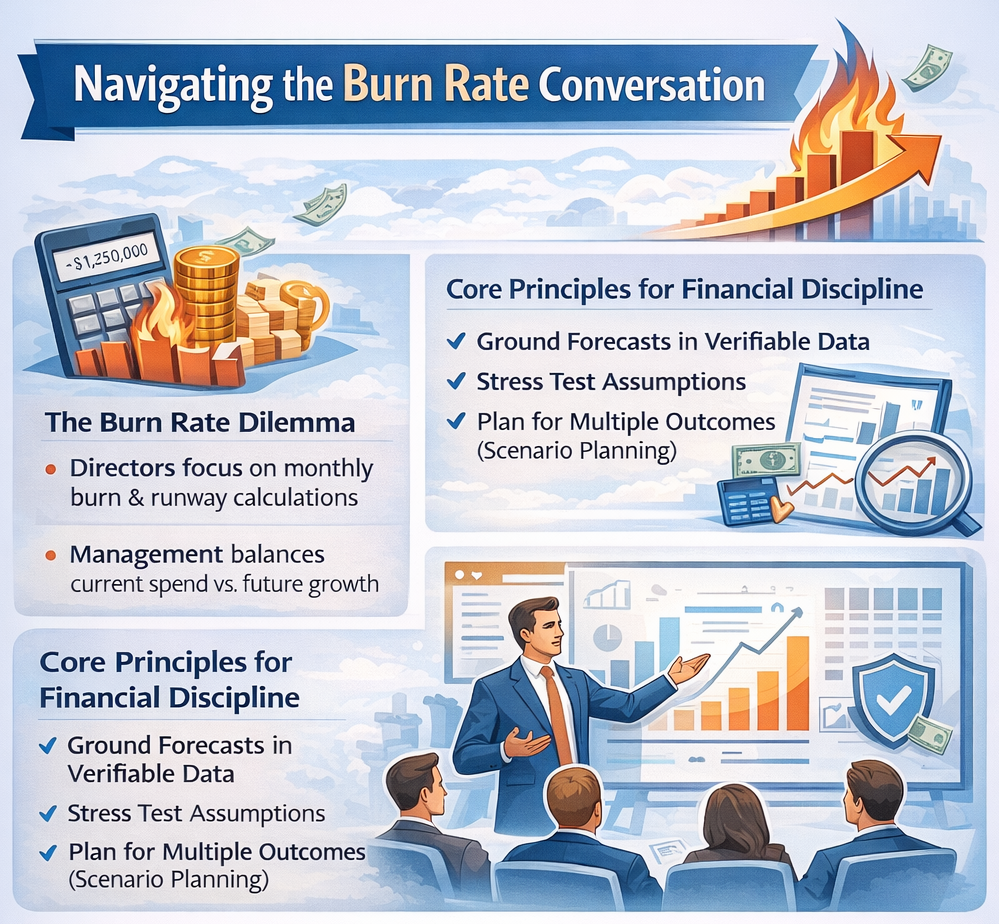
During my tenure managing finance and analytics for organizations generating revenues from $9 million to over $180 million, I learned that boards respect financial models that acknowledge uncertainty and prepare for multiple outcomes far more than they value overconfident projections.
The chief financial officer plays a pivotal role here, not merely as a numbers person but as a narrative architect. Walking into a boardroom with clear explanations of resource allocation, milestone dependencies, and contingency plans builds credibility. This transparency must be truthful. Boards detect manufactured optimism quickly. They reward realism and thorough preparation.
Structuring Hiring Plans
Founders naturally want to build teams rapidly. They see talent acquisition as the primary scaling mechanism. Product leaders, go-to-market teams, and customer support functions all compete for headcount approvals. Boards generally agree with the principle of investing in people, but they question the sequencing. They want evidence that existing teams operate efficiently before approving expansion. They ask about onboarding effectiveness, performance metrics, and return on human capital investment.
This skepticism derives from experience. Many board members have witnessed companies hire aggressively during growth phases only to face painful contractions when revenue assumptions fail to materialize. At Lifestyle Solutions, where I managed global finance for a $120 million organization, we learned to link every headcount decision to specific revenue targets, customer acquisition milestones, or operational efficiency gains. Each role came with a business case that articulated value creation, not just functional need.
The approach transforms hiring from an emotional plea for resources into a strategic investment discussion. When companies perform ahead of plan, this becomes part of the growth story. When performance lags, hiring decisions demonstrate how talent acquisition supports recovery. Boards do not need granular detail. They need confidence in the underlying logic.
Managing Strategic Pivots
Pivots represent some of the most challenging moments in the board-management relationship. A strategic shift often follows painful recognition that current trajectory proves unsustainable. Perhaps product-market fit remains elusive. Perhaps sales cycles extend far longer than projected. Perhaps competitive dynamics have shifted fundamentally. For founders, acknowledging these realities carries emotional weight. For boards, pivots signal potential erosion of the original investment thesis.
Transparency becomes paramount. Chief executives should never surprise boards with pivots. Early involvement, shared data, and collaborative decision-making build trust even through difficult transitions. During my time leading finance at organizations across cybersecurity, digital marketing, and manufacturing sectors, I observed that boards understand market realities require course corrections. What they fear is opacity and unilateral decision-making that excludes their input.
Bringing boards into the analytical process does not mean surrendering control. It means building alignment through inclusive deliberation. This creates shared ownership of strategic choices and preserves trust through difficult transitions.
Navigating Merger and Acquisition Discussions
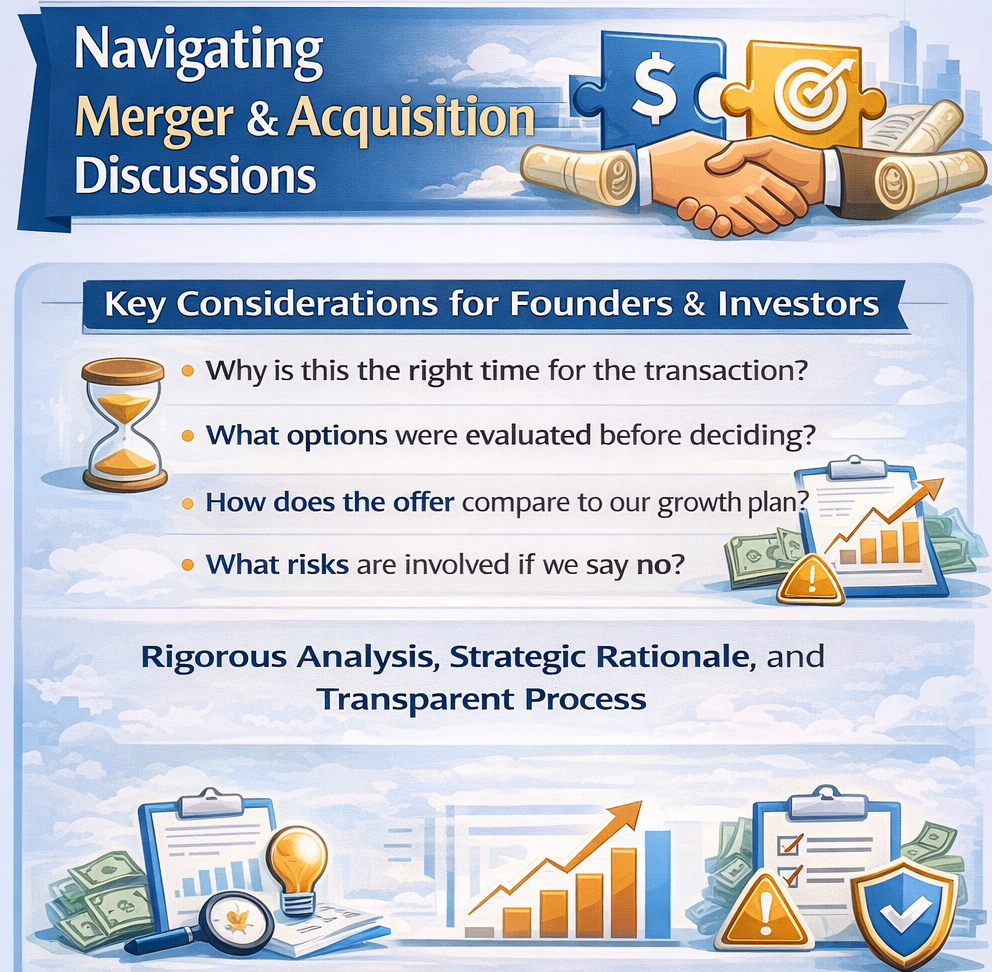
Merger and acquisition opportunities introduce unique complexity. For founders, acquisition offers can feel validating and strategically sound. For investors, valuations may fall short of expected returns. Boards will question whether the company has maximized its potential. They will wonder whether buyers see something directors have missed. They may worry about market perception of weakness.
These are rational concerns, not emotional reactions. Management must anchor merger and acquisition discussions in rigorous process and factual analysis. The conversation should begin with strategic rationale:
- What makes this transaction compelling now?
- What alternatives have been explored?
- How does the offer compare to internal projections?
- What are the risks of declining?
Through my experience overseeing over $150 million in merger and acquisition transactions and post-merger integrations, including complex deals at Atari SA and Cryptic Studios, I learned that laying out these considerations systematically creates the foundation for collaborative decision-making. Even when consensus proves elusive, transparent process preserves relationship integrity.
The Currency of Trust
Throughout every dimension of board dynamics, trust remains the essential currency. Trust builds through consistency. Leaders who deliver on commitments, report both positive and negative developments candidly, and demonstrate continuous learning earn credibility. Trust also requires humility. Acknowledging mistakes, accepting feedback, and showing intellectual flexibility matter more than appearing infallible.
My professional certifications as a CPA, CMA, CIA, CPIM, and PMP, along with academic credentials including an MS and MBA, provided technical foundations. But the real education came from building finance organizations, redesigning value-chain processes, deploying key performance indicator frameworks, and translating complex operating models into board-level insights across wildly different industries. Boards do not expect perfection. They expect progress, transparency, and partnership.
Practical Tactics
Several practical approaches help manage board dynamics effectively:
- Establish clear expectations about board materials – Send comprehensive packages in advance. Make them concise and focused on metrics, milestones, and challenges. Reserve meeting time for discussion rather than presentation.
- Conduct regular one-on-one conversations with individual board members – These informal channels surface candid feedback and prevent groupthink. Directors speak more openly in smaller settings.
- Document board decisions and revisit them systematically – This creates continuity and demonstrates that management executes against agreed-upon plans. It also provides context when introducing new initiatives. The board sees intentionality rather than reactivity.
At BeyondID, where I designed enterprise key performance indicator frameworks using MicroStrategy and Domo for tracking bookings, utilization, backlog, annual recurring revenue, and customer margin, we built board reporting that connected operational metrics to strategic objectives. This gave directors visibility into execution without overwhelming them with operational minutiae.
Finally, remember that tension itself does not signal failure. A board that never challenges management abdicates its governance responsibility. A chief executive who never disagrees with the board abandons theirs. The objective is not harmony. The objective is productive tension that yields better decisions.
Conclusion
Managing board tensions represents one of the most sophisticated and essential skills in executive leadership. It requires emotional intelligence to navigate interpersonal dynamics, strategic thinking to frame complex issues effectively, and deep business understanding to translate operational realities into governance-level insights. It demands the ability to listen actively, communicate precisely, and adapt thoughtfully when circumstances shift. When executed well, the result transcends mere alignment. It creates stronger, more resilient organizations capable of weathering uncertainty and capitalizing on opportunity. The path through complexity, whether navigating cap table dynamics or boardroom deliberations, requires clarity of purpose and clarity of communication. Chief executives, chief financial officers, and leadership teams must be the source of that clarity. Only through consistent transparency, rigorous preparation, and genuine partnership can trust be built, differences be bridged, and companies move forward with the confidence and conviction necessary for sustained success.
Disclaimer: This blog is intended for informational purposes only and does not constitute legal, tax, or accounting advice. You should consult your own tax advisor or counsel for advice tailored to your specific situation.
Hindol Datta is a seasoned finance executive with over 25 years of leadership experience across SaaS, cybersecurity, logistics, and digital marketing industries. He has served as CFO and VP of Finance in both public and private companies, leading $120M+ in fundraising and $150M+ in M&A transactions while driving predictive analytics and ERP transformations. Known for blending strategic foresight with operational discipline, he builds high-performing global finance organizations that enable scalable growth and data-driven decision-making.
AI-assisted insights, supplemented by 25 years of finance leadership experience.