




Executive Summary
One of the more peculiar quirks of business is that most companies only start preparing for an exit when it is already at their doorstep. A call from an investment banker, a knock from a potential acquirer, or a whisper from the board about exploring strategic alternatives, these tend to be the tripwires that unleash a mad dash to organize data rooms, polish decks, and plug financial leaks that should never have sprung in the first place. That kind of reactive posture might have been tolerated a generation ago. But not today. Not when capital moves faster, markets swing wider, and private companies are scrutinized almost as intensely as public ones. Throughout my twenty-five years leading finance across cybersecurity, SaaS, manufacturing, logistics, and gaming, I have learned that in this world, the wise CFO knows that every day is exit day. Not because you are eager to sell. But because a company that is always ready to exit is a company that is always in control. Constant exit readiness is not about selling the business. It is about running it so well that you could sell it, or IPO it, or partner it, at a moment’s notice. And doing so on your terms.
Clean Numbers: The First Signal of Credibility
You do not need a data room to know whether you are ready. Just ask: if a buyer asked for your trailing twelve-month financials today, could you produce them within an hour, fully reconciled and audit-traceable? Could you explain variances and trends with confidence, not just numbers but narratives? Every finance leader should be able to say yes. And if not, the first order of business is not to prepare for a sale. It is to fix the fundamentals.
Clean books are not just about accounting. They are a signal of institutional trustworthiness. Buyers, investors, and even internal stakeholders equate sloppy numbers with sloppy governance. They do not care about your growth curve if your general ledger is a bowl of spaghetti. Monthly closes should be tight. Controls should be tested. KPIs should be consistent. And you should know what your last audit turned up and already have a remediation plan in place.
When I improved month-end close from 17 days to under six days at a cybersecurity firm, we implemented automated variance analysis, exception reporting, and comprehensive audit trails. This level of operational discipline signals to potential acquirers or public market investors that the finance function operates with rigor and precision. These are not just exit readiness items. They are how a great business runs, full stop.
Forecasts as Strategic Weapons
Buyers want to understand not just where you are but where you are going and how reliably you can get there. If your forecasts are chronically off, that undermines confidence in everything else. Good CFOs build a forecasting function that is dynamic, model-driven, and responsive to change. Rolling forecasts, scenario planning, and driver-based models are not just nice-to-haves. They are tools of institutional credibility.
When you are exit-ready, you can show how a 10 percent swing in demand flows through your gross margin, or what headcount scenarios look like under different growth rates. More importantly, you can show that you have made decisions using those forecasts, invested, cut, paused, accelerated, with discipline and foresight. When I rebuilt GAAP and IFRS financials for a high-growth SaaS company and designed cohort analysis frameworks, we developed scenario-based forecasting with explicit probability weights. This capability became critical during investor diligence and would be equally valuable in any exit process.
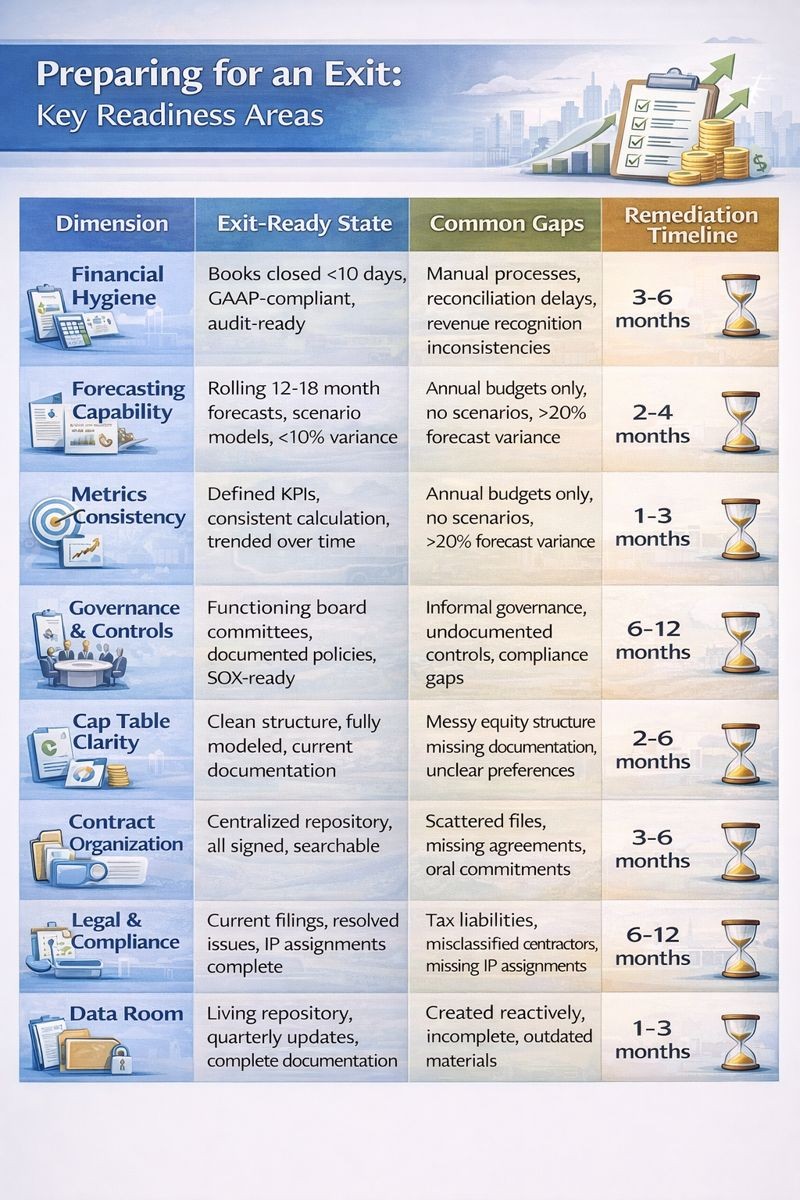
Exit Readiness Assessment Framework
This framework provides a comprehensive checklist across eight critical dimensions that CFOs should maintain continuously rather than scrambling to prepare when an exit opportunity arises. Each dimension includes key indicators of readiness and common gaps that create friction during diligence processes.
KPIs and Metrics: Consistency Builds Trust
Whether you are selling to a strategic acquirer or taking the company public, investors and buyers want to know your business model in metrics: customer acquisition cost, lifetime value, churn, gross margin, net revenue retention, payback period, burn multiple, free cash flow margin. But more importantly, they want consistency. Being exit-ready means defining your metrics once and sticking to them. If you change your definition of annual recurring revenue three times in twelve months, you are not showing agility. You are showing confusion.
The best companies use metrics not as vanity but as instruments of control. They understand why customer acquisition cost increased and what they are doing about it. They track cohort retention down to the behavior level. And they build bridges between teams including finance, operations, marketing, and product through a common language of data.
When I built enterprise KPI frameworks using MicroStrategy, Domo, and Power BI tracking bookings, utilization, backlog, annual recurring revenue, pipeline health, customer margin, and retention, we established definitions once and maintained consistency across all board materials, investor updates, and internal dashboards. This consistency creates credibility during diligence processes.
Governance as Competitive Advantage
Many companies do not treat governance seriously until it is forced on them by investors or regulators. But a company that is always exit-ready embraces governance as a competitive advantage. That means having an audit-ready board, functioning committees, a clear delegation of authority, and a culture of accountability. Are your board materials structured and strategic, or a collage of metrics and hope? Does your compensation plan align to long-term value or short-term comfort? Do you document decisions?
When I led board reporting at a gaming enterprise where I oversaw $100 million in acquisitions and post-merger integration, we established formal audit committee processes, quarterly compliance reviews, and structured board reporting calendars. This governance infrastructure signaled to potential acquirers that the company operated with public-company discipline even as a private entity.
When buyers and public market investors assess a company, they look for signs that the leadership team has been running it as if it were already public. That starts with governance. It is not a distraction from building. It is the scaffolding that lets you build taller.
Strategic Planning Meets Operational Rigor
Being exit-ready does not mean you are always trying to exit. It means your operations are tight and your strategy is aligned to value creation. That requires a living, breathing long-range plan that is tied to action. Is your long-range plan realistic, built from bottoms-up data, and tied to key investments in product, go-to-market, and organizational design? Does it contemplate capital needs, market shifts, and execution risk? Or is it just a hockey-stick curve that no one believes?
Buyers and public investors can tell when a strategy is aspirational versus operational. Exit-ready companies can explain how their engineering roadmap links to margin expansion, how their market segmentation maps to total addressable market capture, and how their capital deployment is tied to return on investment, not wishful thinking.
Cap Table Clarity and Incentive Alignment
There is no faster way to sour a deal than a messy cap table. Unexplained SAFEs, back-of-napkin option grants, or ambiguous acceleration clauses are red flags. The cap table should be clean, current, and modeled across scenarios. Are your equity plans aligned to market norms? Are your executive incentives aligned to the outcomes a buyer or public investor cares about? Are your early investors on board with the exit strategy, or sitting on preferences that make the math untenable?
When I secured $40 million in Series B funding and an $8 million credit line at a nonprofit organization, we maintained meticulous cap table documentation including detailed waterfall models showing proceeds distribution under various exit scenarios. This transparency accelerated due diligence and built investor confidence. CFOs who are always exit-ready manage the cap table like it is a balance sheet, because it is. It reflects every promise made and every dollar priced. And it needs constant maintenance.
Contracts and Legal Hygiene
One of the first things diligence teams look at is your material agreements: customer contracts, vendor deals, loan covenants, leases, IP assignments, and employment letters. They want to know what you have promised, what you owe, what you control, and what might cause problems later. This is where many startups and even growth companies falter. Contracts live in scattered folders. Some are unsigned. Some are oral agreements remembered only by a departed employee. That is a liability.
Every company should maintain a contract repository, organized and searchable. Every agreement should be accessible, signed, and categorized. Do your customer agreements give them refund rights? Do they lock you into pricing? Do your vendor agreements contain auto-renewals or change-of-control clauses? Do you actually own your IP, or did a contractor forget to assign it? Do not let diligence be the moment you discover you do not own the software your business depends on.
Tax, Regulatory, and Compliance Readiness
Nothing will kill momentum like discovering a sales tax liability or international transfer pricing issue during diligence. It is not just the back taxes. It is the signal that your finance function is not on top of compliance. Have a tax advisor who understands your business model. Be current on filings. File 83(b) elections on time. Track your net operating losses. Maintain sales tax nexus assessments.
When I managed global finance for a $120 million logistics organization with operations spanning the United States, India, and Nepal, we established documented intercompany agreements, transfer pricing policies, and comprehensive tax compliance processes. This proactive approach prevented diligence surprises and demonstrated financial sophistication. If you are in a regulated industry including fintech, healthcare, or data privacy, be ready to show licenses, consents, and audits. Buyers will assume that if they acquire you, they acquire your problems too.
The Living Data Room
Most companies treat the data room like a fire drill. A buyer shows interest, and suddenly the team scrambles to assemble a checklist. That is backwards. Every company should maintain a living data room, not because you plan to sell but because it is the best way to run your business. It forces discipline. It ensures readiness. And it shows that you have got nothing to hide.
A well-run data room typically includes corporate documents including charter, bylaws, cap table, and board consents, financials including three plus years of audited or cleanly prepared statements, forecasts, and metrics, tax returns, notices, and NOL schedules, HR including org chart, compensation data, and equity grants, legal including customer and vendor agreements and litigation status, IP including assignments, patents, and trademarks, product including roadmaps, architecture, and dependency risks, and security including SOC 2 reports, penetration tests, and policies. Update this quarterly, not just when an offer shows up.
Culture, Reputation, and Narrative Control
You can have the cleanest books in the world and still lose the deal if your team is dysfunctional or your culture is toxic. Smart buyers and investors ask around. They interview employees, customers, former executives, and even competitors. What do people say about working with you? Exit readiness is not just about numbers. It is about reputation. Keep your house clean in how you treat people, not just how you book revenue.
When diligence begins, do not go into hiding. Lead it. Drive the process. Narrate the materials. Be upfront about warts. Every business has them. What buyers hate is discovering them themselves. The CFO should be the voice of credibility. Calm. Clear. Credible. When you own the truth, even bad news can build trust.
My certifications as a CPA, CMA, and CIA emphasize the technical rigor and governance discipline required for exit readiness. But what truly prepares companies for successful exits is not credentials alone. It is the daily discipline of operating with transparency, maintaining rigorous systems, and building institutional quality into every process. Conclusion
Conclusion
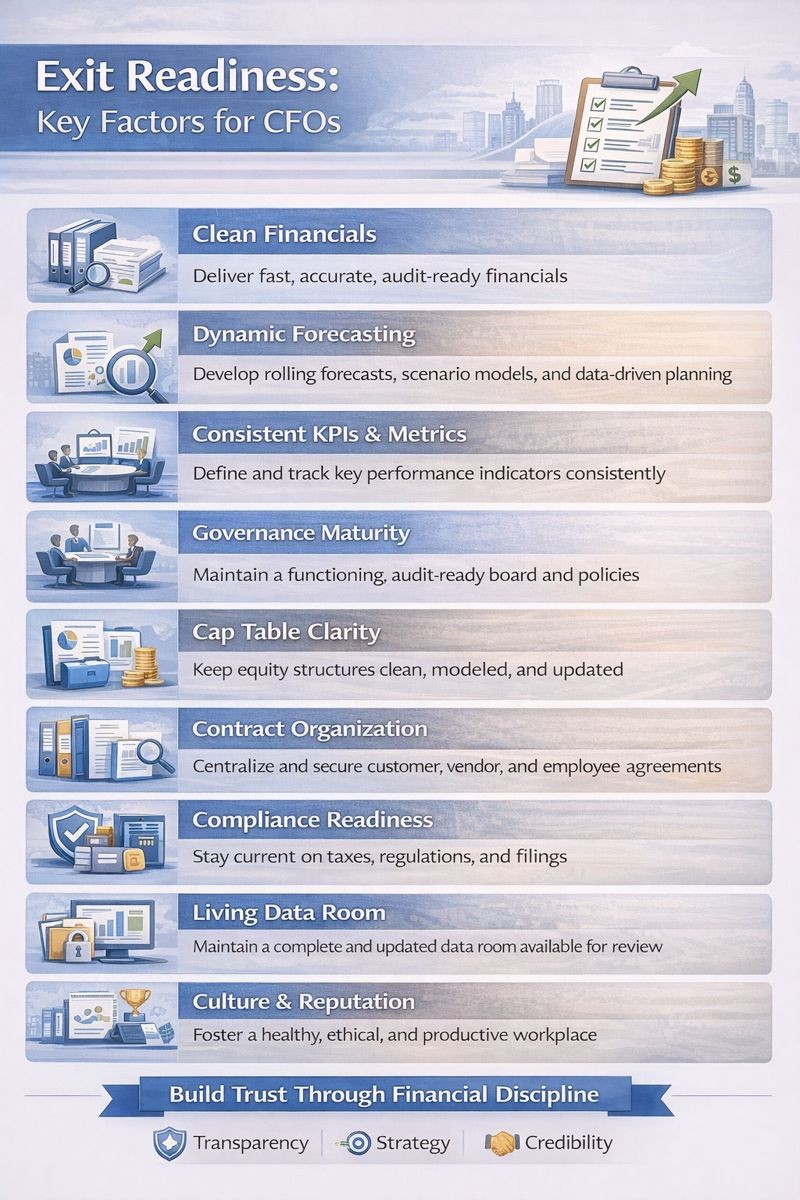
Exit readiness is not a project. It is a discipline. A way of operating. It means running the business so well that if an opportunity arises, you do not have to scramble. You just execute. And here is the insight: companies that operate with that mindset, disciplined, data-driven, strategically aligned, often do not need to sell. They attract capital on favorable terms. They scale cleanly. And when they do exit, they do so from a position of strength, not desperation. Due diligence, in that sense, is not just about preparing for scrutiny. It is about living in a way that does not fear it. The companies that succeed in exits are those that treated every day as exit day, building value continuously rather than staging it frantically. That is not just good finance. That is good business.
Disclaimer: This blog is intended for informational purposes only and does not constitute legal, tax, or accounting advice. You should consult your own tax advisor or counsel for advice tailored to your specific situation.
Hindol Datta is a seasoned finance executive with over 25 years of leadership experience across SaaS, cybersecurity, logistics, and digital marketing industries. He has served as CFO and VP of Finance in both public and private companies, leading $120M+ in fundraising and $150M+ in M&A transactions while driving predictive analytics and ERP transformations. Known for blending strategic foresight with operational discipline, he builds high-performing global finance organizations that enable scalable growth and data-driven decision-making.
AI-assisted insights, supplemented by 25 years of finance leadership experience.