




Executive Summary
EBITDA has become the lingua franca of corporate performance. It is fast, flexible, and familiar. Investors know it. Bankers price with it. Boards benchmark against it. And yet, despite its ubiquity, EBITDA is rarely understood as anything more than a shorthand. Throughout my twenty-five years leading finance across cybersecurity, SaaS, manufacturing, logistics, and gaming, I have learned that this shorthand, while useful, can be dangerous. It can obscure more than it reveals. It can simplify the complex and package it in a way that feels like clarity. But EBITDA is not a narrative. It is a number. And numbers without context are instruments without orchestration.
The EBITDA Misconceptions
Misconception 1: EBITDA Represents Cash Flow
The first misconception is that EBITDA represents cash flow. It does not. EBITDA strips away interest, taxes, depreciation, and amortization, all of which are real costs with real implications. For a capital-intensive business, depreciation is not an accounting artifact. It is a proxy for future capital expenditure. For a highly-leveraged firm, interest is not an optionality. It is a constraint. And for international companies, tax structures are strategic architecture.
Investors know this. They adjust. They unpick the assumptions, rebuild models, and reconstruct working capital flows. But they also listen. Not to the EBITDA figure alone but to how it is presented. The tone, the confidence, the fluency of the CFO. A strong CFO does not defend EBITDA. They use it as a point of departure. They translate it into capital efficiency, cash generation, and reinvestment capacity.
When I secured $40 million in Series B funding and an $8 million credit line at a nonprofit organization, investors scrutinized EBITDA closely but demanded comprehensive cash flow modeling. We presented three-year projections showing EBITDA growing from $2 million to $8 million, but we paired this with detailed working capital assumptions, capital expenditure plans for technology infrastructure, and debt service coverage ratios. We demonstrated that while EBITDA would grow 300 percent, free cash flow would grow 450 percent due to improving working capital efficiency. This cash flow narrative, anchored but not limited to EBITDA, converted investor interest into commitment.
Misconception 2: EBITDA Enables Direct Comparison
The second problem is standardization. EBITDA invites comparison, which is tempting in capital markets. But businesses are not commodities. They have different lifecycles, customer profiles, and reinvestment needs. Two companies with the same EBITDA margin might have vastly different prospects. One might be spending heavily to acquire long-term customers. The other might be under-investing and coasting on legacy contracts.
Furthermore, EBITDA is often adjusted. Management adds back non-recurring items, share-based compensation, and restructuring charges. These adjustments are not inherently misleading. They can improve signal fidelity. But when overused, they breed suspicion. A CFO who explains these adjustments with precision and transparency builds trust. One who waves them away invites skepticism.
EBITDA Translation Framework
| Metric Component | What EBITDA Shows | What It Obscures | CFO Narrative Requirement |
| Revenue Quality | Top-line growth | Customer retention, cohort behavior, revenue concentration | Explain durability, repeatability, customer economics |
| Margin Structure | Profitability percentage | Cost structure scalability, pricing power sustainability | Show operating leverage, unit economics, margin drivers |
| Cash Conversion | Earnings level | Working capital needs, capex intensity, timing mismatches | Demonstrate cash generation, conversion ratio, cycle time |
| Growth Investment | Current profitability | R&D spend, customer acquisition, market expansion | Clarify investment thesis, expected returns, payback periods |
| Capital Structure | Operating performance | Leverage risk, interest burden, refinancing exposure | Connect EBITDA to debt service, coverage ratios, flexibility |
| Adjustments | Normalized performance | One-time vs. recurring items, compensation reality | Justify each add-back, show historical pattern, explain governance |
Building the Investor Narrative
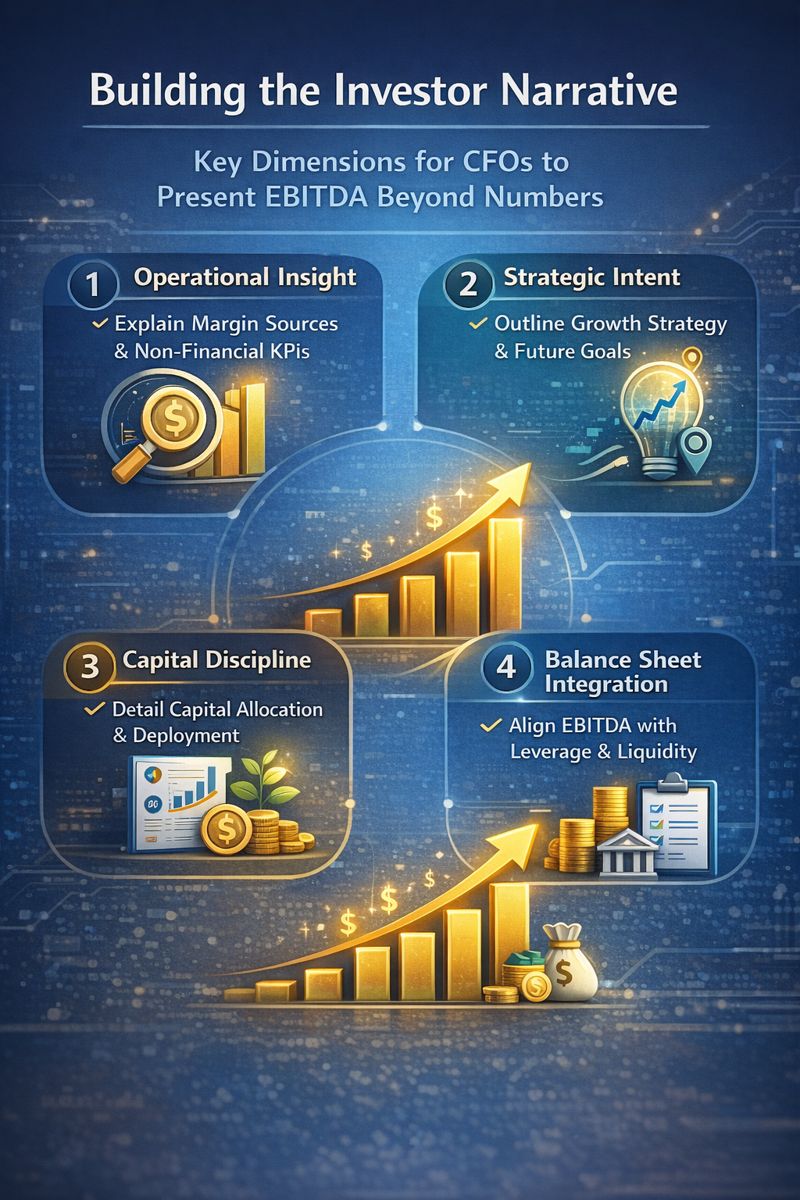
If EBITDA is not a narrative, then what is? It is a component, a necessary but not sufficient element of investor communication. The CFO who treats it as a metric alone misses the opportunity to shape investor belief. The real power lies in context, in contrast, and in consequence.
Dimension 1: Operational Insight
Narrative begins with operational insight. How is the business creating margin? Is it through pricing power, operating leverage, or temporary cost suppression? Is demand resilient or subsidized? Is the sales engine repeatable or heroic? EBITDA without this commentary is noise. EBITDA embedded in operational truth becomes signal.
CFOs must also elevate non-financial data. Customer retention, net promoter score, usage metrics, and lead velocity are not vanity. They are leading indicators of future earnings quality. Investors who see strong EBITDA and weakening customer satisfaction do not celebrate. They prepare for reversal. The CFO must connect financial performance to customer value delivery. That connection is the backbone of credibility.
Dimension 2: Strategic Intent
The second dimension of narrative is strategic intent. EBITDA tells what happened. The CFO must explain why, and more importantly, what comes next. Is the business investing in a new segment? Entering a margin-dilutive market? Restructuring operations to support scale? These decisions affect the EBITDA arc. But investors care more about trajectory than snapshot. They want to understand whether today’s numbers are base, peak, or transition.
Dimension 3: Capital Discipline
The third element is capital discipline. Investors trust companies that treat capital like a resource, not an entitlement. CFOs who explain how EBITDA is allocated including to reinvestment, to deleveraging, to dividends, to mergers and acquisitions demonstrate stewardship. Capital allocation narratives are among the most persuasive tools in investor communication. They show agency, foresight, and commitment to compounding.
When I managed global finance for a $120 million logistics organization, quarterly earnings discussions centered not on EBITDA alone but on capital deployment. We showed EBITDA of $18 million with detailed allocation: $6 million to technology infrastructure modernization expected to reduce operating costs 15 percent within two years, $4 million to fleet expansion in high-margin corridors with 18-month payback, $3 million to debt reduction improving our interest coverage ratio from 3.2x to 4.1x, and $5 million retained as strategic reserves. This allocation narrative demonstrated that we understood EBITDA as fuel for value creation, not as an end goal. Investor confidence improved measurably, reflected in our cost of capital declining 80 basis points over the subsequent year.
Dimension 4: Balance Sheet Integration
Then there is the balance sheet. EBITDA must be triangulated against leverage. A company with high EBITDA and high debt is fragile unless cash flow is predictable and reinvestment minimal. A capital-light company might justify higher multiples even with lower EBITDA margins. Narrative lives in the contrast. It must explain why the business model supports the capital structure, and vice versa.
From Interpretation to Confidence
If the CFO’s job is to turn numbers into confidence, then the mechanism is interpretation. Interpretation requires fluency in both data and audience. It demands technical depth and psychological nuance. Investors are not looking for perfection. They are looking for predictability, accountability, and orientation.
Building Coherence
Confidence begins with coherence. Are the metrics aligned? Does revenue growth match customer adoption? Does margin expansion reflect efficiency or unsustainable cost deferral? Do capital investments yield measurable outcomes? These alignments are not automatic. They must be engineered and then communicated.
The CFO must also set expectations. Forecasting is not prediction. It is intention. Good forecasts are believable not because they are conservative but because they are constructed transparently. Assumptions are clear. Sensitivities are acknowledged. Downside protections are articulated. Investors want to know: if things go wrong, who sees it first? The CFO who preempts risks earns the right to discuss rewards.
Communication Structure
Communication structure matters. The best CFOs use a narrative arc:
- Open with context (market dynamics, strategic positioning)
- Present outcomes (financial performance with operational drivers)
- Explain drivers (what created the results, sustainable vs. temporary factors)
- Share outlook (forward trajectory with assumptions and sensitivities)
- Close with implications (capital allocation, strategic priorities, investor takeaways)
Every chart, every metric, every slide supports that arc. There is no overstuffed appendix. No buried commentary. The signal is front-loaded.
Tone and Constancy
Tone is equally important. Defensive CFOs erode trust. Dismissive CFOs alienate. Overly polished CFOs raise suspicion. The ideal tone is firm, informed, and intellectually humble. It shows mastery of the business without presumption. It invites dialogue. It welcomes scrutiny.
Confidence also comes from constancy. Changing metrics, shifting KPIs, or inconsistent disclosures confuse investors. CFOs must maintain a clear set of performance indicators. They can evolve but the rationale must be explained. Metric drift feels like narrative manipulation. Consistency builds signal integrity.
Owning the Lows
Finally, confidence requires owning the lows. Every company misses. Every forecast, at some point, breaks. The question is not whether the numbers fell short. It is whether the CFO saw it, explained it, and responded. The best CFOs treat misses as credibility tests. They show how decisions were made. What assumptions failed. What corrective actions were taken. And they do so without flinching.
When I improved month-end close from 17 days to under six days at a cybersecurity firm, we simultaneously improved forecast accuracy. But we also encountered a quarter where customer churn spiked unexpectedly due to competitive pressure. Rather than minimize the variance, I led the earnings discussion by immediately addressing the 12 percent EBITDA miss, explaining that retention in one customer segment declined from 94 percent to 87 percent, detailing the competitive dynamics that drove the shift, and presenting the three-month action plan including pricing adjustments, enhanced customer success protocols, and product feature acceleration. Investors appreciated the transparency. Our stock declined 3 percent initially but recovered within two weeks as confidence in our response overcame concern about the miss.
My certifications as a CPA, CMA, and CIA provide technical foundation for financial analysis and investor communication. But what separates effective CFO investor relations from metric reporting is not accounting sophistication alone. It is the narrative skill to translate EBITDA into operational insight, strategic intent, and capital discipline. It is the communication structure that builds coherence through context and trajectory. And it is the courage to own outcomes honestly, building the constancy and credibility that convert numbers into investor confidence.
Conclusion
EBITDA, on its own, is inert. But in the hands of a strategic CFO, it becomes part of a broader choreography. A story of allocation, execution, and value creation. That story, told with precision and courage, is what turns numbers into belief. And belief, once earned, becomes the most durable currency in markets that trade on confidence.
Disclaimer: This blog is intended for informational purposes only and does not constitute legal, tax, or accounting advice. You should consult your own tax advisor or counsel for advice tailored to your specific situation.
Hindol Datta is a seasoned finance executive with over 25 years of leadership experience across SaaS, cybersecurity, logistics, and digital marketing industries. He has served as CFO and VP of Finance in both public and private companies, leading $120M+ in fundraising and $150M+ in M&A transactions while driving predictive analytics and ERP transformations. Known for blending strategic foresight with operational discipline, he builds high-performing global finance organizations that enable scalable growth and data-driven decision-making.
AI-assisted insights, supplemented by 25 years of finance leadership experience.