




Executive Summary
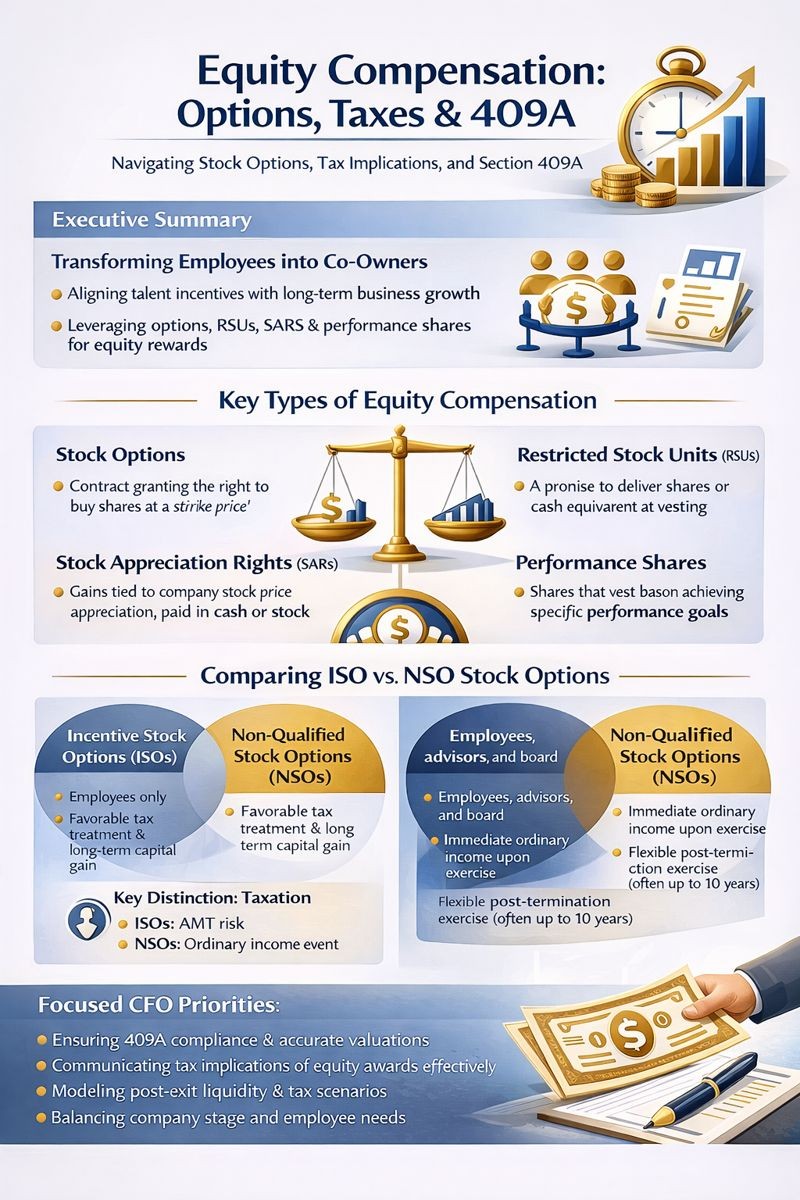
Equity compensation has become a cornerstone of modern talent strategy, especially within startups and high-growth firms. At its essence, it transforms employees from wage earners to co-owners, aligning incentives between contributors and the long-term trajectory of the business. Throughout my twenty-five years leading finance across cybersecurity, SaaS, manufacturing, logistics, and gaming, I have learned that for CFOs and compensation committees, understanding the various types of options and their strategic use is essential. Equity compensation can take multiple forms including stock options, restricted stock units, stock appreciation rights, and performance shares. Among these, stock options remain the most versatile and complex, offering a blend of motivational upside and administrative nuance. Stock options grant employees the right, but not the obligation, to purchase company stock at a predetermined price known as the strike or exercise price. The value of the option lies in its future potential. If the company’s valuation increases, the holder can purchase stock at a discount to market, realizing financial gain.
Types of Equity Compensation
Stock options come in two main types: Incentive Stock Options and Non-Qualified Stock Options. The distinction between these two is foundational to tax treatment, regulatory compliance, and the overall structure of the compensation plan.
Incentive Stock Options (ISOs)
Incentive Stock Options are eligible for favorable tax treatment under the Internal Revenue Code but come with stringent limitations. They are only available to employees, must meet specific holding period requirements, and are capped in annual grants. ISOs occupy a privileged space within the equity landscape due to their favorable tax treatment. However, this advantage is paired with complexity and compliance obligations.
Key Characteristics:
- Available only to employees
- Must be granted pursuant to a written plan approved by shareholders
- Exercise price must be at or above the fair market value on grant date
- Tax deferral mechanism: no regular income tax at exercise
- Favorable tax treatment: if held for at least two years from grant and one year from exercise, gains qualify as long-term capital gains
- Alternative minimum tax exposure: the bargain element between FMV at exercise and strike price is an AMT adjustment
- $100,000 annual grant limit per employee based on FMV at grant
- Must be exercised within 90 days of employment termination to retain favorable status
For CFOs, ISOs are most effective when targeting long-term employees expected to meet holding requirements. They provide a tax-efficient pathway to wealth creation, reinforcing retention and commitment. However, the AMT risk and holding period requirements must be clearly communicated.
When I managed equity compensation programs at multiple organizations, we designed ISO grants for senior technical leaders with multi-year vesting schedules. We provided detailed modeling tools showing AMT implications at various exercise points and stock price scenarios. This education enabled informed decision-making and prevented tax surprises that could damage employee trust.
Non-Qualified Stock Options (NSOs)
Non-Qualified Stock Options provide the flexibility that ISOs lack. They can be issued to employees, board members, advisors, and consultants, making them a critical tool in broader compensation strategy. However, they introduce more immediate tax consequences and require detailed planning.
Key Characteristics:
- Available to employees, board members, advisors, consultants
- Taxed at exercise: spread between FMV and exercise price is ordinary income
- Creates W-2 income event requiring payroll tax withholding
- More flexible vesting conditions: time, performance, or market-based metrics
- Post-termination exercise windows can extend beyond 90 days, often up to 10 years
- Subject to ASC 718 accounting: fair value expensed over vesting period
- Requires accurate 409A FMV pricing to avoid deferred compensation violations
For CFOs, the timing of NSO exercises becomes a focal point of tax strategy. Recipients often delay exercise to avoid current taxation, especially if liquidity events are not near. However, this defers the start of long-term capital gain holding periods, potentially reducing after-tax proceeds at exit.
NSOs are often the instrument of choice for later-stage and public companies where liquidity is accessible and the ability to deduct compensation expenses is a strategic advantage. To maximize NSO effectiveness, CFOs should offer educational sessions, integrate modeling tools within HR portals, and provide proactive tax planning resources.
Equity Compensation Type Comparison
| Feature | ISOs | NSOs | RSUs |
| Eligibility | Employees only | Employees, board, advisors, consultants | Employees, board, advisors |
| Tax at Grant | None | None | None |
| Tax at Exercise/Vest | AMT exposure (bargain element) | Ordinary income on spread | Ordinary income on FMV |
| Tax at Sale | Long-term capital gains (if holding periods met) | Capital gains on appreciation | Capital gains on appreciation |
| Holding Period Requirements | 2 years from grant, 1 year from exercise | None | None |
| Annual Limit | $100,000 FMV per employee | None | None |
| Post-Termination Exercise | 90 days (or converts to NSO) | Flexible (often up to 10 years) | N/A (unvested forfeit) |
| Company Tax Deduction | None (if qualifying disposition) | Yes (at exercise) | Yes (at vesting) |
| Accounting Treatment | ASC 718 fair value over vesting | ASC 718 fair value over vesting | ASC 718 FMV at grant over vesting |
Restricted Stock Units (RSUs)
Restricted Stock Units have gained popularity as a more predictable and administratively efficient alternative to stock options. Unlike options, RSUs represent a promise to deliver shares or their cash equivalent at a future date, contingent on continued employment or performance.
Key Characteristics:
- Taxed at vesting, not at grant
- FMV of shares treated as ordinary income subject to payroll taxes
- Accounting simplicity: expense based on FMV at grant, amortized over vesting
- Especially useful for late-stage private and public companies
- Performance shares add vesting conditions based on defined metrics
- Require careful consideration of share pool usage and dilution modeling
For CFOs, RSUs offer accounting simplicity. Under ASC 718, RSU expense is based on the FMV at grant, amortized over the vesting period. There is no need to estimate future volatility or simulate scenarios as with options. Communication around taxation is critical. Employees must plan for tax obligations upon vesting, especially in jurisdictions that do not allow withholding via share delivery.
Section 409A Valuation: Compliance and Mechanics
Internal Revenue Code Section 409A governs the deferral of compensation and plays a pivotal role in private company equity issuance. Noncompliance invites severe penalties, making 409A valuation foundational for CFOs.
409A Fundamentals
A 409A valuation determines the fair market value of a company’s common stock. This FMV serves as the strike price floor for option grants. Issuing options below FMV without safe harbor treatment creates a deferred compensation violation.
409A Penalties
- Immediate income inclusion for the recipient
- 20 percent additional tax
- Interest penalties on underpayments
- Applies to the recipient, not the company, but reputational and HR fallout can be immense
Safe Harbor Compliance
A properly conducted independent 409A valuation can provide a presumption of reasonableness (commonly referred to as safe harbor). CFOs should treat 409A as a calendar discipline, not a one-time event.
Tax Rates, Timing, and Planning Strategies
Taxation of equity compensation is a strategic puzzle. It impacts employee behavior, company cash flow, and perceived value. CFOs must understand the tax treatments for each instrument and align them with timing, liquidity, and holding strategies.
Tax Treatment Summary
ISOs: If held to long-term thresholds, gains convert to capital gains, currently taxed at 0 percent, 15 percent, or 20 percent depending on income levels. The AMT exposure, however, means that high-income employees may face phantom tax burdens at exercise.
NSOs: Taxed at exercise as ordinary income with federal rates ranging up to 37 percent plus applicable state taxes. Subsequent gains are taxed as capital gains, creating a dual-layer effect.
RSUs: Taxed at vesting as ordinary income. Companies must withhold payroll taxes, which may include bonuses or supplemental wage treatments. This can distort take-home pay and create administrative complexity.
Planning Strategies
Your job is not to advise individuals. Your job is to prevent predictable surprises.
Strategies employees commonly evaluate with their advisors
- Early exercise (where allowed) to start holding periods earlier
- 83(b) elections (typically for restricted stock, not RSUs) to lock in low FMV early
- Exercise-and-hold vs exercise-and-sell depending on liquidity timing and risk tolerance
- Sell-to-cover / net settlement planning for RSU tax obligations
International Considerations
Equity compensation becomes exponentially more complex in a global context. Different jurisdictions have varying rules on grant, vesting, taxation, and repatriation of proceeds. CFOs must balance global parity with local optimization.
Key Challenges:
- Local taxation at grant, vest, or exercise
- Reporting and withholding requirements varying by country
- Currency conversion and remittance limits
- Securities registration or exemptions
- Country-specific programs like UK EMI options
CFOs must work with global payroll, legal, and tax teams to establish a country-specific playbook. Communication becomes even more critical. Employees need localized FAQs, translated materials, and culturally relevant messaging. The CFO should maintain an international compliance calendar, conduct annual reviews of legal changes, and consider global administration tools to streamline operations.
Preparing for Exit: IPOs and M&A
An equity plan’s final test is how it performs during exit, whether IPO or mergers and acquisitions. At this point, options, RSUs, and shares convert to cash, public equity, or a combination thereof. The CFO must orchestrate this conversion with precision.
In an IPO:
- Options and RSUs become public equity
- Lock-up periods restrict selling
- RSUs may trigger vesting accelerations
- Must plan for tax withholding, share settlements, trading education
- Option holders need exercise guidance
In M&A:
- Treatment depends on deal structure
- Cash deals: options cashed out or cancelled
- Stock deals: options rolled over or replaced
- Accelerated vesting and change-of-control clauses must be modeled
- Retention bonuses and post-acquisition equity needed
My certifications as a CPA, CMA, and CIA provide technical foundation for equity compensation design and compliance. But what separates effective equity programs from administrative burdens is not technical sophistication alone. It is the ability to translate complex tax rules into clear employee communication, maintain rigorous 409A compliance calendars, design instruments appropriate to company stage and employee needs, and orchestrate seamless transitions during liquidity events that preserve trust while maximizing value realization.
Conclusion
CFOs must ensure structural compliance, tax efficiency, and liquidity modeling while also partnering with HR and communications to frame the equity story as a central narrative of value creation. At the end of the equity lifecycle, what matters is not just wealth transfer but trust. Did employees feel informed? Were surprises avoided? Did design match outcome? The CFO’s success lies not in the plan alone but in the transition from incentive to legacy.
Disclaimer: This blog is intended for informational purposes only and does not constitute legal, tax, or accounting advice. You should consult your own tax advisor or counsel for advice tailored to your specific situation.
Hindol Datta is a seasoned finance executive with over 25 years of leadership experience across SaaS, cybersecurity, logistics, and digital marketing industries. He has served as CFO and VP of Finance in both public and private companies, leading $120M+ in fundraising and $150M+ in M&A transactions while driving predictive analytics and ERP transformations. Known for blending strategic foresight with operational discipline, he builds high-performing global finance organizations that enable scalable growth and data-driven decision-making.
AI-assisted insights, supplemented by 25 years of finance leadership experience.