




Executive Summary
The modern board faces not only complexity but velocity. Strategic decisions are made amid incomplete information, accelerating disruption, and rising stakeholder pressure. The most dangerous response to this complexity is proceduralism, relying on checklists, timelines, and mechanical approvals to navigate judgment terrain. Throughout my twenty-five years leading finance across cybersecurity, SaaS, manufacturing, logistics, and gaming, I have learned that the antidote is not more process. It is principle. Boards that operate on shared, articulated principles rather than ad hoc reactions make faster, better, and more coherent decisions. They become consistent without becoming rigid. They become decisive without becoming dogmatic. They govern not by precedent but by purpose.
Three Interdependent Elements
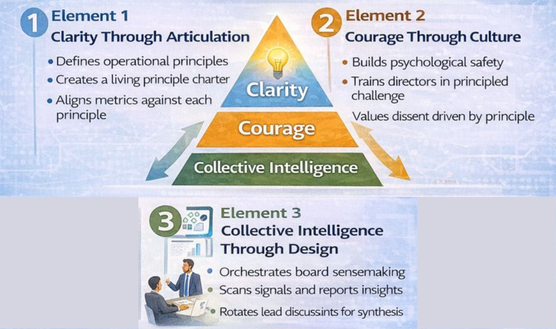
Designing a principle-based board requires three interdependent elements: clarity, courage, and collective intelligence. Clarity anchors judgment. Courage enables dissent. Collective intelligence transforms expertise into foresight. These are not philosophical aspirations. They are design requirements. They must be embedded, not assumed.
Element 1: Clarity Through Articulation
Clarity begins with articulation. Boards must define what principles guide their decisions. These are not slogans. They are operational commitments. A principle may state: we prioritize long-term value over short-term optics. Another: we invest in leadership development as a core risk management strategy. Another: we respond to reputational risks with transparency over protectionism. These are not invented in crisis. They are declared in calm. They are co-developed with directors and executive leadership. And once articulated, they are revisited annually.
A principle charter is a living document. It sits alongside the board charter. It is referenced in meetings. It frames decision rationale. It informs new director onboarding. Its purpose is simple: to make values explicit and decisions coherent. A director facing a controversial vote must be able to ask which principle governs this and find an answer beyond politics.
Shared definition is the next pillar. Principles must be defined operationally. If the board commits to long-term value, what does that mean in capital allocation? If innovation is a principle, what is its measurement? Boards must define thresholds, indicators, and behaviors that exemplify each principle. Otherwise, terms become codewords and disagreements become semantic.
When I led board reporting at a gaming enterprise where I oversaw $100 million in acquisitions and post-merger integration, we established formal audit committee processes grounded in clear principles. One core principle was integration integrity: every acquisition must maintain cultural alignment, financial transparency, and operational continuity throughout integration. We defined operational metrics for each dimension and established decision gates where board input was required if any metric fell below threshold. This principle-based approach prevented reactive crisis management and enabled proactive oversight.
Element 2: Courage Through Culture
A principle is only as powerful as the will to apply it under pressure. Boards must cultivate courage not as confrontation but as readiness. Directors must be willing to surface dissent, challenge leadership, and demand clarity when it is inconvenient. This requires psychological safety. And safety requires culture.
Board chairs are the primary architects of courage. They model transparency. They invite dissent. They thank challenge. They redirect applause toward substance. They ask questions not to validate management but to test conviction. A courageous board is not loud. It is consistent. Its directors raise concerns early. They pursue principle application without seeking conflict. And they unite behind decisions once made because those decisions reflect shared values, not split interests.
Courage also requires training. Scenario rehearsals prepare directors to challenge without antagonizing. Case reviews build pattern recognition. Regular reflection on past decisions including what principle did we apply and what blind spots were present builds judgment muscle. Courage is not an abstract trait. It is a practiced skill.
When I improved month-end close from 17 days to under six days at a cybersecurity firm, the board demonstrated courage by supporting aggressive process transformation despite execution risk. They applied their principle of operational excellence, established clear success metrics, allocated appropriate resources, and provided air cover for the finance team to challenge established workflows. This courage to back principle-driven change despite uncertainty enabled breakthrough performance improvement.
Element 3: Collective Intelligence Through Design
The final foundation is collective intelligence. A board’s value is not the sum of résumés. It is the quality of sensemaking across difference. Collective intelligence emerges when directors connect expertise to strategic foresight not as individual voices but as a cognitive system. This requires trust. It also requires design.
Boards that harness collective intelligence operate with rhythms. They convene pre-meeting synthesis calls. They assign lead discussants per topic. They rotate perspectives. They host structured disagreements. They treat each director not as an approval node but as a pattern detector. They encourage directors to build on each other’s ideas not in serial commentary but in collaborative construction.
Strong boards task committees with scanning including cyber risk, capital markets, and digital innovation and reporting back not just on facts but on signals. Directors learn to listen not only to answers but to absences: what is not being said, where assumptions are fragile, what needs preemptive review. This mindset transforms passive participation into principled inquiry.
From Theory to Practice
A principle, once articulated, only becomes real through action. The principle charter must flow into decision architecture. High-performing boards tag agenda items by principle alignment. They include a short paragraph in pre-read materials: here is how management sees this decision aligning with our principles. During meetings, the chair frames the debate using this lens. Directors respond with clarity: I support this initiative but I believe it weakens our long-term risk posture and that needs to be acknowledged.
Boards that adopt principle charters revisit them annually, especially after major decisions or organizational pivots. They test them against recent events: Did our actions reflect our stated principles? Were they helpful in shaping trade-offs? This feedback loop matures the charter into a governance asset, not just a shelf artifact.
My certifications as a CPA, CMA, and CIA emphasize governance frameworks and organizational effectiveness. But what separates principle-based boards from procedural ones is not technical expertise or compliance rigor. It is the discipline to articulate values explicitly, the courage to apply them under pressure, and the collective intelligence to interpret them collaboratively when faced with novel situations that do not fit established precedents.
Conclusion
Boards that work from principles do not avoid hard decisions. They make them with coherence. They understand their own operating model. They know what matters. And they build the structures to apply that consistently under pressure, over time, and across people. Designing a principle-based board is not a one-time initiative. It is a system of governance. It is a culture of accountability. It is a commitment to making judgment visible, intelligible, and aligned. Clarity becomes the anchor. Courage becomes the norm. Collective intelligence becomes the method.
Disclaimer: This blog is intended for informational purposes only and does not constitute legal, tax, or accounting advice. You should consult your own tax advisor or counsel for advice tailored to your specific situation.
Hindol Datta is a seasoned finance executive with over 25 years of leadership experience across SaaS, cybersecurity, logistics, and digital marketing industries. He has served as CFO and VP of Finance in both public and private companies, leading $120M+ in fundraising and $150M+ in M&A transactions while driving predictive analytics and ERP transformations. Known for blending strategic foresight with operational discipline, he builds high-performing global finance organizations that enable scalable growth and data-driven decision-making.
AI-assisted insights, supplemented by 25 years of finance leadership experience.