



A Practitioner’s Perspective on Finance Leadership in an Era of Perpetual Disruption
The modern CFO role has undergone a fundamental transformation from guardian of cost discipline to strategic architect of enterprise value. This evolution is not merely an expansion of responsibilities but a comprehensive redefinition of how finance leaders contribute to organizational success. Today’s CFO must navigate constant disruption, from pandemic-induced supply chain volatility to AI-driven workflow automation, while simultaneously managing stakeholder expectations around ESG performance, cybersecurity governance, and digital transformation. Recent data confirms this shift: 78 percent of U.S. CFOs now directly engage in digital transformation initiatives, and over 60 percent oversee analytics functions. The most effective CFOs demonstrate three fundamental transitions: from finance-centric thinking to value architecture, from cost orientation to investment orientation, and from control-focused operations to cross-functional collaboration. These strategic leaders leverage data analytics, artificial intelligence, and cloud-based platforms to transform finance organizations from cost centers into drivers of innovation and competitive advantage. The journey requires mastery of both traditional financial stewardship and forward-looking strategic capabilities, balancing fiscal discipline with long-term capability development.
The American business landscape demands a different breed of CFO than existed even a decade ago. The legacy role, anchored in accounting principles and quarterly earnings discipline, has become insufficient in a world where disruption is perpetual rather than episodic. As someone who has navigated this transformation across cybersecurity, SaaS, digital marketing, logistics, and manufacturing sectors, I have witnessed firsthand how the finance function must evolve to remain relevant and impactful.
The New Reality: Disruption as the Baseline
The intensity of change in modern business is relentless. The COVID-19 pandemic upended every assumption about forecasting and supply chain dynamics. Artificial intelligence is rapidly automating finance workflows that once required entire departments. Stakeholders now demand visibility not just into financial health but also into environmental, social, and governance practices. The macroeconomic context has grown increasingly complex, shaped by geopolitical instability, fluctuating inflation, and volatile interest rates.
Within this context, the CFO must evolve from reactive custodian of capital to proactive strategist capable of navigating uncertainty and leveraging disruption for competitive advantage. This is not theoretical. In my work building the multi-entity global finance architecture for a fast-growing cybersecurity company, the traditional playbook of month-end close optimization and compliance management was necessary but far from sufficient. The real value came from designing KPI frameworks that provided real-time visibility into bookings, utilization, backlog, and customer margin, enabling the executive team to make informed decisions at the speed of market change.
Three Fundamental Shifts
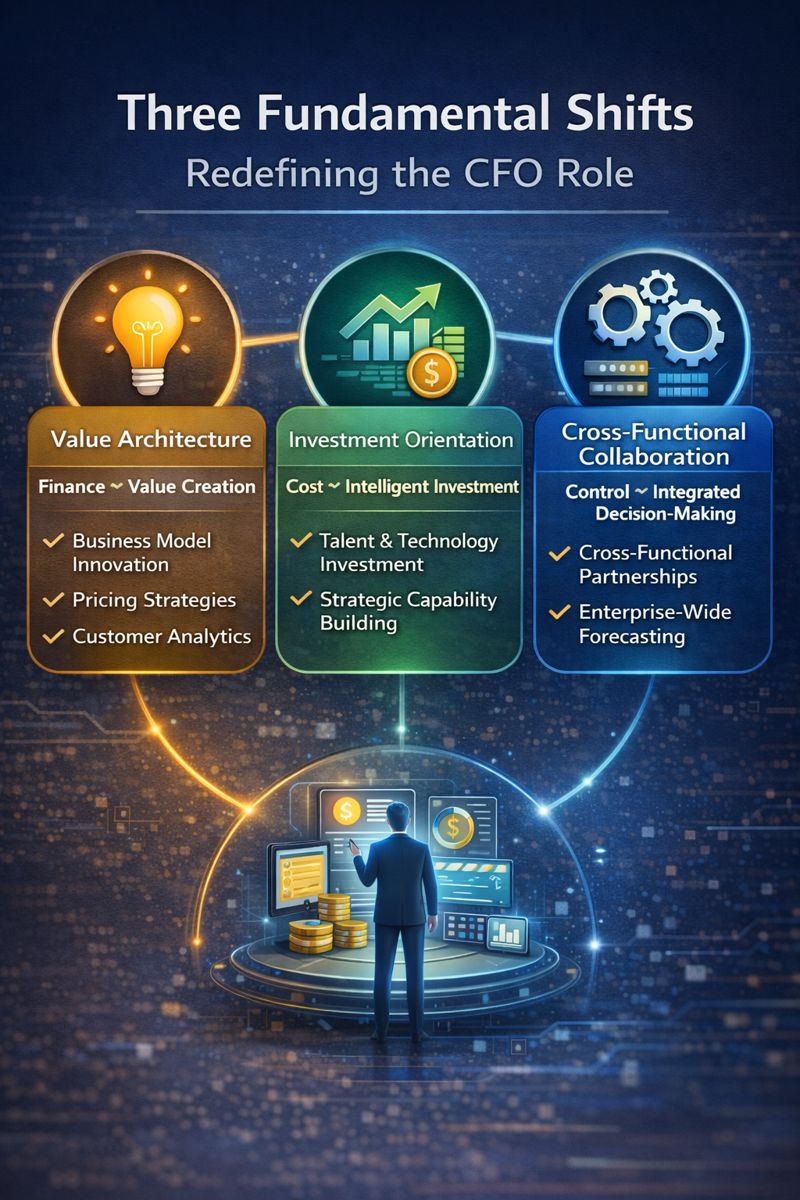
The most effective CFOs today embody three essential transitions that redefine the role. First, there is the shift from finance to value architecture. This requires deep engagement with business model innovation, pricing strategies, customer behavior analytics, and market entry decisions. Understanding how value is created, not merely how it is reported, becomes paramount. During my tenure overseeing a $120M logistics and wholesale organization, the breakthrough came not from perfecting the close process but from overhauling the entire freight and warehouse management approach, reducing logistics cost per unit by 22 percent while simultaneously improving service levels. This required understanding the operational drivers of value at a granular level and architecting financial systems that could inform real-time optimization decisions.
Second, there is the transition from cost orientation to investment orientation. Strategic CFOs no longer reactively slash budgets. Instead, they guide decisions about where to invest in talent, technology, and partnerships, balancing short-term fiscal discipline with long-term capability development. When I led the finance function for a high-growth SaaS company operating across U.S. and EU entities, the critical work was not cutting costs but rebuilding GAAP and IFRS financials to enable VC-grade financial models and cohort analysis. This foundation allowed leadership to make intelligent investment decisions around customer acquisition, product development, and geographic expansion based on actual unit economics rather than intuition.
Third, the CFO must evolve from control to collaboration. This requires fluency across functions and close partnerships with technology, marketing, and operations leaders. The finance office becomes a hub of integrated decision-making rather than a gatekeeper. In scaling a digital marketing platform through FP&A, audit, ad operations, and analytics integration, the most impactful work involved creating pipeline forecasting capabilities that improved revenue predictability across the organization. This was not a finance project; it was an enterprise project that required deep collaboration with sales, marketing, and technology teams.
Data and Technology as Strategic Enablers
The operationalization of this strategic shift hinges on integrating data and technology into the finance function. Modern CFOs must be adept in the languages of analytics, artificial intelligence, and automation. Finance organizations are being reengineered as digital factories that marry traditional accounting with real-time, predictive insights.
Advanced analytics now supports scenario planning that incorporates multitudes of internal and external variables. CFOs can no longer rely solely on historical revenue trends. In implementing NetSuite and OpenAir PSA systems while automating revenue recognition and project accounting, I experienced a 28 percent increase in accuracy. However, the greater value came from the ability to model multiple scenarios simultaneously, stress-testing assumptions about customer churn, pricing elasticity, and cost structure in ways that were previously impossible.
AI and robotic process automation are transforming finance operations. Routine tasks such as closing the books, detecting fraud, and reconciling accounts are increasingly handled by automated systems. When I reduced monthly burn from $800K to $200K for an email marketing SaaS company, the sustainable approach required automation of previously manual processes, freeing the finance team to focus on strategic analysis rather than transaction processing. Deloitte’s 2024 CFO Signals report indicates that 72 percent of finance leaders are either piloting or scaling AI within their core processes, and this trend will only accelerate.
Cloud technology and system interoperability further enhance the CFO’s strategic capacity. Cloud-based platforms allow for real-time visibility across global operations, enabling unified reporting and rapid decision-making. These systems dismantle silos between finance and other functions, fostering an integrated view of performance and risk. In designing multi-entity consolidations across U.S., India, and Nepal operations, the transition from disparate systems to a unified cloud architecture reduced month-end close from 17 days to under 6 days while dramatically improving data quality and accessibility for decision-making.
Organizational Leadership and Stakeholder Engagement
The organizational implications of this shift are profound. The CFO is now central to designing operating models that balance stability with adaptability. This entails leading cross-functional transformation initiatives, serving as connective tissue between capital markets and business units, and reshaping the talent profile of the finance organization.
In practice, this means CFOs are often at the helm of strategy councils, orchestrating enterprise-wide initiatives that span technology adoption, product innovation, and operational reengineering. When I secured $40M in Series B funding and an $8M credit line for an education and nonprofit organization, the work required deep integration with program leadership to translate mission impact into financial narratives that resonated with impact investors. This was not traditional CFO work; it was strategic storytelling grounded in rigorous financial analysis.
CFOs have become the primary translators of strategy into financial narratives. They bridge the gap between investors and internal operators, articulating the financial implications of business strategies in both traditional and non-financial terms. The narrative now includes discussions on ESG performance, digital transformation metrics, and organizational culture. In managing global finance for a cannabis manufacturing operation, navigating complex licensing agreements and compliance audits required not just technical accounting expertise but the ability to communicate risk, opportunity, and strategic positioning to regulators, investors, and internal stakeholders simultaneously.
The finance talent landscape is also being redefined. The traditional preference for accounting expertise is being supplemented by demand for digital literacy, strategic thinking, and business acumen. Modern finance teams include data scientists, business analysts, and technologists. This cultural evolution within finance emphasizes agility, innovation, and cross-disciplinary collaboration. Building enterprise KPI frameworks using business intelligence tools required finance professionals who could speak the language of both accounting and data engineering, bridging worlds that were historically separate.
Governance, Metrics, and Strategic Partnerships
Executing this expanded role requires robust governance, relevant metrics, and strategic partnerships. Governance must extend beyond compliance to embed risk analytics into everyday decision-making. Finance leaders are implementing controls that are proactive, predictive, and aligned with enterprise risk appetites. In establishing SOX compliance and internal controls across multiple organizations, the most valuable approach was not implementing rigid checklists but building risk-aware cultures where finance and operations teams collaborated to identify and mitigate risks in real time.
Metrics are shifting from lagging indicators such as return on investment to leading indicators that provide forward-looking insight. These include customer lifetime value, digital adoption rates, and innovation velocity. When I built client-facing reporting capabilities for a digital marketing company, the transition from historical financial reporting to predictive analytics around customer acquisition costs, lifetime value, and cohort behavior transformed how the organization allocated resources and measured success.
Strategic partnerships further amplify the CFO’s impact. Collaborations with venture capital firms, fintech innovators, and academic institutions enable access to emerging technologies and talent. In driving company scale from $9M to $180M revenue and securing $36.5M in growth capital for a digital marketing platform, the relationships with investors, technology partners, and industry networks proved as valuable as the capital itself, providing external perspectives and capabilities critical in a hyper-competitive environment.
Looking Forward
The American CFO is poised to become even more influential in shaping organizational success. The role requires thinking like a chess grandmaster, anticipating moves and consequences several steps ahead. CFOs must not only safeguard capital but also shape its most productive uses. They must architect the structures, cultures, and capabilities that drive sustainable advantage.
The balance sheet remains a foundational tool, but it is no longer the defining one. In an age characterized by perpetual change and escalating expectations, the CFO who can craft a compelling blueprint for value creation will emerge as a cornerstone of corporate leadership. This requires integrating deep financial expertise with strategic vision, technological fluency with operational insight, and analytical rigor with collaborative leadership.
Conclusion
The modern CFO stands at the center of organizational strategy, translating financial discipline into enterprise-wide impact. No longer confined to reporting and control, today’s CFO shapes how value is created, invested, and sustained. By connecting data, technology, and business insight, they enable smarter decisions, stronger alignment, and long-term advantage. In a world of constant disruption, the CFO’s role is not just to protect value, but to actively build it.
Disclaimer: This blog is intended for informational purposes only and does not constitute legal, tax, or accounting advice. You should consult your own tax advisor or counsel for advice tailored to your specific situation.
Hindol Datta is a seasoned finance executive with over 25 years of leadership experience across SaaS, cybersecurity, logistics, and digital marketing industries. He has served as CFO and VP of Finance in both public and private companies, leading $120M+ in fundraising and $150M+ in M&A transactions while driving predictive analytics and ERP transformations. Known for blending strategic foresight with operational discipline, he builds high-performing global finance organizations that enable scalable growth and data-driven decision-making.
AI-assisted insights, supplemented by 25 years of finance leadership experience.