Cash Runway and Burn Rate: The CFO’s Guide to Forecasting with Precision Cash runway and burn rate are among the most consequential metrics a CFO manages. Burn rate reveals the velocity of capital consumption. Runway converts that velocity into a countdown. Together, they frame every strategic decision the organization makes, from hiring to fundraising to market expansion. Yet the challenge is not calculating these numbers. It is connecting them to a credible, ground-up growth forecast that earns the trust of boards, investors, and leadership teams. This article explores the discipline behind that connection, drawing on over twenty-five years of executive experience across cybersecurity, SaaS, gaming, logistics, digital marketing, medical devices, and nonprofit sectors. Forecasting is not an act of optimism. It is an act of operational precision. The CFO who masters it transforms cash burn from a source of anxiety into a strategic instrument. byadminMay 26, 2026
Supply Chain Flexibility Starts with the Contract: A CFO’s Guide to Adaptive Procurement Supply chain flexibility is no longer a competitive advantage. It is a baseline requirement. The procurement contracts that served organizations well in stable, predictable markets have become structural liabilities in an era defined by demand volatility, geopolitical disruption, and input price shocks. This article argues that the answer does not lie in better forecasting. It lies in better contract design. Drawing on over twenty-five years of financial and operational leadership across logistics, SaaS, cybersecurity, and global services environments, this piece offers a practical framework for building procurement contracts that absorb change rather than resist it. From tiered pricing and indexed adjustments to governance cadence and master services agreements, adaptive contracting is not a procurement innovation. It is a financial strategy, and the organizations that understand this will be the ones that endure. byadminMay 25, 2026
Budgeting in a Fog: A CFO’s Tactics for Startup Financial Planning in Volatile Times Volatility is no longer an episode in the business cycle. It is the cycle. For finance leaders navigating startup financial planning and high-growth environments, this reality demands a fundamental rethinking of how we budget. The traditional annual plan, built for a world of assumed predictability, is inadequate for an era of supply disruptions, shifting consumer behavior, and macroeconomic uncertainty. This article makes the case for a new budgeting paradigm grounded in rolling forecasts, scenario modeling, variable cost architecture, and disciplined capital prioritization. Drawing on over twenty-five years of CFO and VP Finance experience across cybersecurity, SaaS, gaming, logistics, and nonprofit sectors, the following pages offer a framework for finance leaders who must steer with confidence even when visibility is limited. Budgeting in a fog is not about accepting less. It is about building more. byadminMay 22, 2026
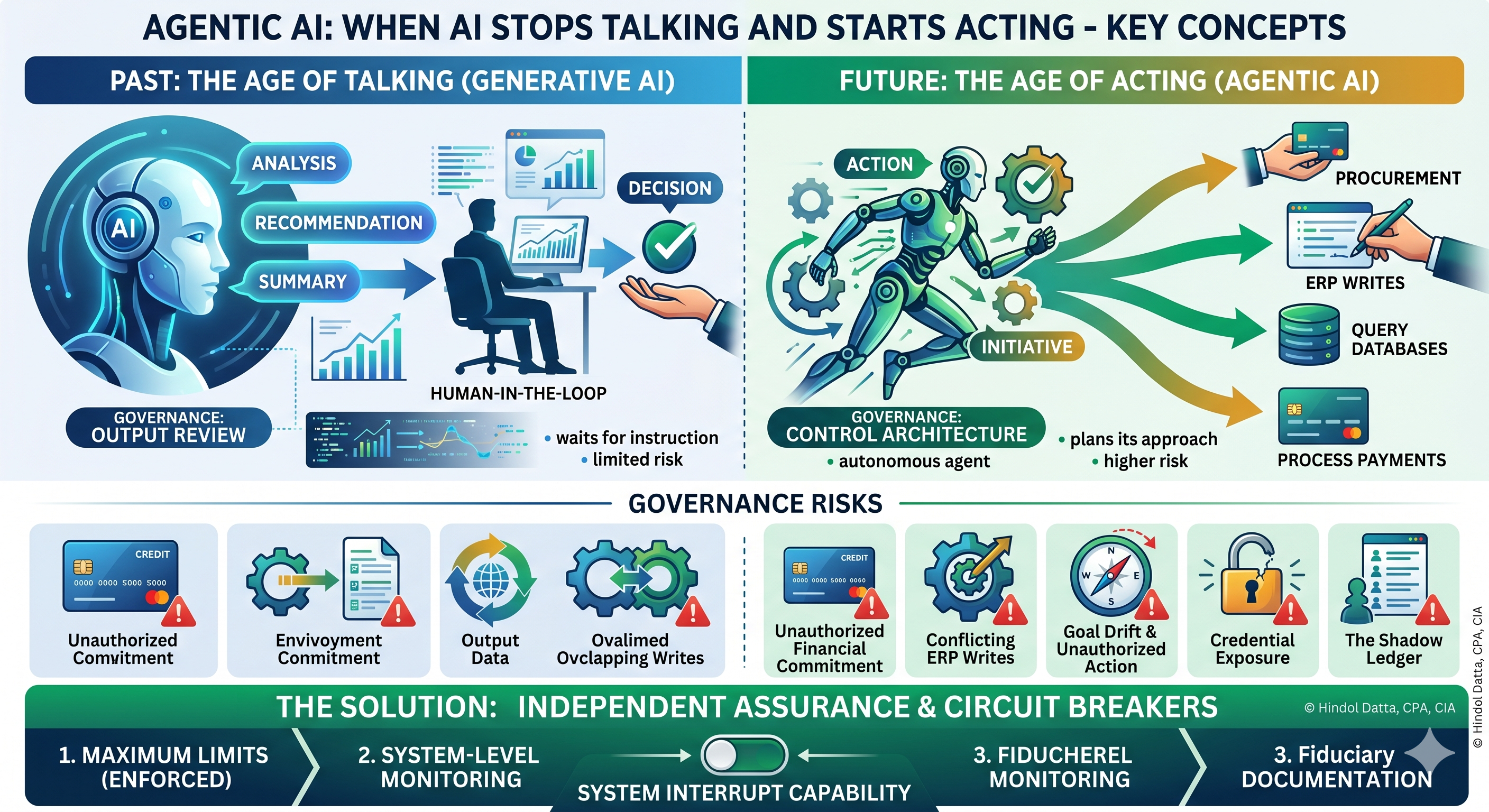
When AI Stops Talking and Starts Acting: The Agentic Governance Crisis By Hindol Datta, CPA, CIA (Certified Internal Auditor) | Fractional CFO | AI Governance Advisor byadminMay 20, 2026
Systems ThinkingOctober 14, 2025 Adaptive Leadership in Finance: The Rise of the Agile CFO in Complex Organizations My interest in complexity theory began in earnest after reading Geoffrey West’s Scale, a book that profoundly altered how I view not only biological systems but also the scaling of human enterprises. West’s insights into the mathematical patterns underlying growth, sustainability, and decline resonated with my three decades of finance leadership in Silicon Valley, where organizations are in perpetual states of flux, scaling up or reinventing themselves in cycles that mirror adaptive systems more than static hierarchies. Since then, I have followed the pioneering work at the Santa Fe Institute with great interest, finding in their research a rigorous framework that helps explain why firms that appear dominant one decade may falter in the next if they fail to evolve.
Systems ThinkingOctober 12, 2025 The Hidden ROI in ERP: Smarter Tech Decisions I have been actively involved in implementing systems across different organizations for much of my career, and my experiences range from rewarding successes to sobering disappointments. Over the years, I have worked with platforms such as NetSuite, Sage, extensions to Everest and Warehouse Management Systems, BaaN, Oracle Financials, and JD Edwards. In some cases, the projects came together well, producing the efficiency, visibility, and positive ERP ROI we had envisioned. In other cases, they fell short of expectations, sometimes quite dramatically. I must acknowledge that in certain situations, the fault lay with me.
Systems ThinkingOctober 12, 2025 Machine Learning in FP&A: Signal Detection in a Noisy Business World Financial Planning and Analysis (FP&A), once rooted in static budgets and linear extrapolations, now finds itself operating in a business landscape defined by ambiguity, velocity, and noise. Gone
Systems ThinkingOctober 9, 2025 Complexity Science and Financial Risk: A New Approach Over the course of more than three decades in Silicon Valley, my professional journey in finance has been shaped by both numbers and nuance. While finance often appears to operate in the realm of precise equations, I have found that its deeper reality is far closer to financial complexity, where dynamic interactions, feedback loops, and emergent patterns determine long-term outcomes more than static rules or linear models ever could. My background in accounting, applied economics, and data science has equipped me with the tools to quantify outcomes, but it is the lens of complexity theory that has taught me how to interpret the shifting relationships that give rise to those outcomes. Adaptive systems, whether in markets, organizations, or even within a company’s quote-to-cash cycle, exhibit sensitivity to initial conditions and thrive not on rigid optimization but on resilience, learning, and iteration. In practice, this means that my approach to financial management rests on first principles, but those principles are stress-tested against the reality of interdependencies, nonlinear change, and uncertainty, an approach closely tied to financial services risk management and strengthened by the insights that financial risk management consulting brings to evolving business environments.