Cash Runway and Burn Rate: The CFO’s Guide to Forecasting with Precision Cash runway and burn rate are among the most consequential metrics a CFO manages. Burn rate reveals the velocity of capital consumption. Runway converts that velocity into a countdown. Together, they frame every strategic decision the organization makes, from hiring to fundraising to market expansion. Yet the challenge is not calculating these numbers. It is connecting them to a credible, ground-up growth forecast that earns the trust of boards, investors, and leadership teams. This article explores the discipline behind that connection, drawing on over twenty-five years of executive experience across cybersecurity, SaaS, gaming, logistics, digital marketing, medical devices, and nonprofit sectors. Forecasting is not an act of optimism. It is an act of operational precision. The CFO who masters it transforms cash burn from a source of anxiety into a strategic instrument. byadminMay 26, 2026
Supply Chain Flexibility Starts with the Contract: A CFO’s Guide to Adaptive Procurement Supply chain flexibility is no longer a competitive advantage. It is a baseline requirement. The procurement contracts that served organizations well in stable, predictable markets have become structural liabilities in an era defined by demand volatility, geopolitical disruption, and input price shocks. This article argues that the answer does not lie in better forecasting. It lies in better contract design. Drawing on over twenty-five years of financial and operational leadership across logistics, SaaS, cybersecurity, and global services environments, this piece offers a practical framework for building procurement contracts that absorb change rather than resist it. From tiered pricing and indexed adjustments to governance cadence and master services agreements, adaptive contracting is not a procurement innovation. It is a financial strategy, and the organizations that understand this will be the ones that endure. byadminMay 25, 2026
Budgeting in a Fog: A CFO’s Tactics for Startup Financial Planning in Volatile Times Volatility is no longer an episode in the business cycle. It is the cycle. For finance leaders navigating startup financial planning and high-growth environments, this reality demands a fundamental rethinking of how we budget. The traditional annual plan, built for a world of assumed predictability, is inadequate for an era of supply disruptions, shifting consumer behavior, and macroeconomic uncertainty. This article makes the case for a new budgeting paradigm grounded in rolling forecasts, scenario modeling, variable cost architecture, and disciplined capital prioritization. Drawing on over twenty-five years of CFO and VP Finance experience across cybersecurity, SaaS, gaming, logistics, and nonprofit sectors, the following pages offer a framework for finance leaders who must steer with confidence even when visibility is limited. Budgeting in a fog is not about accepting less. It is about building more. byadminMay 22, 2026
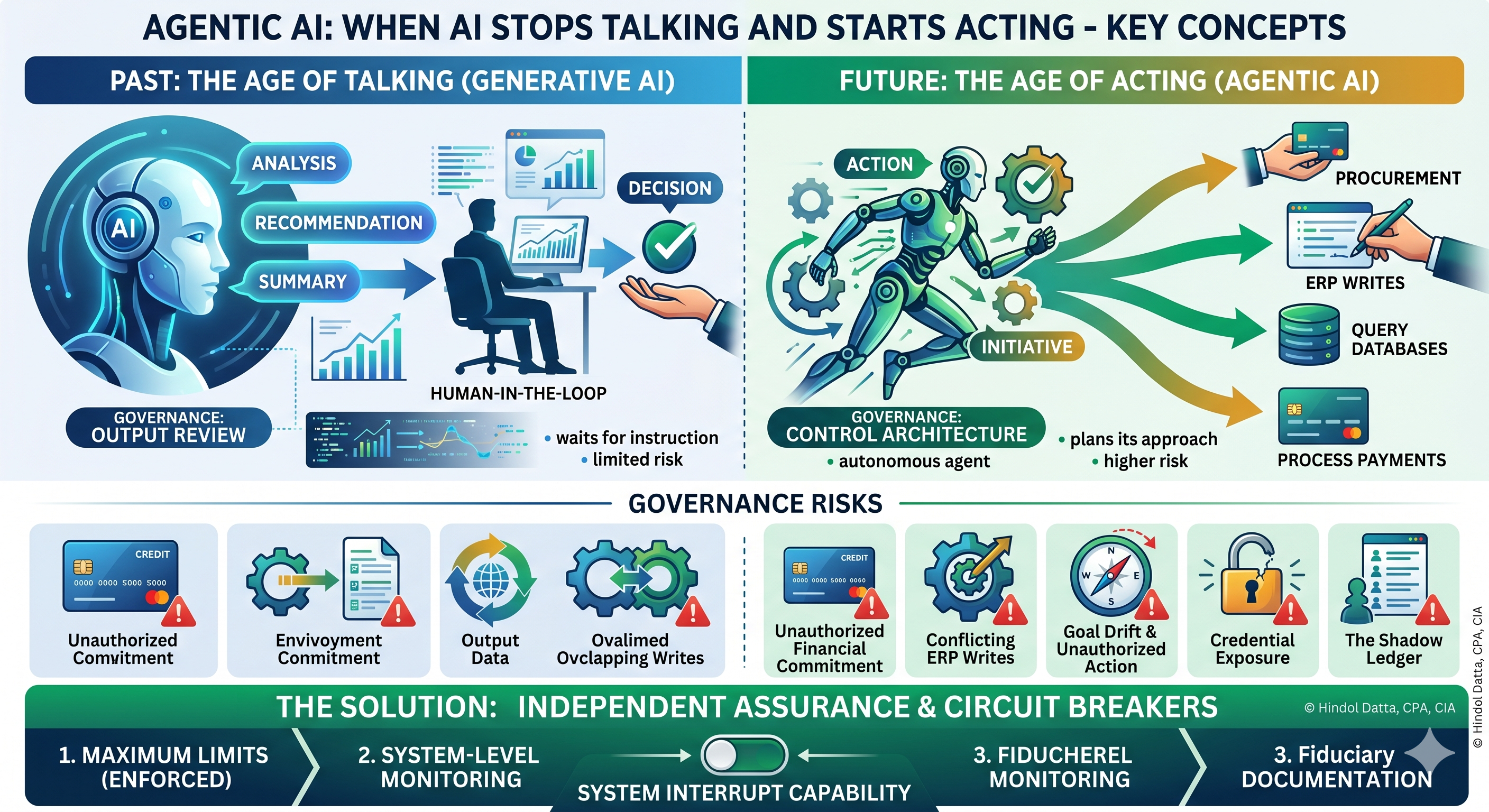
When AI Stops Talking and Starts Acting: The Agentic Governance Crisis By Hindol Datta, CPA, CIA (Certified Internal Auditor) | Fractional CFO | AI Governance Advisor byadminMay 20, 2026
Systems ThinkingDecember 22, 2025 Transforming Procurement: The Rise of Intelligent Systems Executive Summary
Systems ThinkingDecember 19, 2025 When Tech Meets Process: Post-M&A Systems Integration as a Strategic Weapon Executive Summary
Systems ThinkingOctober 14, 2025 CFOs as Decision Intelligence Leaders “In the business world, the rearview mirror is always clearer than the windshield.” – Warren Buffett
Systems ThinkingOctober 14, 2025 Mastering Strategic Optionality: CFOs Navigate Uncertainty Plans rarely survive contact with reality. As Eisenhower said, it’s planning, not the plan, that builds resilience. For CFOs, the goal isn’t predicting the future; it’s preparing the organization to navigate it. That preparation comes from exploring strategic options, building adaptable CFO strategies, and strengthening financial planning to ensure the business can adjust no matter what the future holds.
Systems ThinkingOctober 14, 2025 Leading from the Front: How CFOs Use First Principles Thinking to Drive Value In times of change and uncertainty, the most important quality for a CFO isn’t just technical skill. It’s clarity of thought. And the best tool for clear thinking? First principles thinking. First principles problem solving means breaking problems down to their most basic truths and building solutions from scratch, not copying what others do. Instead of asking, “How have others done it?” ask, “What is absolutely true here, and what follows logically?” For CFOs, this approach helps define value creation, clarify trade-offs, navigate uncertainty, and deploy capital wisely. It is a critical component of CFO strategy and underscores the CFO’s role in strategic planning. What is first principles thinking in practice? Here’s how it works:
Systems ThinkingOctober 14, 2025 Why CFOs Should Read Chaos Theory: Finding Hidden Patterns in Business Risk “Chaos is not disorder; it’s order we don’t yet understand.”
Systems ThinkingOctober 14, 2025 Merge or Submerge: Why Complexity Theory Should Guide Post-Merger Strategy “The whole is more than the sum of its parts – unless entropy is your co-pilot.”
Systems ThinkingOctober 14, 2025 The Art of the Deal Starts with Data: M&A in the Age of Machine Intelligence Mergers and acquisitions have always been seen as a mix of instinct, relationships, and financial modeling. In the past, a banker’s pitch and a few well-placed assumptions often carried the day. But today, that playbook is outdated. The most successful deals are now shaped by data, not just persuasion.
Systems ThinkingOctober 14, 2025 Digital CFO 2.0: Architecting the Infrastructure of the Future Enterprise The CFO’s role has gone through one of the biggest transformations in modern business. Once defined by reporting, reconciling, and controlling, the finance office was mostly about compliance and historical accuracy. Decisions were driven by quarterly cycles and backward-looking numbers.
Systems ThinkingOctober 14, 2025 Forecasting with GenAI: Speed and Accuracy for CFOs In the traditional finance playbook, forecasting has long been the heart of strategic planning. It is where the story of the enterprise unfolds in numbers. But as the pace of change accelerates and uncertainty becomes the norm, forecasting has evolved from a quarterly ritual to a real-time strategic capability. Now, with the arrival of generative intelligence, the modern CFO has a new kind of engine, one that is faster, adaptive, contextual, and narrative-ready. This is not simply automation. It is an augmentation. Generative AI does not just speed up CFO prediction cycles. It brings a structural shift in how data, models, and context come together. The promise is compelling: financial modeling forecasting that delivers a stronger financial forecast model, more accurate results, faster insights, and embedded explainability that executives and boards can act on, showcasing the true impact of AI in finance.