




Executive Summary
There is a peculiar hush that descends on a company when decline begins. It arrives not with fanfare but in the pause before a meeting, in the halfway smiled “morning” across the open plan floor, in the dashboard’s insistent flattening day after day. Throughout thirty years leading finance and operations across SaaS, digital marketing, gaming, and education nonprofits, I have witnessed that hush settle over organizations. I remember sitting in a senior leadership retreat when we were three months into lagging sales, margins were vaporizing, and the pause in conversation was brittle. In that moment, I realized that leadership messaging during decline is more than public relations. It becomes the lifeline that connects people to purpose. The act of saying the unsaid. Growth stirs hope. Decline stirs doubt. And in times of doubt everyone seeks direction, looking to leadership not for promises but for presence.
The Quiet Accumulation of Decline
Decline is accumulative and seldom sudden. A missed quarterly target here, slight budget cuts there, recruitment paused, promotions frozen. In the economics of organizational behavior these small signals add up. The aggregate expectation of resources, support, and opportunity falls.
When internal conditions deteriorate people adjust their expectations. They conserve effort. They spend discretionary energy cautiously. They stop volunteering bold ideas. This is the economics of morale: the internal supply and demand of effort in relation to trust.
At a digital marketing organization that scaled from nine million to one hundred eighty million in revenue, I witnessed how recruitment slows when people stop believing. That sentiment sapped leadership energy without anyone admitting defeat.
Truth and the Philosophy of Responsibility
Hannah Arendt once wrote that to understand your humanity, you must speak the truth in public. She was referring to politics, but the principle applies in organizations too. In times of decline, the very act of speaking the truth becomes an embodied representation of responsibility.
Economics teaches us that information asymmetry reduces trust. When leaders conceal or delay bad news, they create a vacuum that whispers worst-case scenarios louder than any announcement.
I recall an executive team whose logistics measurement system had failed, causing a fifteen percent shortfall in delivery efficiency that rippled into client complaints. For two weeks, the leadership debated how to announce it. The longer they waited the more rumors took root: rumors of layoffs, bankruptcy, hostile takeovers.
Eventually someone sent a Friday evening note: “We are facing challenges in our system. We do not yet know the full impact and are working on it.” Landing this truth that evening, imperfect though it was, calmed the tents. Rumor lost its oxygen. The philosophy of transparency had won out.
When Decline Becomes Defining
Our lives are stories with central characters acting against the backdrop of circumstance. But stories can falter when the stakes grow. A decline can feel like betrayal to people who have invested time, skill, and emotion in the narrative. The moral contract is breached when promises of growth, opportunity, and meaning recede.
At one education nonprofit where I secured forty million in Series B funding, intermittent funding cuts removed parts of the promise we had sold. There was grief then, real grief, even as we kept showing up. I learned that decline is not just a business condition but an existential one, demanding more than plans but compassion.
Four Principles of Leadership Messaging in Decline
As decline deepens, messaging becomes a structural function of leadership. It is not marketing but architecture that shapes the foundations of trust. Building trust in decline demands mastering four principles:
- Truth Without Overwhelm: Saying what is real and relevant, but not everything possible. Resisting the urge to unpack every data anomaly while giving enough context for people to understand decisions. Selective transparency signals competence, not cowardice.
- Ownership Without Blame: Leaders owning the decline without scapegoating. Saying we missed the market shift, we underestimated morale, we did not anticipate constraints. Sincere words of “I was wrong” carry more weight than stylish PowerPoint decks.
- Clarity Without Certainty: Acknowledging unknowns while charting as much course as possible. Humans do better with a horizon than blank space. Committing to updates every two weeks, sharing response plans, and conducting listening sessions makes the unknown navigable.
- Bonds Over Broadcast: Making communication relational. Not broadcast schedules but check-ins with managers. Not shiny town halls but raw conversations where questions are welcomed honestly.
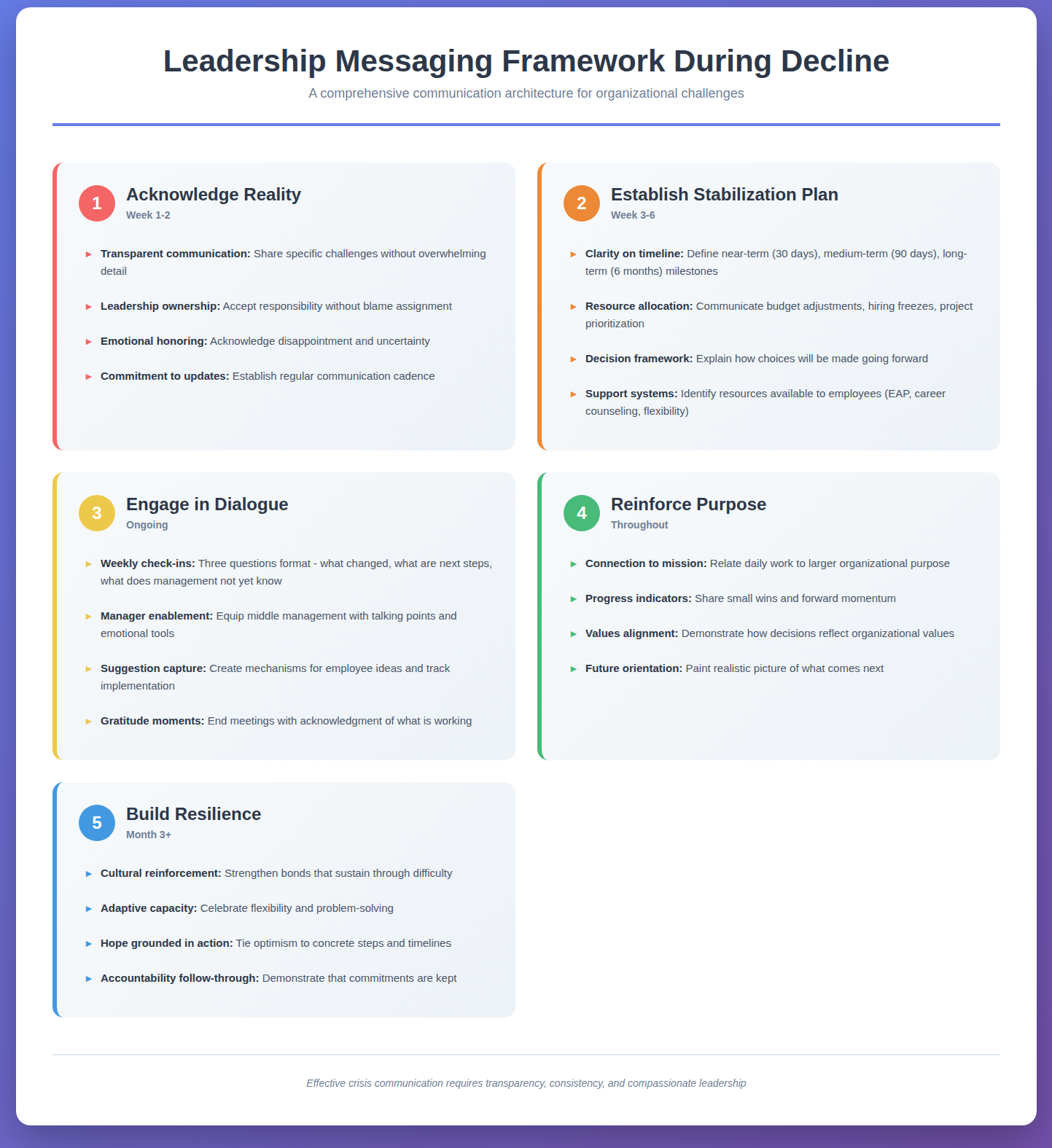
Leadership Messaging Framework During Decline
The following framework maps the communication architecture required during organizational decline:
A Personal Account of Leading Through Decline
Let me tell you how I stumbled into these lessons. At one point I was leading a small consultancy with a strong pipeline and collegial culture. Then a major client canceled mid-year. Another slowed payments. A failed bid. A partner left. Within a quarter the seriousness of the downturn hit me.
I could feel it in the waiting emails, the unreturned phone calls, the prospects seeking discounts. The silence became a mirror to my own disillusion. I panicked inside, but knew my team was watching. They needed orientation, not panic.
I began drafting a message for a Thursday morning meeting. I wrote about what we still had: loyal clients, talented people, a vision that mattered. Then the realities. We had three months of runway. We had to protect payroll. We might renegotiate deals. We would be leaner.
I stopped before launching into contingency scenarios. My aim was to ground them, not bury them. At the meeting I spoke slowly. I paused. I said I was not happy about it, but grateful for their skill, care, and faith. I said we would get back into growth. And the hard truth: if the moons did not align we would shrink.
We ended in quiet. Not applause. Just silence. But we now shared a common compass.
The Power of Structured Dialogue
In the weeks that followed we held weekly check-ins with three questions:
- What had changed since last week?
- What were our next steps?
- What did we need that management did not yet know?
People opened up. They talked about worry and pride. We let them describe what still worked while we fixed what faltered. We listened as much as we spoke.
By spring we had stabilized. Not everything was normal. But we had survived decline with morale intact, and had reclaimed nobility in practice.
The Economic Roots of Morale
In economics early returns on effort are steep; the first tasks deliver the greatest hope. But after that marginal utility flattens. If effort does not yield outcome, future motivation declines.
People will work harder when they feel contribution is valued and visible. When decline begins to erode outcome, messaging must amplify value not volume. It must connect daily work to purpose larger than the quarter. It must signal that labor remains meaningful even when payoff has stalled.
At a logistics organization managing one hundred twenty million in revenue, when market conditions deteriorated we shifted recognition from volume metrics to quality and innovation metrics, preserving morale by validating contributions that decline had not diminished.
The Philosophical Lens of Human Work
Simone Weil wrote about affliction and the strength found in attention. In decline there is affliction, the suffering of lost progress. But Weil reminded us that attention to truth, to clarity, to real work, if done honestly, is redemptive.
Leadership messaging rooted in clarity invites people to attend to their work differently. It says: I will not shield you from the struggle. I will walk it alongside you.
In that consultancy winter I walked with my team. We updated them, asked for ideas, delegated responsibly out of trust. They responded by diagnosing overhead inefficiencies, proposing new initiatives, reaching out to dormant contacts. These were born of trust, not order.
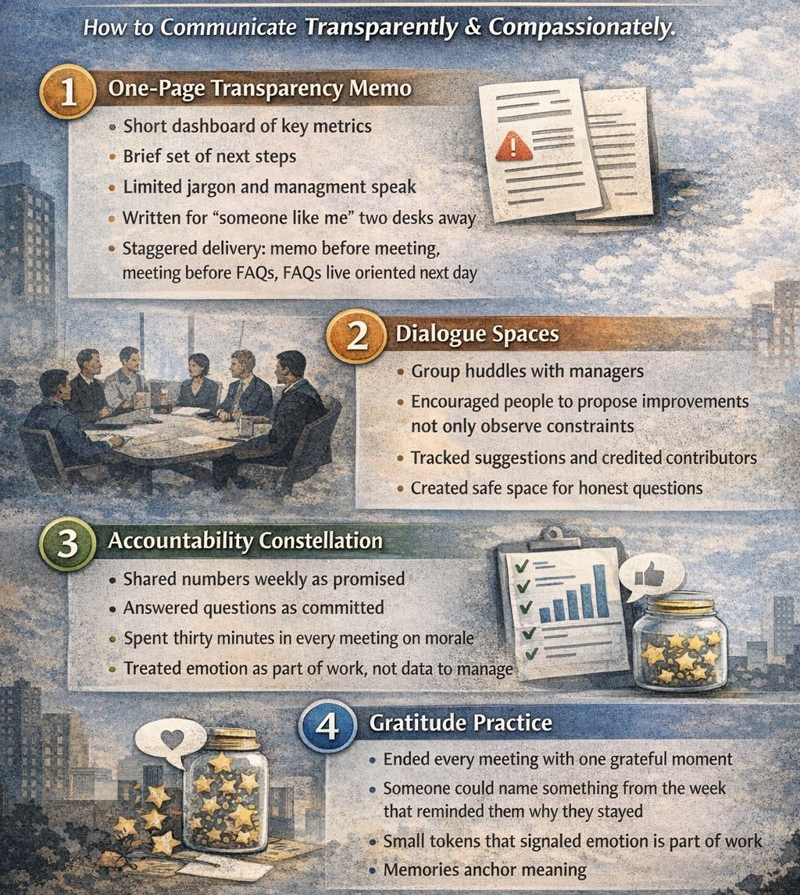
The Mechanics of Effective Messaging
Leading With a Moral Economy
Decline reminds us we work in a moral economy of promises and trust. Adam Smith wrote of moral sentiments as motivational force. In organizations trust is the currency. Leadership messaging is the exchange.
Trust is earned when truth is spoken even when it costs, when follow-through matches words, when leaders show vulnerability.
I once sat across from a reluctant CEO who paused a quarterly memo for fear of losing face. I told him the only face he could lose was the silent one. He shared. In doing so he regained credibility by giving his people clarity.
Hope That Is Honest
There is hope in decline, but it must be honest. Optimism punctuated with data. Courage tempered with humility. Vision scaled to near horizon and structured in steps.
I heard a leader speak in an all hands. Instead of promising million dollar rebounds, he said the next four weeks were about stabilization and listening. Ninety days for new proposals. Six months for relaunch. Then: if we keep our word, I think people will follow.
That kind of pacing brings hope from suspicion. It writes a timetable people can move with.
The Role of Boards and External Partners
In decline people look outside too. They ask investors, board members, advisors: what are you seeing, what are you thinking? Leadership messaging must acknowledge those voices by saying our board has supported us, we are mindful of runway, we have asked for support and provided transparency. That shows structure and managed oversight, not chaos.
Culture Without Illusions
Messaging must remind people that culture is a resource like any other. It can be depleted by decline or fortified by attention. The most human companies bring their soul when they have lost their shine. They tell the truth about who they are: flawed, aspirational, present in the struggle. That is culture lived not marketed.
Conclusion
Decline will test your plans, your people, your heart, and your voice. Leadership messaging in decline is the instrument of connection between what has been lost and what might be rediscovered. When decline shakes our foundations, we do not salvage what was but decide what will come next. We anchor on truth, build bridges of trust, and lead with a moral compass. Decline is not an inevitable detour but a pivotal point of choice. And it is in our words, our clarity when we speak and act in decline that future hope finds purchase. The pause that reveals the turn is not an ending but an invitation to lead with presence, honesty, and humanity.
Disclaimer: This blog is intended for informational purposes only and does not constitute legal, tax, or accounting advice. You should consult your own tax advisor or counsel for advice tailored to your specific situation.
Hindol Datta is a seasoned finance executive with over 25 years of leadership experience across SaaS, cybersecurity, logistics, and digital marketing industries. He has served as CFO and VP of Finance in both public and private companies, leading $120M+ in fundraising and $150M+ in M&A transactions while driving predictive analytics and ERP transformations. Known for blending strategic foresight with operational discipline, he builds high-performing global finance organizations that enable scalable growth and data-driven decision-making.
AI-assisted insights, supplemented by 25 years of finance leadership experience.