



Executive Summary
If there is one thing that separates the good companies from the enduring ones, it is not their current valuation, margin structure, or even their access to capital. It is their ability to build leaders from within. And in the finance function, so often seen as the most technical and least teachable of domains, this internal bench-building becomes not just a matter of succession but of strategy. Throughout my twenty-five years leading finance across cybersecurity, SaaS, manufacturing, logistics, and gaming, I have learned that most companies think of finance succession planning as a contingency, a checkbox on the board’s talent agenda or an exercise prompted by a sudden resignation. But in companies that scale intelligently, the building of future CFOs is not reactive. It is deliberate. It is woven into how the finance team is structured, how roles are assigned, and how insight is distributed. Because developing a future CFO is not about exposure to accounting complexity. It is about developing judgment, and judgment takes time.
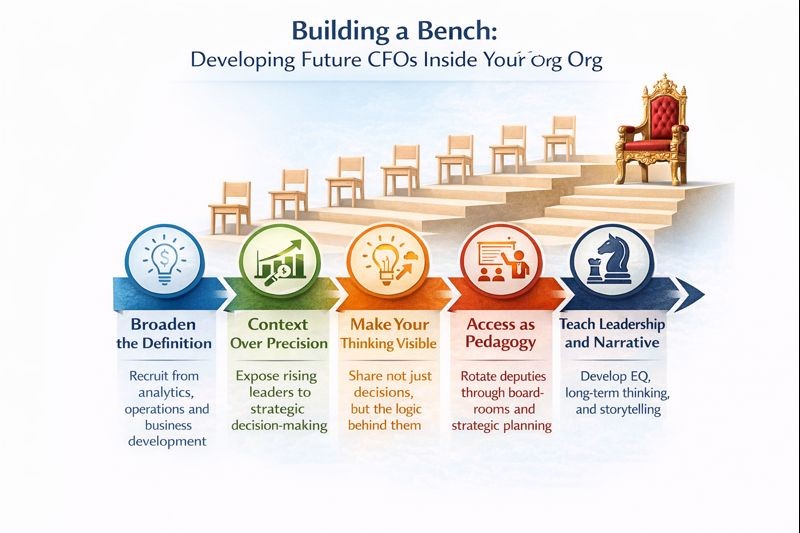
Broadening the Definition
There is a fundamental truth every current CFO must accept before mentoring others: the next generation will not look like you. They will not have followed your exact path. Some may come up through financial planning and analysis rather than audit. Others through business operations or corporate development. And increasingly, some of the most promising leaders might have started in data science or product analytics. The finance function is no longer a single lane. It is a highway. And if you are serious about building a bench, you must first broaden your definition of what qualifies as CFO material.
When I built enterprise KPI frameworks using MicroStrategy, Domo, and Power BI tracking bookings, utilization, backlog, annual recurring revenue, pipeline health, customer margin, and retention, some of my best future leaders came from analytics backgrounds, not traditional accounting. They understood how to translate data into decisions, which is increasingly the core competency of modern finance leadership.
Context Over Precision
The best way to develop CFOs is to give them context early. This means letting rising talent see how decisions are made, not just how numbers are reconciled. Too many finance professionals get stuck in precision without perspective. They can explain a variance down to the penny but cannot frame why it matters strategically. If your team only knows how to close books and produce dashboards, you are not building a bench. You are building a bottleneck.
What separates a controller from a CFO is not their mastery of systems but their ability to think in trade-offs. Can they evaluate a product investment against its capital cost? Can they model downside risk while maintaining upside flexibility? Can they interpret how a change in customer behavior might ripple through gross margin three quarters from now? These are not just skills. They are modes of thinking. And they must be taught by example, not just instruction.
When I improved month-end close from 17 days to under six days at a cybersecurity firm, I involved the entire finance team in understanding not just the process improvement but the strategic value. Why did speed matter? Because it gave us decision-making advantage. That context transformed how the team viewed their work, from compliance function to competitive capability.
Making Your Thinking Visible
To build a future CFO, you must make your thinking visible. Do not just tell your deputies what decision you made. Walk them through how you made it. Why this structure, not that one? Why equity here and debt there? Why defer this hire but greenlight that tool? The point is not to showcase brilliance. It is to build intuition. Great finance leaders are pattern recognizers. But those patterns only form when someone explains the layers beneath the answer.
When I secured $40 million in Series B funding and an $8 million credit line at a nonprofit organization, I brought my entire leadership team through the capital structure decision process. We modeled debt versus equity trade-offs, discussed covenant flexibility, and analyzed dilution scenarios together. That exposure prepared them for future capital decisions they would eventually own.
And this does not happen in quarterly town halls. It happens in the side conversations, the working sessions, the moments where ambiguity arises. That is where future CFOs are made, not in the accuracy of a budget but in how they respond when the budget is wrong. Judgment is forged in uncertainty. If your team only works in clarity, they will never develop the muscle to lead.
Access as Pedagogy
Equally important is access. If your head of financial planning and analysis never sees the board deck until it is final, you are limiting their development. If your controller never joins strategic planning meetings, you are boxing them into compliance. Exposure is not a perk. It is pedagogy. Future CFOs must learn to read a room, manage stakeholder dynamics, and translate across departments. These skills are not innate. They are earned through repetition and proximity.
When I led board reporting at a gaming enterprise where I oversaw $100 million in acquisitions and post-merger integration, I rotated different finance leaders through board presentation responsibilities. One quarter, the FP&A director presented growth projections. The next, the controller explained internal controls enhancements. That exposure built confidence and capability across the team.
This is especially true in high-growth or private equity-backed companies, where the speed of change can overwhelm even the best operators. In those environments, future CFOs need not just finance fluency but operating stamina. They need to understand how to keep the plane flying while replacing parts of the engine. If you are grooming someone for the seat, let them feel the turbulence. Give them projects where success is defined by clarity under pressure, not just technical accuracy.
Leading People, Not Just Numbers
One of the most overlooked parts of developing CFOs is teaching them how to lead people. Technical professionals often rise because of individual brilliance. But CFOs succeed by building teams that can run without them. If your successor has never led a performance review, mentored a struggling analyst, or managed cross-functional conflict, they are not ready, regardless of how sharp they are in Excel. Emotional intelligence and operational empathy matter. The best CFOs are not just financially literate. They are organizationally literate.
When I managed global finance for a $120 million logistics organization, I deliberately gave rising leaders responsibility for difficult people situations, not just technical projects. Managing a performance improvement plan, resolving cross-functional disputes, and coaching struggling team members built leadership capacity that no technical training could provide.
Teaching the Long View and the Narrative
There is also the matter of time horizon. Many aspiring CFOs think quarter to quarter because that is how they are trained. But a real CFO thinks in arcs including capital arcs, customer arcs, and talent arcs. Teaching this requires a subtle shift in coaching. Do not just ask your team what is the next number. Ask them what does this trend imply if it holds, and what if it does not. This is how you move them from reporters of data to interpreters of the business.
And perhaps most critically, future CFOs must learn to tell the story. Numbers are necessary, but narrative is what moves stakeholders. When I rebuilt GAAP and IFRS financials for a high-growth SaaS company and designed cohort analysis frameworks, I taught the team not just how to calculate metrics but how to explain what they meant. Can your VP of Finance explain the unit economics not just in terms of customer acquisition cost and lifetime value but in terms of how the customer is evolving and how that affects lifetime margin? If not, you have a storyteller gap. And in modern finance, that is a leadership gap.
Responding to Ambition
This is not to say everyone on your team wants the CFO job. Nor should they. But you will know the ones who do. They ask better questions. They care about more than their silo. They think in systems, not tasks. Your job is not to create ambition. It is to respond to it. When you see it, invest in it. That means stretch roles, temporary deputizations, shadowing opportunities, and real feedback. Not just performance reviews but truth. Tell them what they are not seeing. Tell them how they come across in a room. Tell them when they are too cautious or too scattered or too reactive. Do it with care, but do it.
My certifications as a CPA, CMA, and CIA provide technical credibility. But what prepared me for CFO roles was leaders who invested in my development, gave me exposure beyond my job description, and provided honest feedback that shaped my judgment.
Conclusion
Of course, building a bench takes capacity. And some CFOs argue they are too busy. That is a failure of priorities. If you are not developing your bench, you are deferring risk. True succession is not cloning yourself. It is planting the seeds of capability in others and watching how they grow. Each will interpret the role differently. That is healthy. The finance function, like the company itself, needs diversity of thought. There is a quiet reward in this work. When you sit in a room and hear someone you mentored articulate a difficult trade-off with confidence and nuance, you feel something better than pride. You feel continuity. And in business, continuity is the real compounding engine. In the end, your legacy will not be the budget you optimized or the cost you cut. It will be the leaders you shaped.
Disclaimer: This blog is intended for informational purposes only and does not constitute legal, tax, or accounting advice. You should consult your own tax advisor or counsel for advice tailored to your specific situation.
Hindol Datta is a seasoned finance executive with over 25 years of leadership experience across SaaS, cybersecurity, logistics, and digital marketing industries. He has served as CFO and VP of Finance in both public and private companies, leading $120M+ in fundraising and $150M+ in M&A transactions while driving predictive analytics and ERP transformations. Known for blending strategic foresight with operational discipline, he builds high-performing global finance organizations that enable scalable growth and data-driven decision-making.
AI-assisted insights, supplemented by 25 years of finance leadership experience.