


Executive Summary
The authority of a board, CEO, or CFO is matched only by its vulnerability. Legal liability spanning civil, regulatory, and criminal domains casts a shadow across every strategic decision, public statement, and control failure. In an environment of heightened regulatory scrutiny, activist enforcement, and stakeholder expectation, understanding the liability landscape is no longer a legal function but a strategic imperative. At the core lies fiduciary duty: directors owe care and loyalty to the corporation and shareholders, while CEOs and CFOs, as operational fiduciaries, bear personal consequences for breaches through negligence, recklessness, or concealment. The liability structure is layered, from federal securities law under Section 10(b) of the Securities Exchange Act to Sarbanes-Oxley certification requirements that trigger strict liability regardless of intent. Eight primary triggers elevate routine governance into personal risk: financial misstatement, inadequate disclosure, failure of internal controls, red-flag neglect, enforcement escalation, event-driven litigation, ESG-related exposure, and personal conduct violations. The defense against liability is not reaction but structure, built through compliance architecture that maps every intersection of law and behavior, disclosure rigor that ensures coherence between statements and reality, control integrity that defines ownership at every point, and cultural vigilance that models truth-telling without fear. When liability crises occur, disciplined response requires clear roles, immediate framework activation, and measured communication that balances accountability with restraint. Real governance begins not with prevention or response but with what happens after the reckoning, turning failure into foresight and vulnerability into credibility through institutional learning and systematic reform.
The authority of a board, CEO, or CFO is matched only by its vulnerability. Legal liability spanning civil, regulatory, and criminal domains casts a shadow across every strategic decision, public statement, and control failure. In today’s environment of heightened regulatory scrutiny, activist enforcement, and stakeholder expectation, leadership cannot afford complacency. Having managed global controllership, internal controls, SOX compliance, and board reporting across organizations while preparing companies for SEC filings, regulatory audits, and institutional investor scrutiny, I have witnessed how the difference between governance excellence and personal exposure often lies not in malice but in systematic readiness. Understanding the liability landscape is no longer a legal function. It is a strategic imperative for every finance and governance leader.
The Anatomy of Executive and Board Liability
At the core of liability lies fiduciary duty. Directors owe a duty of care and loyalty to the corporation and its shareholders. CEOs and CFOs, while operationally embedded, are also fiduciaries. Their signatures, decisions, and representations form the basis for market trust. Breaching this duty through negligence, recklessness, or concealment can lead to personal consequences: SEC penalties, class-action suits, criminal charges, and reputational annihilation. The liability structure is layered. At the top is federal securities law, particularly Section 10(b) of the Securities Exchange Act and Rule 10b-5, which governs fraud, misrepresentation, and omission in connection with the sale of securities. Under Sarbanes-Oxley, CEOs and CFOs must personally certify the accuracy of financial reports. False certification can trigger strict liability regardless of intent.
For boards, the risk lies in oversight failure. Courts, notably in the Caremark line of decisions, have held that directors can be personally liable if they fail to implement or monitor systems designed to detect risk. The bar is high but not unreachable. When red flags are ignored, or when boards operate with willful blindness to internal control gaps, liability attaches. For CEOs and CFOs, exposure is even more immediate. They are signatories, not just overseers. Their liability flows from both action and omission, what they do and what they fail to correct.
Eight Primary Liability Triggers
The triggers are well known, but their velocity is increasing:
- Financial Misstatement: Whether intentional or due to oversight, inaccurate financial reporting, especially earnings manipulation or revenue inflation, remains the primary litigation source. Even restatements without fraud allegations can trigger class actions. When I managed multi-entity consolidations and revenue recognition processes across global operations, the discipline required to ensure accurate ASC 606 compliance was not just technical but personal, knowing that every certification carried fiduciary weight.
- Inadequate Disclosure: As disclosure requirements evolve from traditional financials to ESG, cybersecurity, and risk factors, so too does exposure. The SEC has made clear that material omissions can be prosecuted under traditional antifraud statutes. Boards and executives who underestimate disclosure responsibility find themselves liable not just for what they said but what they did not.
- Failure of Internal Controls: Under Sarbanes-Oxley Section 404, companies must assess and report on internal control over financial reporting. CEOs and CFOs must attest to effectiveness. A failure to maintain controls or to act upon known deficiencies triggers liability.
- Red-Flag Neglect: Courts increasingly look for evidence that leaders had access to warning signs. A whistleblower, an audit finding, a recurring loss event, if these are ignored or minimized, liability exposure escalates. Willful ignorance is not a defense. It is an indictment.
- Enforcement Escalation: SEC investigations, even without formal charges, expose executives and boards to scrutiny. If enforcement leads to charges, insurance indemnity may narrow, D&O coverage may be contested, and defense costs mount exponentially.
- Event-Driven Litigation: Increasingly, boards and executives are sued not for misconduct but for the way they manage crises. A cyberattack, a product failure, a regulatory breach, if leadership is seen as inattentive, slow, or evasive, class-action lawsuits follow.
- ESG-Related Exposure: As sustainability disclosures expand, directors and executives are increasingly liable for what ESG reports claim. If a company asserts carbon neutrality or DEI milestones and those assertions are unsupported or misleading, liability follows.
- Personal Conduct: Leaders are now held accountable for cultural tone, harassment tolerance, and ethical posture. CEOs and CFOs whose personal conduct violates codes or erodes trust become not just operational risks but existential ones.
Liability Risk Progression Framework
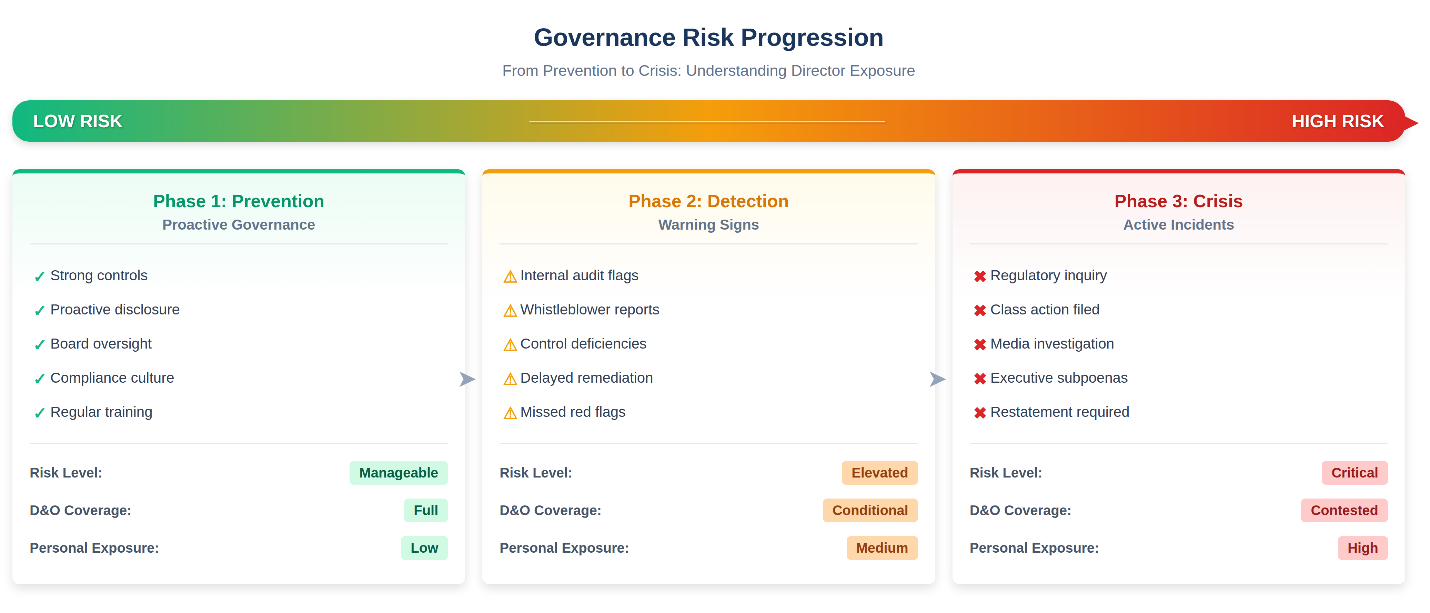
These triggers reflect a fundamental shift. Liability is no longer a question of criminal intent. It is a question of governance readiness. Courts and regulators ask: were systems in place? Did the board receive reports? Did the CEO act? Did the CFO verify? Did the company speak clearly and truthfully? If the answer is no, liability is not just possible. It is probable.
Building Structural Defenses Against Liability
Executives do not fear risk. They fear miscalculation. They fear the moment when judgment slips from rigor into exposure, when an overlooked disclosure or a neglected control becomes a subpoena. The defense against liability is neither reaction nor denial. It is structure, built not with declarations but with systems that anticipate missteps before regulators do.
Compliance Architecture: A well-constructed compliance program maps every intersection of law and behavior. It embeds responsibility into decisions before those decisions are judged. In high-functioning boards, the audit or risk committee maintains a live inventory of enterprise risk across regulations, markets, and operations. When I established SOX compliance frameworks and internal control testing protocols across manufacturing and financial services operations, the discipline was not about passing audits but creating early-warning systems that made risk visible before it became crisis.
Disclosure Rigor: A single public statement, if wrong, can undo a decade of governance. It does not take fraud, just inaccuracy, delay, or selective omission. When boards think about disclosure, they must think in terms of coherence. Do our earnings reflect our risks? Does our ESG language reflect our data? The best companies run their public statements like court briefs: not defensive, but airtight.
Control Integrity: Internal controls are existential. A failure in controls is a failure in truth. The CFO cannot sign what they do not trust. The board cannot certify what it does not test. The company must define ownership for every control point with no ambiguity. If the process breaks, the person is known.
Cultural Vigilance: Culture is seen in who speaks, who listens, who escalates without fear. It is embedded in the way the CEO responds to dissent, the way the CFO handles uncomfortable truths, the way directors ask questions that do not flatter but reveal. Scenario testing using real crises replayed with the real team builds institutional muscle.
Crisis Response and Institutional Learning
Liability does not knock. It arrives, often quietly, sometimes violently, when systems meant to guard trust buckle under pressure. For boards, CEOs, and CFOs, the moment of reckoning rarely begins with fraud. It begins with omission, when a report is delayed, when a question goes unanswered, when a signal is missed and silence becomes complicity. When an organization is drawn into regulatory scrutiny, the first question is procedural: who knew what, when. The second question is cultural: what did leadership do about it.
A disciplined response requires clear roles:
The Board: Must oversee, not micromanage, the investigative process. A special committee may be formed, independent counsel retained, and protocols established for document collection, witness interviews, and regulatory cooperation. If the board is implicated, lead independent directors must take control.
The CEO: Must lead externally. This means visibility with stakeholders, calm with employees, and precision with markets. It means acknowledging concern without preempting facts, transparency without self-incrimination.
The CFO: Must do more than recite controls. They must validate numbers, confirm scope, and prepare for restatement if required. Their credibility is not financial. It is personal. In managing finance operations through regulatory audits and preparing organizations for institutional investor due diligence, the critical capability was not defensive posturing but systematic documentation and clear communication of both strengths and remediation plans.
If regulators escalate through subpoenas, interviews, or raids, defense preparation must intensify. External counsel coordinates. Boards conduct independent reviews. Executives prepare timelines and documentation. Every inconsistency is a liability vector. Precision is survival.
From Crisis to Reform: Institutional Evolution
Real governance begins not with prevention or response but with what happens after the reckoning. Boards, CEOs, and CFOs who treat liability as a passing storm miss the deeper opportunity. The first task is truth. Not legal truth, but operational truth. What allowed the failure? Unless the organization confronts the mechanics of failure, it is doomed to recycle them.
Some companies commission independent post-mortems and publish the findings as transparency. Stakeholders respond not to perfection but to honesty. Once the review is complete, reform must follow:
Structural Reform: Governance committees revise reporting lines and escalation triggers. Risk functions are elevated and compliance is resourced.
Board Self-Evaluation: Did they ask the right questions? Were signals missed because they lacked context or courage?
Executive Behavior Reset: Financial narratives must be cautious. Disclosures must err on the side of clarity. Integrity is what leaders tolerate.
Cultural Transformation: Culture requires daily enforcement where ethics are enforced equally and reporting concerns is career-safe.
Some companies embed liability memory into training, teaching the crisis as case study. Over time, liability becomes a teacher that sharpens oversight and forces systems to evolve.
Conclusion
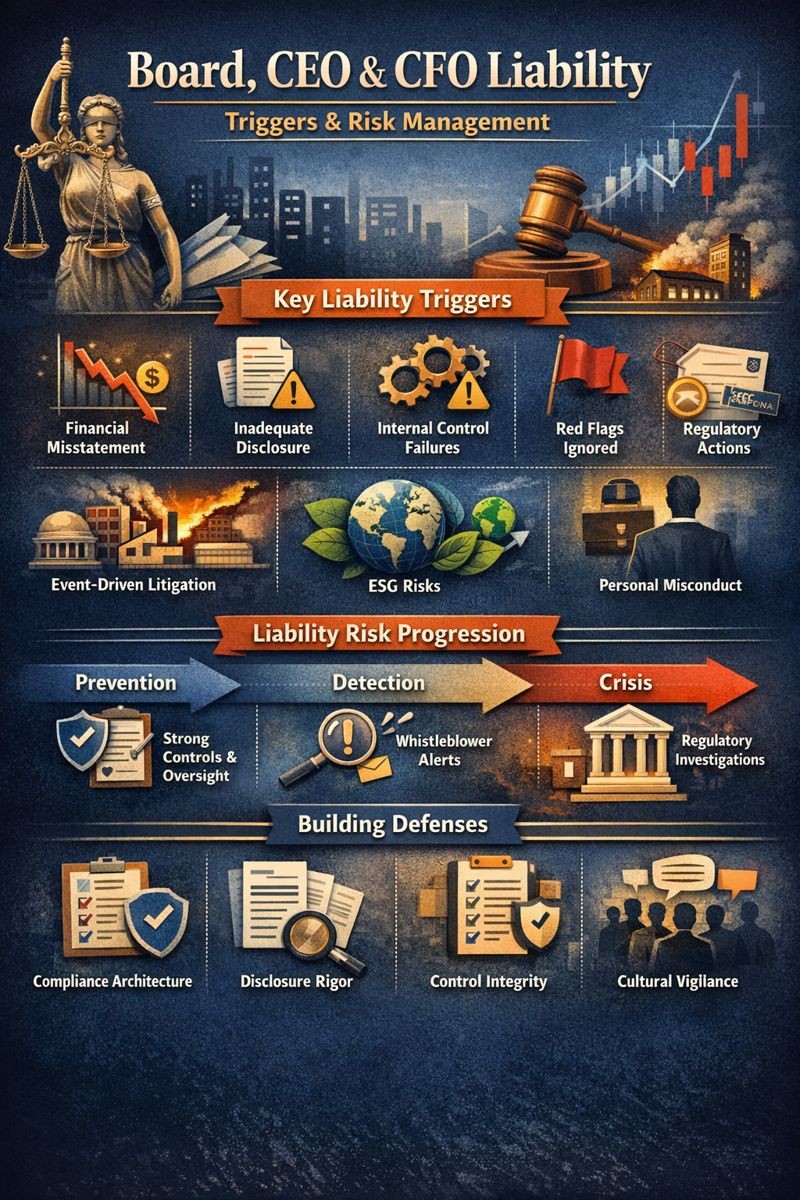
Liability is not a legal event. It is a leadership outcome. The companies that emerge stronger from liability crises are those that turn failure into foresight, vulnerability into credibility through institutional learning and systematic reform. This requires building defenses not through declarations but through compliance architecture that maps law to behavior, disclosure rigor that ensures coherence between statements and reality, control integrity that defines ownership at every point, and cultural vigilance that models truth without fear. When crisis arrives, disciplined response with clear roles, immediate framework activation, and measured communication separates survival from collapse. Real governance matures not in avoiding exposure but in metabolizing it, turning lessons into systems and mistakes into institutional memory. For boards, CEOs, and CFOs, the path forward is clear: governance cannot be performative; it must be protective, turning the predictable triggers of liability into catalysts for organizational excellence and enduring stakeholder trust.
Disclaimer: This blog is intended for informational purposes only and does not constitute legal, tax, or accounting advice. You should consult your own tax advisor or counsel for advice tailored to your specific situation.
Hindol Datta is a seasoned finance executive with over 25 years of leadership experience across SaaS, cybersecurity, logistics, and digital marketing industries. He has served as CFO and VP of Finance in both public and private companies, leading $120M+ in fundraising and $150M+ in M&A transactions while driving predictive analytics and ERP transformations. Known for blending strategic foresight with operational discipline, he builds high-performing global finance organizations that enable scalable growth and data-driven decision-making.
AI-assisted insights, supplemented by 25 years of finance leadership experience.