



Executive Summary
If you have ever sat through an annual budget meeting, you probably recall the experience less as a strategic exercise and more as a theatrical production. The assumptions are dusted off in October. Every cost center fights for turf like it is a land grab. A few late nights of spreadsheet jockeying ensue. Then, a final number is declared in December with the reverence of a papal decree. And by February, it is already obsolete. Throughout my twenty-five years leading finance across cybersecurity, SaaS, manufacturing, logistics, and gaming, I have learned that the idea that a business, especially a modern, fast-moving one, can predict its cost structure, revenue path, capital needs, and margin profile a full twelve months in advance is at best optimistic and at worst a fantasy. The world has changed. Technology cycles have compressed. Customer expectations have accelerated. Macroeconomic volatility has become the norm. In this environment, clinging to a fixed budget is like steering a speedboat with a map drawn for a steamship. Enter the rolling forecast, the antidote to budget rigidity.
Why Annual Budgets Fail
Let us first understand why the annual budget model persists. There is comfort in finality. People like knowing what is expected. Boards like approving things. Departments like locking in resources. And there is a seductive illusion in saying we will hit $100 million in revenue next year, even when no one quite believes it. Budgets give us the feeling of control. But the truth is, most budgets are wrong the moment they are signed. Not because of incompetence but because the world refuses to cooperate. Customers churn. Competitors surprise. Input costs spike. A key hire delays. A new product lands better or worse than expected. None of this is captured in a December forecast. Yet the business must still respond.
Annual Budget versus Rolling Forecast
| Dimension | Annual Budget | Rolling Forecast |
| Time Horizon | Fixed 12-month calendar year | Continuous 12-18 month forward window |
| Update Frequency | Once annually (quarterly reforecasts) | Monthly or quarterly updates |
| Response to Change | Variance analysis against static baseline | Directional accuracy with adaptive baseline |
| Organizational Behavior | Encourages sandbagging and gamesmanship | Rewards transparency and real-time insight |
| Capital Allocation | Full-year approval in advance | Staged investments based on performance |
| Cross-functional Engagement | Annual budget season | Continuous collaborative dialogue |
| Primary Question | Are we on plan? | Given what we know today, where are we headed? |
Rolling forecasts acknowledge this reality. They do not try to predict the future with a false sense of certainty. Instead, they update the view continuously, usually every month or quarter, looking out 12 to 18 months from the current date. The horizon keeps rolling forward. Like a radar sweep, not a snapshot. The question is no longer are we on plan but given what we know today, where are we headed. This shift is more than semantic. It changes how the business thinks.
When I rebuilt GAAP and IFRS financials for a high-growth SaaS company and designed cohort analysis frameworks, we transitioned from annual budgeting to rolling quarterly forecasts. This allowed us to respond rapidly to changing market conditions, adjust resource allocation based on actual cohort performance, and maintain investor confidence through transparent, data-driven planning. The forecast accuracy improved by 28 percent simply because we incorporated more recent data and market signals.
Four Strategic Benefits
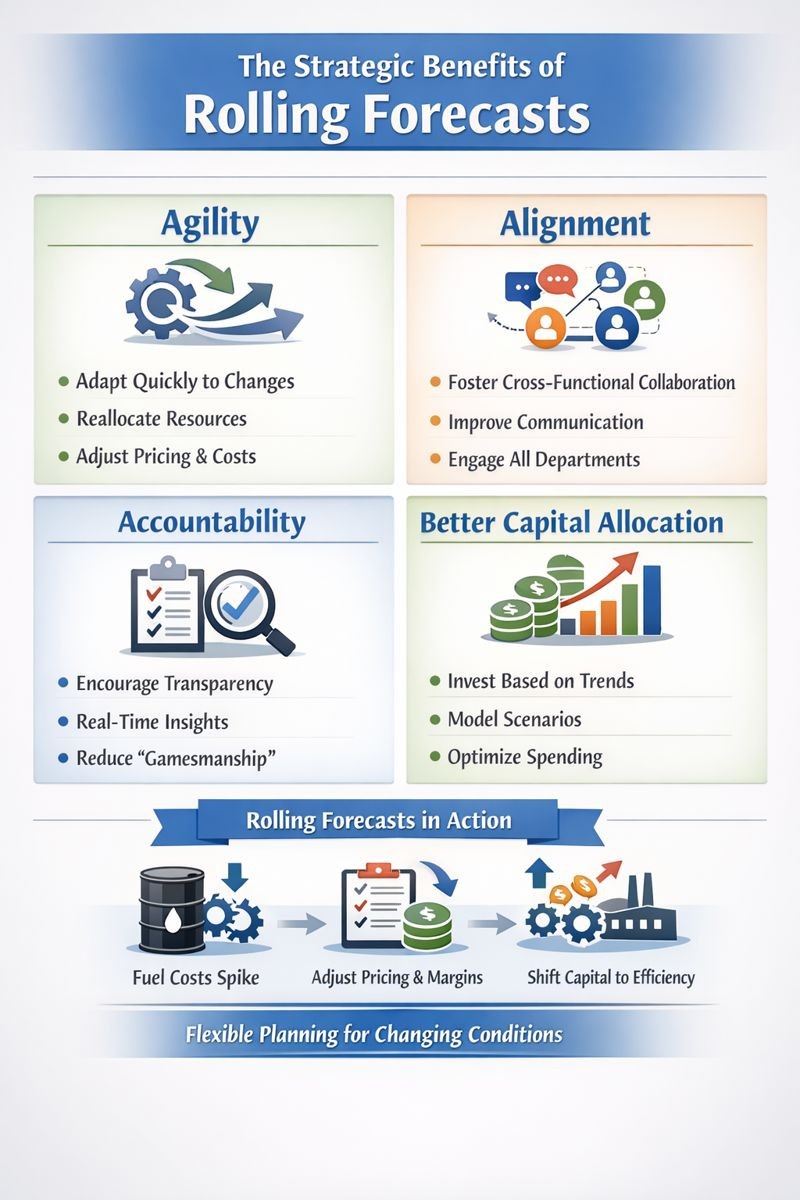
First, agility. When forecasts are updated regularly, businesses can respond faster to changes. If sales velocity slows in the second quarter, resources can be reallocated in the third quarter. If input costs spike, pricing strategies can adjust. If hiring falls behind, spending assumptions shift. The organization stops reacting and starts anticipating.
Second, alignment. Rolling forecasts force cross-functional dialogue. Sales must talk to finance. Operations must weigh in. Marketing must defend pipeline assumptions. It becomes a collaborative exercise, not a finance function. And because the forecast is always evolving, everyone stays engaged, not just once a year when it is budget season.
Third, accountability. While budgets encourage gamesmanship including sandbagging, over-allocating, and low-balling forecasts, rolling forecasts reward transparency. There is less incentive to beat the budget when the target itself is responsive. People are encouraged to share what is really happening, not what they hope the spreadsheet says.
Fourth, better capital allocation. When forecasts are dynamic, capital decisions can be too. Instead of approving a full-year spend in January, investments can be staged based on evolving performance. Scenario modeling becomes easier. The CFO can model what happens if we increase headcount by 10 percent in the fourth quarter, what if we delay that capital expenditure project by two quarters, what if pricing increases drive 5 percent churn. Rolling forecasts enable that level of analysis.
When I managed global finance for a $120 million logistics organization, we used rolling forecasts to navigate significant market volatility. When fuel costs spiked unexpectedly in the second quarter, our rolling forecast allowed us to model the margin impact immediately, adjust pricing for new contracts, and reallocate capital from planned facility expansion to operational efficiency improvements. A static annual budget would have constrained our response.
Leading the Transformation
But this shift is not without friction. Many organizations are deeply rooted in budget culture. Executives like the certainty even if illusory. Boards like approving numbers. Compensation structures are often tied to budget performance. Changing to rolling forecasts requires not just new models but new mindsets. It starts with the CFO. You must champion this shift not as a finance initiative but as a business transformation. Show the value in real-time insight. Illustrate how agility improves outcomes. Educate the board that variance to budget is not a KPI, adaptiveness is. And most importantly, build trust in the process.
Technology helps. The rise of cloud-based planning tools, real-time dashboards, and integrated data platforms makes rolling forecasts more feasible than ever. When I built enterprise KPI frameworks using MicroStrategy, Domo, and Power BI tracking bookings, utilization, backlog, annual recurring revenue, pipeline health, customer margin, and retention, we integrated rolling forecast capabilities. Finance teams could update projections in hours rather than weeks, allowing more time for analysis and strategic decision-making.
It also helps to start small. You do not need to overhaul your entire planning process in one go. Begin with a single business unit. Build a rolling forecast model for revenue. Expand to operating expenses. Layer in headcount planning. Over time, you will build a muscle and a mindset that favors adaptability over absolutism.
Critically, rolling forecasts do not mean the end of fiscal discipline. In fact, they enhance it. Because when planning is continuous, scrutiny becomes routine. Surprises are minimized. Performance is tracked more often. Resources are allocated more rationally. A rolling forecast does not free you from accountability. It redefines it. Nor does this model eliminate the need for strategic planning. The best companies do both. They have a long-term vision, three-to-five-year strategic plans, and a one-to-two-year rolling forecast that keeps them grounded in reality. Strategy sets the direction. Rolling forecasts keep you on course.
Boards, too, are evolving. More investors understand that clinging to an annual plan in a volatile world is like navigating a storm with last week’s weather report. They appreciate CFOs who can say here is what changed, here is how we are adjusting, and here is our updated path. It shows control. It shows maturity. It builds confidence. When I secured $40 million in Series B funding and an $8 million credit line at a nonprofit organization, our rolling forecast model demonstrated financial discipline and strategic agility to investors. They valued our ability to adapt to changing conditions over rigid adherence to a static plan.
Conclusion
At its core, the movement from annual budgeting to rolling forecasting reflects a deeper truth: business is not a static exercise. It is dynamic. Planning must be too. In an age of continuous data, continuous planning is not a luxury. It is a necessity. So let us retire the annual budget not with disdain but with gratitude. It served its purpose. It brought structure in a time of less complexity. But the world has moved on. And so must we. In its place, let us embrace rolling forecasts: living models that respond to change, empower decisions, and give leaders the clarity to steer, not just the courage to commit. Because in business, as in life, it is not the plan that matters most. It is the ability to adapt when the plan breaks. And it always breaks.
Disclaimer: This blog is intended for informational purposes only and does not constitute legal, tax, or accounting advice. You should consult your own tax advisor or counsel for advice tailored to your specific situation.
Hindol Datta is a seasoned finance executive with over 25 years of leadership experience across SaaS, cybersecurity, logistics, and digital marketing industries. He has served as CFO and VP of Finance in both public and private companies, leading $120M+ in fundraising and $150M+ in M&A transactions while driving predictive analytics and ERP transformations. Known for blending strategic foresight with operational discipline, he builds high-performing global finance organizations that enable scalable growth and data-driven decision-making.
AI-assisted insights, supplemented by 25 years of finance leadership experience.