



Executive Summary
Every founder knows the thrill of bootstrapping, the terror of missed payrolls, and the quiet pride of customer validation. What is less commonly addressed is the strange, disorienting moment when a liquidity event reshapes all of it. For founders who sell a stake to private equity, the deal is never the end. It is the beginning of a complex new chapter that blends performance, psychology, and contract mechanics. Having worked across transformations and buyouts, I have seen how well-designed post-deal incentives not only retain founder engagement but deepen strategic alignment. When incentives align with purpose, founders do not just stay. They lead again. The structure of post-deal compensation has evolved to reflect the maturing relationship between capital and capability. No longer can sponsors assume that a simple cash-out followed by a management reshuffle delivers alpha. Most private equity firms today recognize that founder DNA remains critical long after Day Zero. The question becomes how to retain that DNA without letting legacy distort the path to scale. This is where mechanisms like equity rollover, earnouts, and vesting cliffs become not just terms but tools. Used well, they act as bridges between belief and performance. Used poorly, they erode trust and dilute intent.
Designing Equity Rollovers
The first challenge lies in designing equity rollovers that serve as true reinvestments rather than golden handcuffs. Founders often ask whether they should roll 20 percent or 40 percent of their proceeds into the new structure. I advise based on two factors:
- Their appetite for risk relative to the sponsor’s strategy
- The degree of operational control they will retain
A high rollover with no board presence or operational influence becomes financial risk without strategic leverage. Conversely, a moderate rollover aligned with meaningful influence often creates the optimal psychological ownership. I recall one deal where the founder rolled 35 percent, gained a board seat, and led product innovation. His economic and strategic stakes grew together.
The equity rollover signals belief. It demonstrates that the founder is willing to bet on the future they are building with the sponsor. But that bet must come with voice. Without meaningful participation in strategic decisions, the rollover becomes a trap rather than a partnership. This is why I counsel founders to negotiate not just the percentage but the governance rights that accompany it.
Structuring Earnouts Transparently
Earnouts, while often maligned, can work if structured transparently. Founders hate black boxes. They respond well to clear metrics, achievable ranges, and consistent reporting. The worst earnouts contain ambiguous definitions of EBITDA, discretionary thresholds, and retroactive adjustments. These create distrust and distraction.
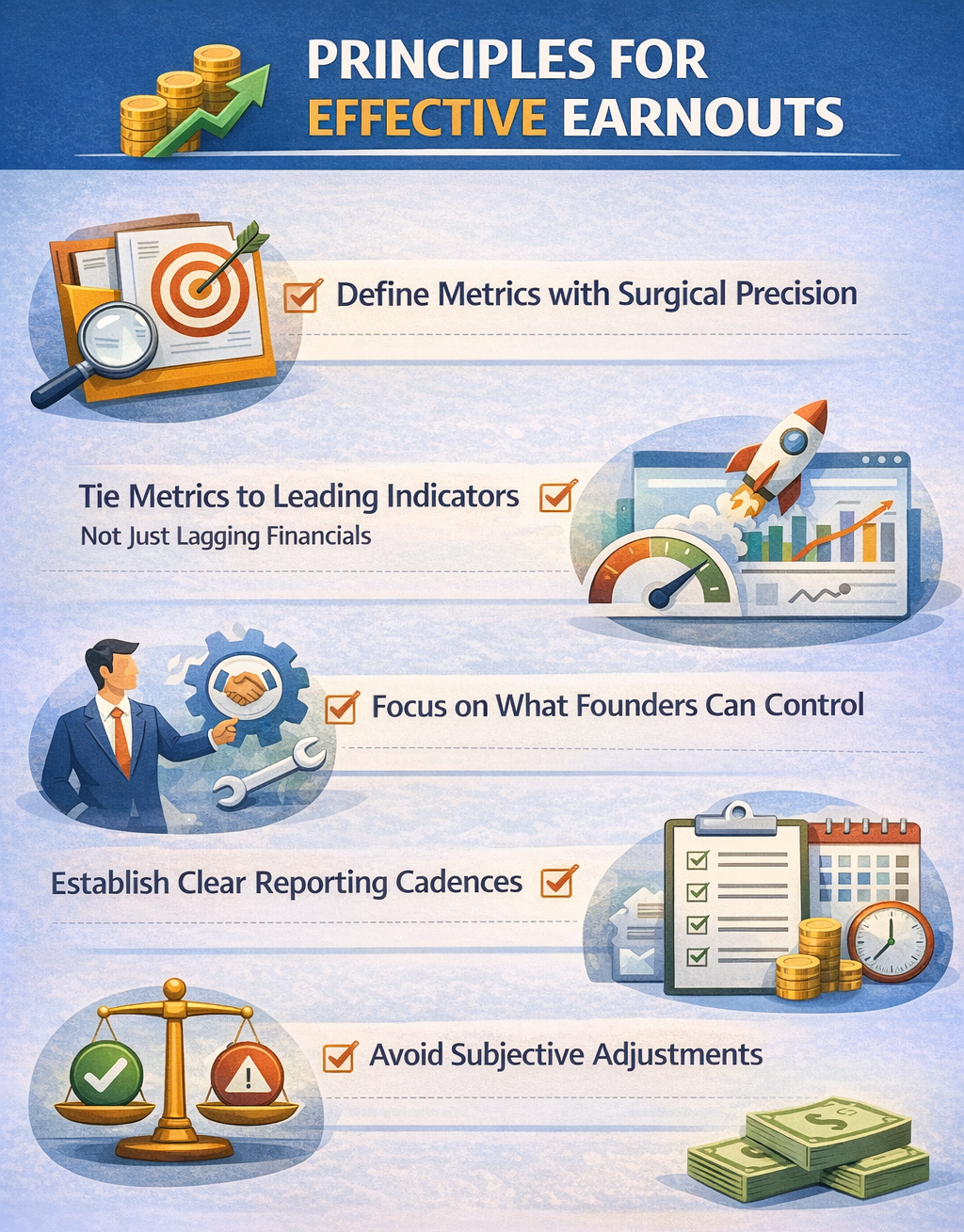
If you want revenue quality, measure net retention. If you want team performance, tie outcomes to hiring milestones. When earnouts focus on what founders can control, they energize rather than paralyze. I encourage teams to build earnouts that feel like shared goals rather than hurdles to clear. The moment an earnout becomes adversarial, it has failed its purpose.
The Vesting Cliff and Cultural Alignment
The vesting cliff is perhaps the most emotional feature of any post-deal agreement. Founders rarely leave for greener pastures. They leave when they feel sidelined or misunderstood. I often argue that vesting cliffs should come with cultural cliffs. If the founder delivers on strategy but the culture breaks under new leadership, value erodes faster than any cap table forecast.
I recommend coupling vesting with structured feedback loops, not just quarterly board meetings but bi-directional check-ins. Let the founder know where they stand. Let the sponsor understand founder perspective. This humanizes the agreement and prevents the silent drift that precedes departure.
I see incentive design as a feedback system. Every term sends a signal. Equity rollover signals belief. Earnouts signal accountability. Vesting cliffs signal commitment. But unless those signals enter a feedback loop of trust and performance, they degrade into noise. I recall one case where the founder had an aggressive earnout tied to international expansion. The board delayed go-to-market support, citing other priorities. The founder missed the earnout. The founder left. The expansion failed. The signals collapsed. Everyone lost.
Co-Constructing Goals
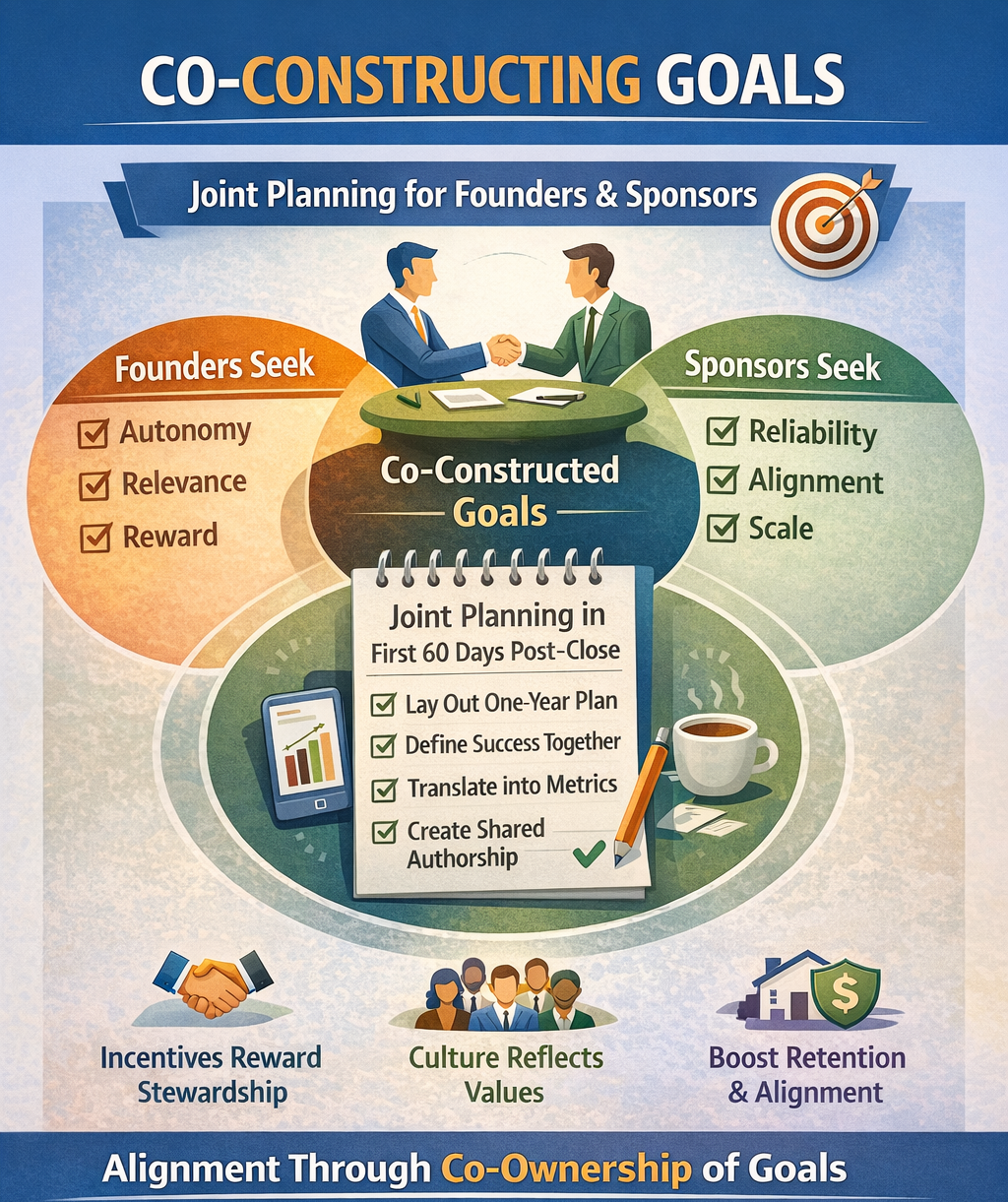
To design better systems, founders seek autonomy, relevance, and reward. Sponsors seek reliability, alignment, and scale. The intersection lies in co-constructed goals. I advocate for joint planning sessions during the first 60 days post-close:
- Lay out the one-year plan
- Define success together
- Translate it into metrics
- Create shared authorship
This ritual creates alignment that incentives then reinforce rather than dictate. When goals are co-authored, both parties feel ownership. When they are imposed, even reasonable targets feel like constraints.
Culture remains the unspoken currency of retention. If the founder no longer recognizes the culture, they will eventually reject the structure. Incentives must therefore reward not just output but stewardship. One PE firm introduced a cultural bonus linked to team retention and internal NPS. That founder stayed three years longer than expected. Not because of money. Because the culture still reflected their values.
Sustaining Momentum Post-Deal
Once the dust of the deal settles, founders must pivot from transaction to transformation. This shift is subtle but critical. It is no longer about valuation headlines. It becomes about building an institution. In this second phase, incentives must evolve from hooks to habits. They must not only retain but activate.
The danger here lies in complacency. Many post-deal organizations default into KPI dashboards, annual reviews, and rigid bonus schemes. These mimic accountability but do not generate energy. I often advise teams to transition from KPI fixation to OKR agility. Systems that support exploration and learning outperform those that merely reward control.
Founders need a roadmap that aligns personal ambition with enterprise outcomes. A three-year strategic vision, co-authored with the board, acts as a map. But that map must leave space for discovery. I counsel boards to define goals with gradients rather than absolutes. Instead of triple EBITDA in 36 months, consider expand operating margin while investing in customer experience. This framing invites founder intuition into the process. It acknowledges that value creation is nonlinear. It also builds trust.
Measuring What Matters
Measurement must reflect the multidimensionality of performance. Financial metrics matter. But so does momentum. When founders feel the flywheel turning, when new hires succeed, when customers deepen engagement, when products evolve, they stay connected. I build dashboards that track not just revenue but vitality. Metrics like NPS, product velocity, team growth, and customer lifetime value become leading indicators. They reveal whether the system is learning or coasting.
Incentives should reflect these layers. I have seen earnouts indexed not just to top-line growth but to multi-layered scorecards. One founder had an earnout that combined revenue growth, customer retention, and platform adoption. The blend gave them a holistic target. They responded with holistic leadership. Another structure included phantom equity triggered by customer expansion into new verticals. This structure unlocked founder creativity. When incentives match the business model’s complexity, they become fuel rather than friction.
The role of the board must also evolve. Oversight must give way to collaboration. I recommend a governance cadence that includes strategic workshops every six months. In these sessions, founders share learnings, adjust course, and reframe risk. The board listens not just for performance but for belief. I have seen boards re-energize founders simply by acknowledging their judgment.
Retention Through Renewal
Narrative continuity becomes essential. The founder’s story remains a powerful asset. It connects internal teams and external stakeholders. I coach founders to continue telling their origin story but also to narrate the evolution. The story does not end with the deal. It shifts into a chapter about resilience, adaptation, and scale. Founders who own this arc build trust across the organization. Their presence signals coherence.
Retention also means renewal. I urge PE sponsors to invest in founder development. Executive coaching, peer networks, and board apprenticeships keep founders growing. These investments signal respect. They also reduce churn. In one situation, the founder became a board member at two portfolio companies after stepping down as CEO. His insights multiplied value across the platform.
Conclusion
Ultimately, incentive structures that retain founders share four traits. They create alignment through co-authored goals. They offer clarity without rigidity. They reward stewardship as well as results. And they adapt as the company grows. These traits require more than spreadsheets. They require conversation, empathy, and foresight. The best post-deal outcomes I have witnessed came not from perfect models but from resilient relationships. Founders stayed not because they had to. They stayed because the organization continued to reflect their intent. They saw the future and still saw themselves in it. Designing incentives that work begins with understanding that founders are not just assets. They are stories in motion. To retain them, you must honor both the chapter they wrote and the one they still want to author.
Disclaimer: This blog is intended for informational purposes only and does not constitute legal, tax, or accounting advice. You should consult your own tax advisor or counsel for advice tailored to your specific situation.
Hindol Datta is a seasoned finance executive with over 25 years of leadership experience across SaaS, cybersecurity, logistics, and digital marketing industries. He has served as CFO and VP of Finance in both public and private companies, leading $120M+ in fundraising and $150M+ in M&A transactions while driving predictive analytics and ERP transformations. Known for blending strategic foresight with operational discipline, he builds high-performing global finance organizations that enable scalable growth and data-driven decision-making.
AI-assisted insights, supplemented by 25 years of finance leadership experience.