


Executive Summary
Supply chain flexibility is no longer a competitive advantage. It is a baseline requirement. The procurement contracts that served organizations well in stable, predictable markets have become structural liabilities in an era defined by demand volatility, geopolitical disruption, and input price shocks. This article argues that the answer does not lie in better forecasting. It lies in better contract design. Drawing on over twenty-five years of financial and operational leadership across logistics, SaaS, cybersecurity, and global services environments, this piece offers a practical framework for building procurement contracts that absorb change rather than resist it. From tiered pricing and indexed adjustments to governance cadence and master services agreements, adaptive contracting is not a procurement innovation. It is a financial strategy, and the organizations that understand this will be the ones that endure.
The Contract Is the Strategy
Procurement has long existed in the industrial imagination as a function of predictability. Buyers had to forecast volumes with precision. Suppliers happened to deliver on fixed schedules at contracted rates. Stability defined the relationship. The turbulence of the last decade has made that world of stability a relic of the past.
What has emerged is not a crisis of supply. It is a crisis of contract structure. Supply chain flexibility, as a practical operating capability, cannot be achieved through faster negotiation cycles or better technology alone. It requires a philosophical reframing of what a contract is meant to do. A contract should not lock down value. It should enable value to emerge under a range of conditions. Static contracts in dynamic systems are not merely obsolete. They are fragile.
Having worked across long-horizon procurement environments spanning logistics, services, and global operations, I have come to believe that the future of procurement lies not in forecasting precision but in contractual adaptability. True resilience is not about resisting change. It is about absorbing change without structural compromise.
The Architecture of an Adaptive Contract
Tiered Pricing and Volume Reset Clauses
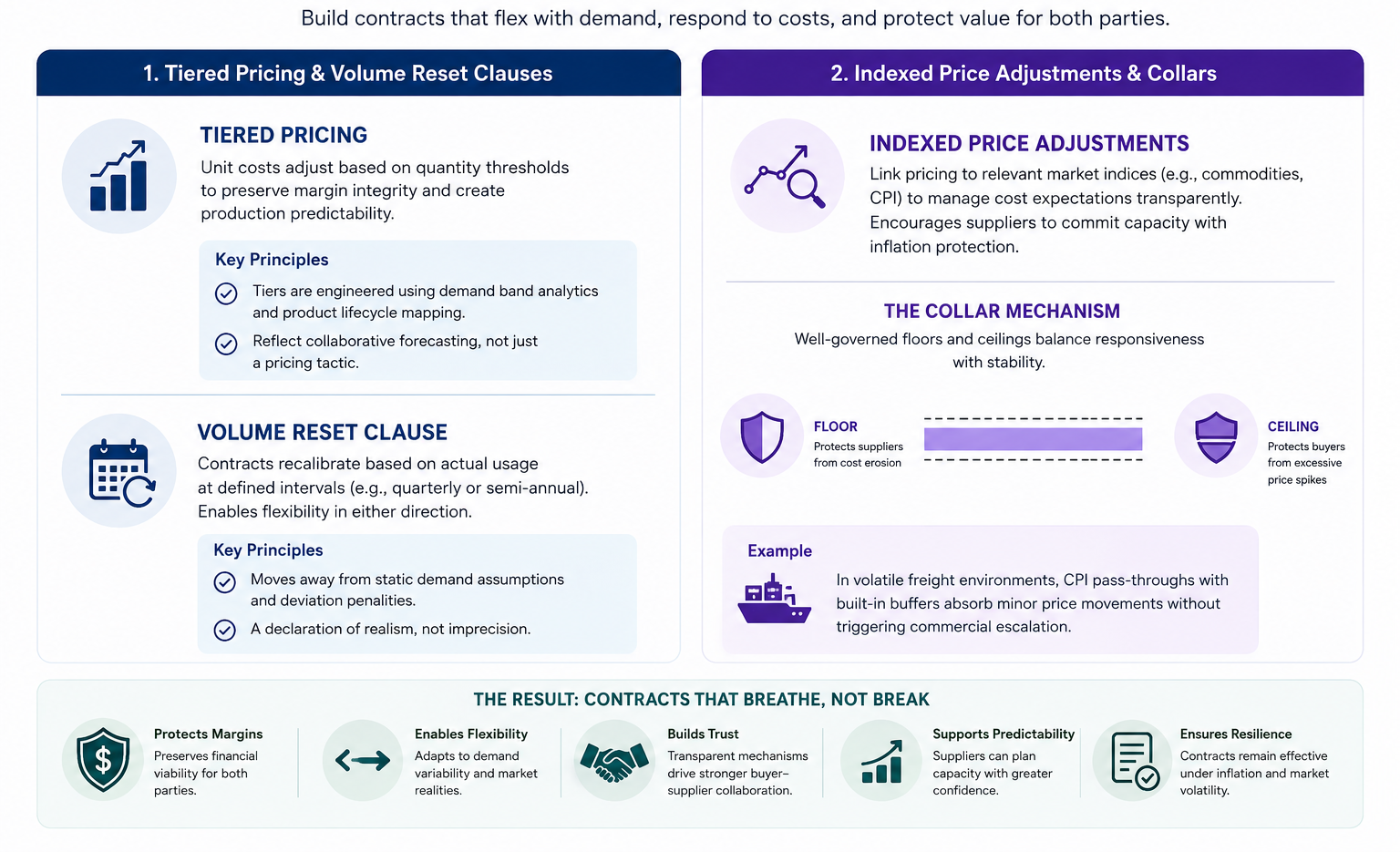
The first departure from traditional contract design is the abandonment of one-size-fits-all pricing models. In an era of fluctuating demand curves and uncertain supply channels, contracts must be responsive to both volume variability and market input costs.
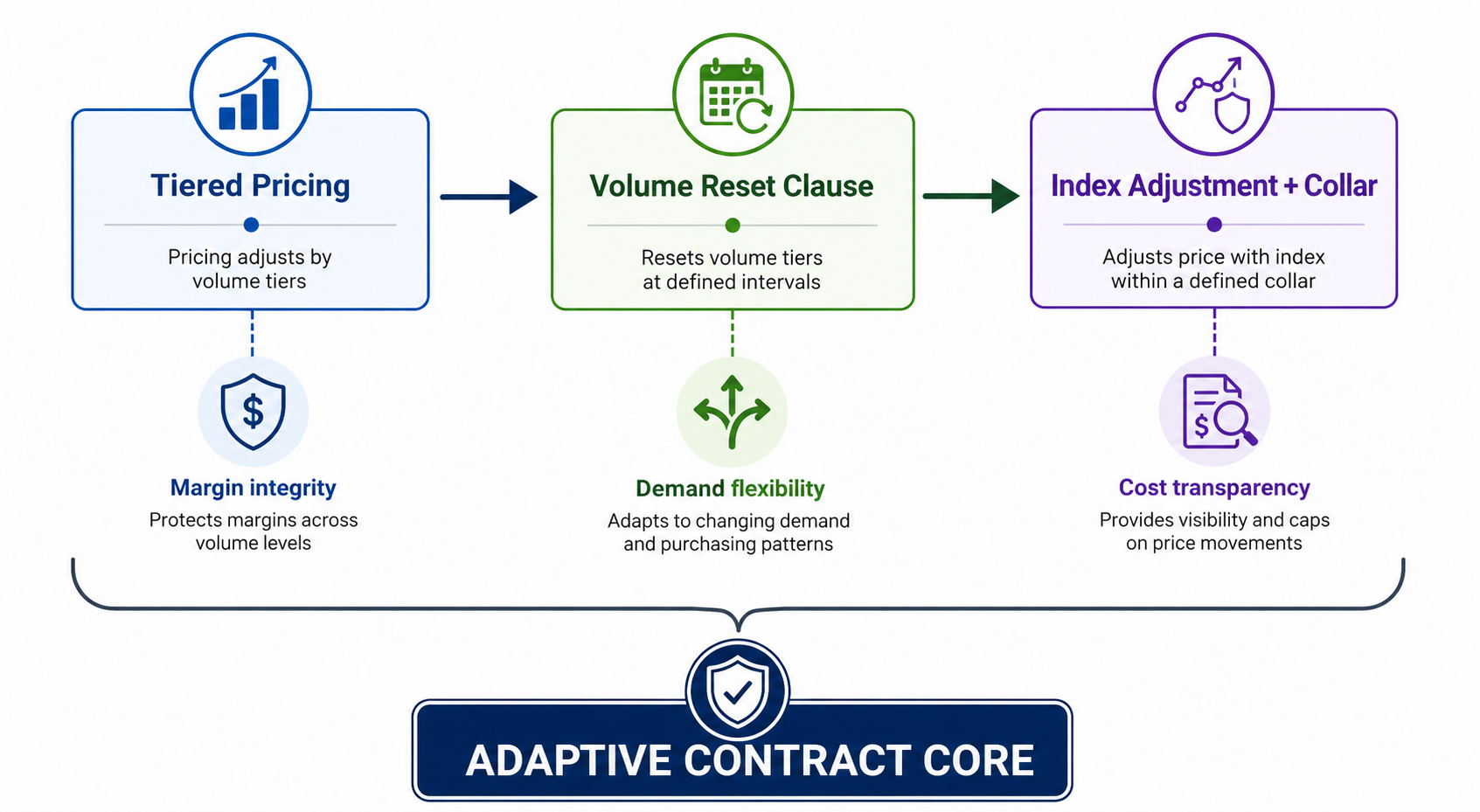
Tiered pricing structures, where unit costs adjust based on quantity thresholds, can preserve margin integrity while giving suppliers production predictability. Based on analytics and product lifecycle mapping, they must be engineered on demand. A well-designed pricing tier is less a pricing tactic and more a reflection of collaborative forecasting between buyer and supplier.
The volume reset clause is closely related. Many traditional contracts assume static demand over fixed intervals and penalize deviation. Modern supply ecosystems require procurement models that can flex in either direction. Linked to quarterly or semi-annual usage thresholds, Volume reset clauses allow contracts to be recalibrated based on actual consumption. They are not indicators of imprecision. They are declarations of realism.
Indexed Price Adjustments and Collars
Tying pricing to market-relevant indices, whether through commodity linkage or consumer price index pass-throughs, allows both parties to manage cost expectations transparently. In practice, suppliers are far more willing to commit capacity when they know inflationary pressure will not erode their position.
The key is ensuring the indexing mechanism is neither so volatile as to create noise nor so stale as to misrepresent true delivery costs. The balance lies in well-governed floors and ceilings, known as collars, which preserve financial viability for both parties while keeping pricing responsive. In volatile freight environments, for example, embedding CPI pass-throughs with built-in buffers allows for minor price movement absorption without triggering commercial escalation. The result is a contract that breathes rather than breaks under stress.
Governance: The Often-Overlooked Dimension
Contract terms alone cannot deliver flexible supply chain outcomes. They must be embedded in governance structures that are equally dynamic.
Too many organizations treat contracts as static documents, signed and archived until breach or renewal. The more effective approach is quarterly commercial reviews on all contracts above a materiality threshold. These are not compliance audits. They are living forums where terms are stress-tested against current market data, operational realities, and risk projections. This rhythm creates institutional muscle memory for change and builds what I consider the real strategic differentiator in procurement: not forecasting skill, but recalibration agility.
Equally critical is the master services agreement. In fast-moving markets, an MSA is not merely a legal backstop. It is a velocity enabler. An expired MSA creates a legal gray zone where operational flexibility is hindered by uncertainty. The moment a reset is required or a dispute arises, the absence of a current MSA becomes a critical liability. The discipline is simple: if an MSA has expired, an amendment must be executed at minimum. Ideally, expiration becomes a trigger for governance renewal, realigning terms with the current risk environment rather than simply updating dates.
Institutionalizing Optionality
To embed supply chain flexibility at scale, organizations must move beyond reactive renegotiation and into anticipatory design. This means developing a contract playbook that includes:
- Modular terms that can be adjusted without full renegotiation
- Scenario clauses tied to predefined market conditions or operational triggers
- Termination and suspension protocols calibrated to the volatility profile of each category
- Pre-approved clause libraries that give deal teams speed without sacrificing governance
The most successful procurement functions do not centralize decision-making. They decentralize frameworks. Governance without agility is bureaucracy. Agility without governance is risk. The art lies in their integration.
For categories with high pricing variability, such as raw materials or technology components, dynamic price bands and commodity indexation reduce the frequency of contentious renegotiations. For digital services or fast-evolving product lines, flexibility must extend to deliverables and service levels, with each adjustable element bounded by clear parameters and tied to a recalibration mechanism. Flexibility must never become ambiguity.
Risk allocation deserves particular attention. Fixed-risk models transfer too much unpredictability to one party, leading to either margin erosion or service degradation. Shared risk models, where penalties and incentives are indexed to performance corridors rather than binary success metrics, shift the contract from a punishment regime to a co-managed performance system. Over time, this builds trust and improves long-term outcomes. The supplier becomes not merely a vendor but a participant in value creation.
Conclusion
Adaptive procurement contracts are not inherently complex. Because they are designed to evolve, they rarely require extensive post-facto amendment. Their modularity allows them to absorb change without litigation or escalation. This is precisely what makes them so valuable.
Supply chain flexibility, at its highest expression, is a financial strategy as much as an operational one. The organizations that understand this will stop treating procurement as a cost gatekeeper and start treating it as a steward of commercial resilience. Contracts must mirror the systems they serve. In dynamic, global, and often unpredictable markets, they must act more like living frameworks than static documents. They must contain within them the rules of engagement not only for success but for volatility. And they must do so without adding friction to decision-making. Resilience in procurement is not about perfection. It is about preserving agility under stress, and that begins with the contract.
Disclaimer: This blog is intended for informational purposes only and does not constitute legal, tax, or accounting advice. You should consult your own tax advisor or counsel for advice tailored to your specific situation.
Hindol Datta is a seasoned finance executive with over 25 years of leadership experience across SaaS, cybersecurity, logistics, and digital marketing industries. He has served as CFO and VP of Finance in both public and private companies, leading $120M+ in fundraising and $150M+ in M&A transactions while driving predictive analytics and ERP transformations. Known for blending strategic foresight with operational discipline, he builds high-performing global finance organizations that enable scalable growth and data-driven decision-making.
AI-assisted insights, supplemented by 25 years of finance leadership experience.