Executive Summary
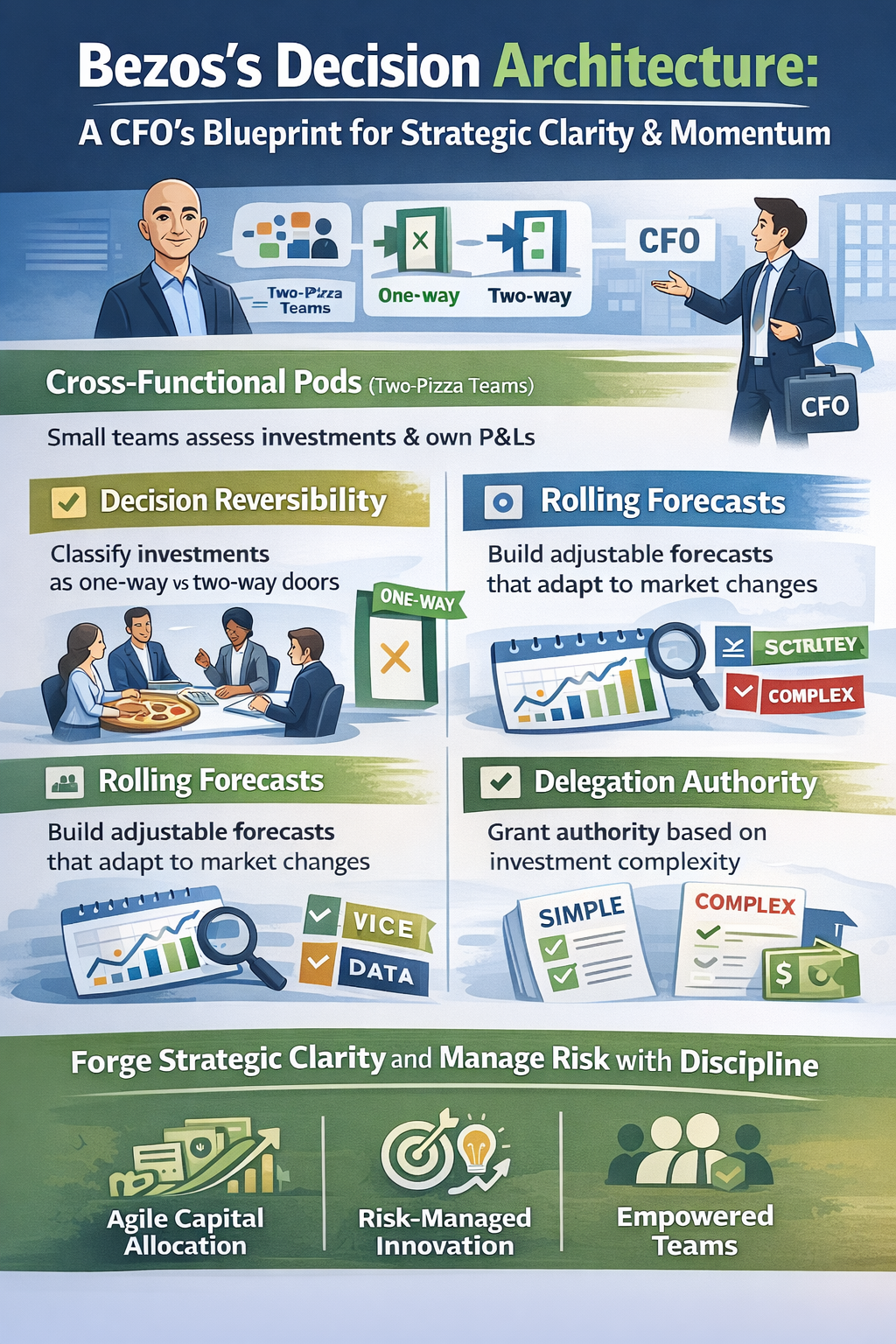
When Jeff Bezos founded Amazon in 1994, he created a decision-making architecture governing who decides, how fast, and with what information. These methods became embedded in Amazon: two-pizza teams limiting coordination overhead, one-way versus two-way door distinctions calibrating review depth to decision reversibility, Day 1 mindset maintaining organizational freshness, and disagree-and-commit protocols accelerating alignment after debate. For Chief Financial Officers, these ideas provide clarity about capital allocation, trust distribution, and agility deployment across the organization. This analysis demonstrates how CFOs can weave Bezos’s decision architecture into finance functions to elevate rigor and speed in capital allocation and risk management. The framework translates into organizing capital budgeting around cross-functional pods, classifying investments by reversibility, building rolling forecasts, establishing delegation authority based on complexity, and formalizing disagree-and-commit protocols. This redefines the CFO role from fiscal sentry to strategic conductor, enabling finance to deploy capital to innovation, manage risk-taking with discipline, and build organizational capacity.
Two-Pizza Teams and Financial Accountability
Bezos’s two-pizza team principle, stating no team should be larger than two pizzas can feed, codifies fundamental truths in communication dynamics, accountability, and operational speed. A CFO adopting this in finance signals profound shift: capital decisions are embedded across the organization, not centralized.
Imagine capital budgeting organized around small cross-functional pods combining finance, operations, product, and legal, each owning a profit and loss slice. These pods evaluate investments end to end, making smaller commitments before scaling. A pod considering automation tooling builds minimal viable budget for prototyping, tests adoption, and only then recommends further capital.
This structure localizes decision-making, reducing overload on central finance while spreading discipline across the organization, and accelerates learning, enabling capital deployment with continuous feedback rather than rigid annual cycles.
Mapping Decisions: One-Way Versus Two-Way Doors
In his 2015 shareholder letter, Bezos differentiated between one-way door decisions that are irreversible and high-stakes versus two-way door decisions that are reversible and operational. This creates decision taxonomy that CFOs can model alongside capital allocation.
Hiring a finance manager for emerging region might be two-way decision: if market does not materialize, roles can be repurposed. Multi-million-dollar data center represents one-way door with sunk costs. Bezos advises broader review and scenario modeling for one-way doors versus thinner justification for two-way ones.
Finance teams track this taxonomy in investment pipelines. Proposed capital outlays tagged as Type 1 or Type 2 determine review thresholds, stakeholder involvement, and execution cadence.
Operating in Day 1
Day 1 refers to Bezos’s concept of organizational freshness: customer obsession, bias for action, risk tolerance, and high-velocity decisions. CFOs can adapt Day 1 thinking in three areas:
- Forecast flexibility: Build rolling forecasts and scenario models that pivot with market changes, making liquidity runway, high-risk flags, and capital agility planning primitives
- Customer-valued investment: Link each capital expenditure to customer or market value rather than internal criteria
- High-velocity execution: Make most decisions with approximately 70 percent of information available, tolerating early-stage ambiguity and learning fast
Day 1 thinking signals that cost of delay sometimes exceeds cost of imperfect execution.
Protecting Leadership Bandwidth
Bezos structures decisions to mitigate executive cognitive load. Two-pizza teams preserve mental bandwidth by enabling small teams to act without involving leadership on trivial matters. For CFOs, this means empowering functional leaders contingent on financial guardrails. Finance sets policy boundaries, delegating authority limits based on complexity. As long as return on investment thresholds and risk scores are met, teams act independently. Only escalations land in executive inboxes, protecting senior capacity for critical decisions.
Disagree and Commit
Bezos’s disagree and commit mantra directs teams to align after debate for speed and ownership. Within finance, this can be formalized during budgeting sprints or investment reviews. During quarterly business reviews, if team leaders cannot align on capital expenditure but everyone commits to proceed, CFOs record it as such, preventing consensus paralysis. Feedback checkpoints such as milestone reviews and real-time dashboards trigger feedforward or rollback. Disagreeing matters, but once decision is made, all must align behind it.
Cumulative Design
Amazon-derived principles combine into governance architecture: build micro-teams for investment review, tag proposals as one-way or two-way doors aligning review depth with decision gravity, create rhythm-based rolling plans encouraging lean experimentation, and empower micro-teams escalating only when alignment fails or risks breach thresholds. This redefines CFO role from fiscal sentry to strategic conductor.
A CFO Story
Consider logistics firm launching autonomous delivery vehicle pilot. The CFO sets up two-pizza pod combining finance, operations, technology, and legal. They budget $250,000 initially to test within contained geography, classified as reversible two-way door decision granting swift execution authority. Review steps codify hypothesis, measurement triggers, and escalation criteria. By month three, results showing cost efficiencies trigger increase to $1 million. This mirrors Bezos’s architecture: small empowered teams, staged funding, and metrics-informed scale.
Lessons and Pragmatics
Implementation requires systematic approach: classify each capital decision into one-way or two-way categories, embed two-pizza pods in research and development or regional units with defined limits, provide playbooks detailing how to escalate and measure, use quarterly business reviews for staged investment approval, track decision velocity and internal empowerment surveys, and promote disagree-and-commit while celebrating small fast failures.
CFOs Reap Strategic Value
Translating Bezos’s architecture equips finance with three outcomes: strategic clarity and speed as context-driven governance deploys capital to high-value innovation, risk-managed experimentation through stage-gating paired with return on investment clarity, and organizational capacity-building as small empowered pods nurture financial acumen across functions.
Conclusion
Bezos’s principles are not anecdotal quirks but intentional meta-architecture of decision flow, risk awareness, and accountability. For modern CFOs, the question is how to redesign processes declaring who decides, at what speed, with what information, and with whose accountability. Jeff Bezos’s legacy lies in his clarity on decision architecture. For CFOs, that clarity becomes permission to draw sharper boundaries, trust internal teams, hedge reversibility, and accelerate transformation with purpose, providing a template for modern financial leadership that aligns capital with cultural resilience.
Disclaimer: This blog is intended for informational purposes only and does not constitute legal, tax, or accounting advice. You should consult your own tax advisor or counsel for advice tailored to your specific situation.
Hindol Datta is a seasoned finance executive with over 25 years of leadership experience across SaaS, cybersecurity, logistics, and digital marketing industries. He has served as CFO and VP of Finance in both public and private companies, leading $120M+ in fundraising and $150M+ in M&A transactions while driving predictive analytics and ERP transformations. Known for blending strategic foresight with operational discipline, he builds high-performing global finance organizations that enable scalable growth and data-driven decision-making.
AI-assisted insights, supplemented by 25 years of finance leadership experience.