
Executive Summary
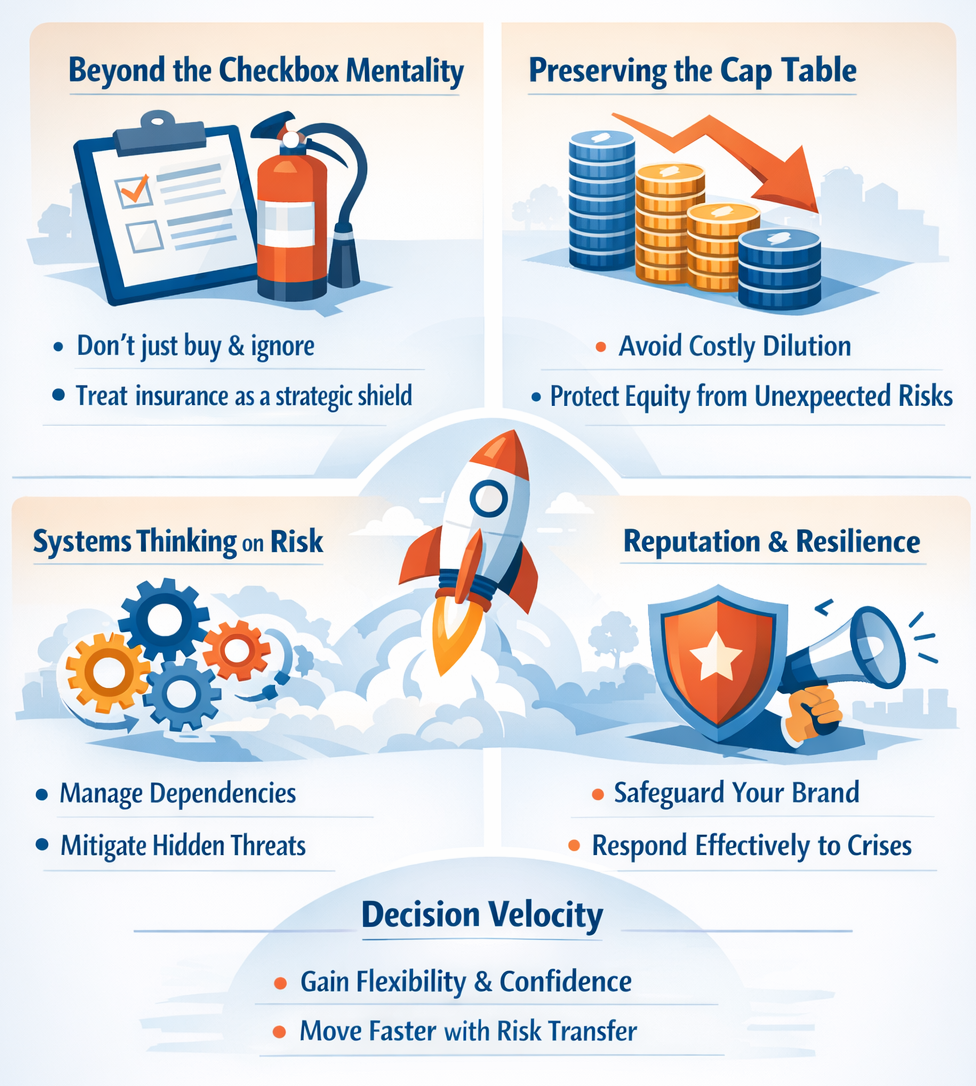
Most founders treat insurance the same way they treat fire extinguishers. They buy it because someone tells them it is required, then move on. This checkbox mentality reflects a broader bias: risk is something to avoid, not engage with. When adversity strikes, insurance becomes less a lifeline and more a labyrinth. What I offer here is a reframing: insurance not as cost, but as a mechanism to preserve capital efficiency, shield leadership focus, and reinforce investor confidence. Insurance operates as a compensatory system, a release valve for systemic shocks that exceed the buffer capacity of a startup’s operational engine. Startups optimize every function for efficiency, which amplifies fragility. Insurance provides the offloading mechanism for risks that, if retained, could become existential. Most founders undervalue how insurance safeguards the cap table. The absence of proper coverage can force emergency bridge funding that dilutes founders by double digits. Reputation is also an asset that insurance protects through signaling foresight and responsibility. Insurance becomes a form of real options management, expanding freedom to operate without narrowing the path. Founders who understand this treat insurance as an asset class, one that does not generate revenue but enables it.
Part I: The Illusion of Coverage
The Problem with the Checkbox Mentality
Most founders treat insurance the same way they treat fire extinguishers. They buy it because someone tells them it is required. They review it once, if at all. Then they move on, assuming that protection exists simply because paperwork does. This approach reflects a broader bias that I have encountered repeatedly over three decades in finance: risk is something to avoid, not to engage with. The consequence is predictable. When adversity strikes, insurance becomes less a lifeline and more a labyrinth.
In startups, this attitude often stems from the velocity of decisions. Founders are taught to optimize for speed and product-market fit, not for downside protection. Risk management sounds like corporate speak. Insurance sounds like a regulatory burden. And cost consciousness, which is admirable in almost every domain, leads to the dismissal of comprehensive coverage as overkill. The irony is that these early choices, made when the company feels invincible, can define the viability of that same company when its most fragile moment arrives.
I have seen startups lose runway because a general liability policy excluded a specific form of business interruption. I have seen cap tables deteriorate after lawsuits that uncovered gaps in directors and officers insurance. In every case, the post-mortem reveals the same cause: insurance was treated as a checkbox, not a strategic layer.
Systems Thinking and the Interdependencies of Risk
My affinity for systems thinking has taught me that most failures do not arise from a single dramatic event. They emerge from delayed feedback loops, misunderstood dependencies, and underestimated tail risks. Insurance operates as a compensatory system in this structure. It acts as a release valve for systemic shocks that exceed the buffer capacity of a startup’s operational or financial engine.
Startups rarely possess internal redundancy. They optimize every function for efficiency. They compress payroll, delay legal reviews, minimize working capital, and build growth engines on top of fragile dependencies: single cloud providers, concentrated customer bases, lone engineers holding critical IP knowledge. These constraints make perfect economic sense in the short term. But they also amplify fragility. In such an environment, risk transfer becomes not just prudent but essential. Insurance provides the necessary offloading mechanism for risks that, if retained, could become existential.
When viewed through this lens, the question is no longer how much insurance do we need. It becomes which risks do we need to transfer to remain strategically viable. This is not about risk aversion. It is about resource allocation. Every dollar a startup spends avoiding or absorbing risk is a dollar not spent building its core.
Preserving the Cap Table: An Underappreciated Benefit
Most founders undervalue how insurance safeguards the cap table. They protect dilution by optimizing fundraising strategy, negotiating valuation, and staging growth. But they rarely connect these conversations to risk mitigation. That oversight is costly.
Consider a scenario: a startup faced a class action related to customer data handling. The claim was defensible, but the cost of defense forced the company to seek emergency bridge funding. The new capital came with downside protection for the investor, including warrants that diluted the original founding team by nearly 20 percent. The startup had no cyber coverage. The litigation cost, which could have been covered at a modest annual premium, instead became a liquidity crisis, and that crisis became an equity event.
I now encourage every founder I advise to add one slide to their board deck: Insurance and Cap Table Preservation. This reframes the discussion, positioning insurance as an active component in capital structure design. No venture investor wants their funding round to underwrite risk that should have been transferred.
Reputation as a Balance Sheet Asset
Over time, I have come to regard corporate reputation as a balance sheet item, even if it never appears in financials. In the early stages of growth, reputation often serves as a substitute for size. It wins deals, accelerates hiring, and attracts capital. But reputation is also acutely vulnerable to risk events, especially those that appear mismanaged or underinsured.
Insurance becomes more than restitution. It becomes reputation management. A well-crafted employment practices liability policy signals procedural integrity. A comprehensive cyber policy tells customers that the company takes data stewardship seriously. These signals preempt reputational erosion not just by paying for claims but by demonstrating foresight.
In one instance, a founder issued a public note within hours of a system breach, activated the insurance-supported crisis protocol, and laid out customer support steps. The reaction was swift and positive. Investors remained calm. The media focused on the response rather than the breach. Insurance preserved the company’s ability to shape its own story.
Decision-Making Under Uncertainty
Founders operate under persistent uncertainty, making directional bets in conditions of incomplete information. Insurance allows founders to act with greater confidence by transferring the downside of being wrong.
Imagine a founder deciding whether to enter a regulated market. The data is incomplete. The compliance cost is unclear. Without insurance, the founder either delays entry, seeks additional capital, or narrows product scope. Each action slows momentum. But with a carefully designed errors and omissions policy, the firm gains downside cover for good-faith missteps in regulatory navigation. The result is not just risk transfer. It is decision velocity.
Insurance becomes a form of real options management. It expands the startup’s freedom to operate without narrowing its path. That flexibility, what systems thinkers call adaptive capacity, is exactly what early-stage companies need to survive.
Part II: Embedding Insurance into the Operating System
Insurance as a Dynamic Risk Portfolio
Every startup evolves through stages, and with each stage comes a shifting profile of risk. Yet many companies treat insurance as a one-time purchase, reviewed at Series A, skimmed at Series B, and forgotten by Series C. This ignores the interdependencies that emerge as complexity scales.
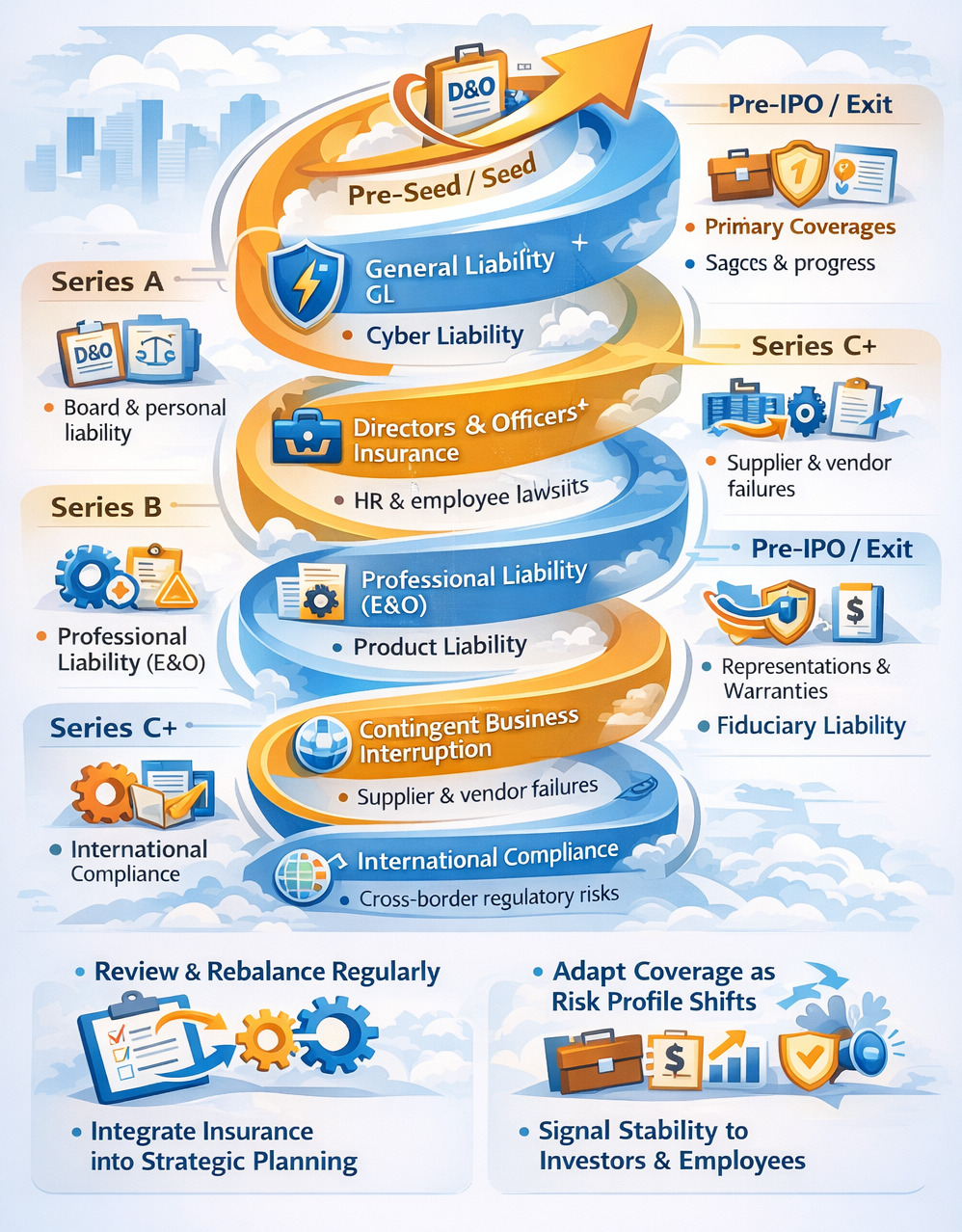
I have come to see insurance not as a checklist but as a portfolio, one that must be reviewed, optimized, and rebalanced like any asset allocation. Early on, general liability and cyber coverage provide foundational protection. Later, as teams expand and governance tightens, employment practices and D&O insurance become more critical. As revenues scale, contingent business interruption and professional liability rise in importance.
Insurance Coverage Portfolio by Startup Stage
| Stage | Primary Coverages | What It Protects | Why It Matters |
| Pre-Seed / Seed | General Liability, Cyber Liability | Property damage, third-party injury, data breaches | Foundation layer. Protects against early operational risks and customer data exposure. |
| Series A | D&O Insurance, EPLI (Employment Practices Liability) | Directors/officers personal liability, employment disputes | Board formation and hiring velocity increase governance and HR risk exposure. |
| Series B | Professional Liability (E&O), Product Liability | Errors/omissions in service delivery, product defects or failures | Revenue scale and customer concentration amplify contract and product performance risk. |
| Series C+ | Contingent Business Interruption, International Compliance | Supplier/vendor failures, cross-border regulatory exposure | Global expansion and complex vendor dependencies introduce systemic operational risk. |
| Pre-IPO / Exit | Representations & Warranties Insurance, Fiduciary Liability | M&A transaction risks, ERISA/benefits plan obligations | Transaction readiness and mature benefits programs require specialized coverage. |
This table maps how insurance needs evolve as startups mature. Early stages focus on foundational operational risks. Growth stages add governance and employment risks as teams and boards expand. Scale stages introduce vendor dependencies, professional liability, and international compliance. Exit stages require transaction-specific and fiduciary coverage. Each stage reflects the risk texture of the business model at that moment.
In this context, insurance works best when managed as a strategic risk portfolio, not an annual compliance item. I have implemented coverage audits at each planning cycle, with finance, legal, and operations reviewing the current portfolio against upcoming strategic moves. M&A plans, new markets, vendor dependencies, and regulatory exposure all factor into the rebalancing process. This audit does not just adjust premiums. It shifts posture from reactive risk management to proactive risk transfer.
Framing Insurance in the Boardroom
I often advise CFOs and founders to integrate insurance into board-level capital conversations. Too often, coverage discussions occur in a separate operational thread, disconnected from equity allocation and runway planning. This separation weakens decision architecture. Insurance, when understood properly, extends runway not just by avoiding loss but by reducing future capital inefficiency.
The framing is simple. A $10 million funding round may be compromised by a $2 million uninsured legal hit. That risk should sit on the board’s radar next to burn rate and revenue pipeline. When founders articulate insurance in these terms, they reposition it from cost center to capital shield.
I recall one board meeting where we ran a scenario tree. What happens to dilution if a key employee lawsuit arises without EPLI? What happens to cash position if a cyber event occurs during a product launch? The board responded not by cutting coverage but by enhancing it. They understood that the premium paid was insurance not just against operational loss but against future valuation erosion.
Rethinking Brokers as Strategic Partners
Founders often treat insurance brokers as vendors. I suggest they treat them as advisors. A strong broker understands industry-specific risks, emerging regulatory trends, and the evolving needs of scaling companies. But to unlock that expertise, founders must engage them beyond the transactional level.
I routinely invite brokers into strategic planning sessions. I ask not for quotes but for perspectives. What claims trends are they seeing across similar stage companies? What blind spots have surfaced in recent litigation? How are insurers pricing risk associated with AI, platform liability, or gig economy models?
When brokers see that the founder values their intelligence, they respond with higher engagement. They bring in specialists, flag underwriter bias, and surface alternative structures. I have seen this improve not just coverage quality but insurer responsiveness in claims resolution, which during high-stakes scenarios often defines outcomes.
Insurance as Signal to Investors and Employees
Startups trade in confidence. Investors bet on competence and foresight. Employees bet on safety and alignment. Insurance, when framed correctly, signals both. A startup with a thoughtful risk posture tells investors: we anticipate volatility and plan for downside. That signal is especially powerful in later-stage funding rounds, where operational maturity weighs as heavily as product-market fit.
For employees, the message is equally potent. I once onboarded an engineering lead who asked whether we had cyber insurance covering third-party code contributions. Because we had already scoped coverage accordingly, the conversation reinforced trust. He later shared that this transparency influenced his decision to join. Engineers, marketers, and product managers watch how leadership manages risk. They infer culture from contingency planning.
Making Risk Review a Strategic Ritual
The most effective way to rethink insurance is to make risk review a recurring, visible practice. I have instituted what I call the Strategic Risk Review as a quarterly ritual. It includes finance, legal, operations, and product leadership. Each quarter, we ask three questions:
- What new risks have we assumed since the last cycle?
- Which risks remain unaddressed?
- Which risks are now insurable, and should we offload them?
This exercise takes less than an hour but changes how teams think. The product roadmap triggers conversation about IP liability. A hiring plan sparks debate about employment practice coverage. A vendor dependency leads to contingent interruption considerations. The point is not to eliminate risk but to catalog it, evaluate it, and assign ownership.
When risk becomes a shared language rather than a backstage technical domain, insurance emerges as a tool of leadership. It enables bold decisions without reckless exposure and allows teams to focus on growth with clarity.
Conclusion
Startups will always chase growth, disruption, and market advantage. That pursuit is both noble and necessary. But it must be paired with an equally disciplined understanding of fragility. Insurance is not a bureaucratic artifact. It is a form of strategic architecture that allows founders to take risk by offloading risk.
Founders who understand this do not treat insurance as a checkbox. They treat it as an asset class, one that does not generate revenue but enables it. They see in risk not just danger but design. They recognize that building an enduring company requires more than product vision and customer insight. It requires a deep awareness of what can go wrong and a plan for when it does. Insurance, when engaged strategically, becomes the mechanism through which founders protect not just their companies but their capacity to lead through uncertainty.
Disclaimer: This blog is intended for informational purposes only and does not constitute legal, tax, or accounting advice. You should consult your own tax advisor or counsel for advice tailored to your specific situation.
Hindol Datta is a seasoned finance executive with over 25 years of leadership experience across SaaS, cybersecurity, logistics, and digital marketing industries. He has served as CFO and VP of Finance in both public and private companies, leading $120M+ in fundraising and $150M+ in M&A transactions while driving predictive analytics and ERP transformations. Known for blending strategic foresight with operational discipline, he builds high-performing global finance organizations that enable scalable growth and data-driven decision-making.
AI-assisted insights, supplemented by 25 years of finance leadership experience.