
Executive Summary
A quiet revolution is taking place inside the enterprise, not in marketing slogans but in how companies think about value, time, and vision itself. Financial automation, once dismissed as a mechanical efficiency play, has become the crucible for innovation in corporate strategy. For most of corporate history, finance has been the keeper of the past. It reconciled what had already occurred and measured the known. Yet with automation, the balance of attention is shifting. Freed from the labor of tallying and tracking, finance is beginning to look forward with new eyes. When real-time data flows through intelligent systems, when anomalies surface autonomously, and when forecasts adjust themselves on fresh inputs, the role of finance morphs from archivist to architect. But vision is not shaped by automation alone. It is shaped by the clarity with which leadership reads the signals that automation surfaces. Corporate vision blurs not through dramatic failure but through quieter forces: data noise, short-termism, internal misalignment, the seduction of consensus, and the hesitation that fear breeds. To restore vision is to remember what mattered before the noise set in. Finance, often the most underestimated function in the vision conversation, becomes vital in this restoration. Budgets, forecasts, and KPIs are not just control mechanisms. They are expressions of what a company values. When automation liberates thought and strategy is recalibrated with humility, the distance between idea and execution narrows. The most inspiring companies are not those that see farther. They are those that see more honestly.
The Revolution Beneath the Surface
In the earliest days of the industrial firm, the machinery of progress was loud. Ledgers crackled under the weight of handwritten entries. The rhythm of commerce was physical and unmistakable. But as decades passed, another rhythm began to pulse beneath the surface, one that did not clang or crackle but clicked. Quietly. Persistently. Invisible to most, yet transformative in every sense. That rhythm is automation. And nowhere has its presence been more quietly revolutionary than in finance.
It is a curious paradox that the function once most associated with bureaucracy, reporting, reconciling, approving, forecasting, has become the crucible for innovation in corporate strategy. But spend any meaningful time with the evolution of financial automation and you will see that this transformation is not merely mechanical. It is philosophical. Because to automate finance is not just to accelerate it. It is to reimagine the way companies think about value, time, and vision itself.
At its most basic, financial automation replaces human effort with algorithmic precision. Month-end closes that once consumed weeks now collapse into days. Invoice approvals, journal entries, intercompany eliminations, tasks that once required rituals of email and spreadsheets, now flow with the cold efficiency of code. The promise is speed, accuracy, and cost reduction. And indeed, those promises are real. But beneath the surface, something deeper is happening. Automation does not just change what finance teams do. It changes what they are for.
From Archivist to Architect
For most of corporate history, finance has been the keeper of the past. It reconciled what had already occurred. It measured the known. It built models to project the probable. Its tools, ledgers, statements, and budgets, reflected this backward gaze. Finance was about proof. Yet with automation, the balance of attention is shifting. Freed from the labor of tallying and tracking, finance is beginning to look forward with new eyes. When real-time data flows through intelligent systems, when anomalies surface autonomously, when forecasts adjust themselves based on fresh inputs, the role of finance morphs from archivist to architect. And architects, unlike archivists, do not merely observe the past. They shape the future.
How Financial Automation Reshapes Corporate Vision
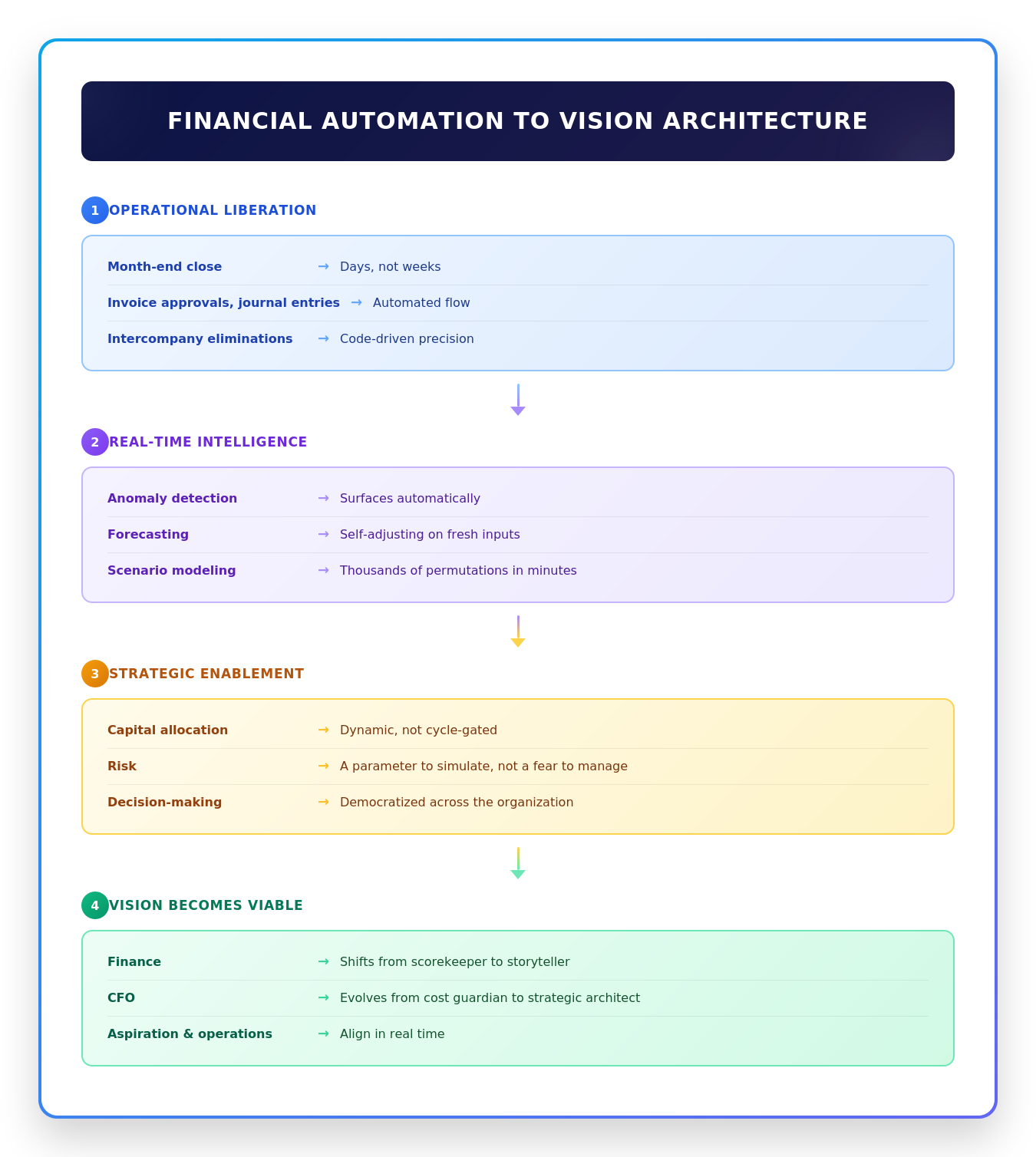
This architecture illustrates how financial automation progresses from freeing teams of routine operational burden, through enabling real-time intelligence and scenario analysis, into strategic decision-making, and finally into a state where corporate vision is no longer a declaration made in isolation but a living system visible in dashboards, simulations, and daily operations. Each layer builds on the one beneath it. Without operational liberation, real-time intelligence has no room to breathe. Without intelligence, strategy remains reactive. And without strategy, vision remains aspiration.
The Effect on Capital Allocation and Scenario Planning
Consider the effect on capital allocation. In the old model, investment decisions were gated by cycles, quarterly reviews, annual plans, episodic re-forecasts. The tempo was slow, the data aged, and the judgment fraught. But with automated forecasting and predictive modeling, companies can re-allocate capital dynamically. They can respond to market shifts not with anxiety but with agility. The corporate vision becomes less a monolith and more a motion picture, updated, iterated, and lived.
Scenario planning illustrates this further. Once the province of static spreadsheets and best-guess inputs, scenario analysis now lives in AI-driven systems that test thousands of permutations in minutes. A global demand shock, a commodity spike, a regulatory swing, these no longer trigger chaos. They trigger simulation. Risk becomes less of a fear and more of a parameter. Vision becomes anti-fragile.
But perhaps the most profound change is cultural. Financial automation, properly embedded, changes how organizations make decisions. It democratizes data and reduces dependency on gatekeepers. When a product manager can explore profitability impacts of a pricing change in real time, when a regional lead can model headcount scenarios without waiting for FP&A, the organization shifts from hierarchy to velocity.
What Blurs Corporate Vision
In every boardroom, there is a moment when someone asks where the company is going. The question seems obvious, yet it is the most difficult to answer with precision. Not because the company lacks goals. Often there are too many. The difficulty lies in the fog between aspiration and awareness, between what is imagined and what is actually unfolding.
Corporate vision is meant to be the lighthouse, a fixed point guiding the enterprise through uncertainty. But vision, like light, can refract. And when it does, what once looked bold can grow blurry. There are many causes of this blurring. Some are structural. Others are psychological. All are deeply human.
The Five Forces That Erode Vision
| Force | How It Operates | Consequence | Early Signal |
| Data Noise | Information flows endlessly. Dashboards glow. Metrics multiply. But clarity is a function of discernment, not quantity. | Decision-makers drown in contextless detail. Vision loses its edge not because it was wrong but because no one can see it through the haze. | Meetings resolve nothing. Reports grow longer but less actionable. |
| Short-Termism | Quarterly targets, investor expectations, and algorithmic volatility pull leadership’s gaze downward. Tactical wins eclipse long-term positioning. | Efficiency masquerades as strategy. New initiatives are abandoned because returns are not immediate. The organization becomes excellent at goals it no longer remembers choosing. | Product roadmaps stall. Hiring freezes appear mid-strategy. |
| Internal Misalignment | Different teams interpret the same vision differently. Product sees innovation. Sales sees velocity. Finance sees margin. Each optimizes for its piece. | Strategic dissonance becomes normalized. No one owns the full picture. Drift is gradual but relentless. | Language diverges across departments. Cross-functional projects stall at handoffs. |
| Consensus Seduction | In an effort to be inclusive, leadership rounds the corners of bold ideas. Vision statements are edited until they offend no one and inspire fewer. | The original impulse is dulled by diplomacy. What remains is pleasant, palatable, and forgettable. | Strategy documents read like committee outputs. No one can articulate a single differentiating conviction. |
| Quiet Fear | Not dramatic fear, but hesitation. Fear of being wrong. Fear of market reaction. Fear of dissent. This fear breeds delay. | Decisions are deferred. Strategies are hedged. The future becomes something to mitigate, not design. Vision becomes a risk to manage, not a force to build toward. | Timelines stretch without justification. Strategic conversations become status updates. |
Vision does not blur all at once. It fades the way a photograph left in sunlight fades, imperceptibly, and then completely. The challenge for leadership is to see clearly, and to help others see with them, not just in moments of triumph but precisely when the fog begins to roll in.
Restoring and Realigning Vision
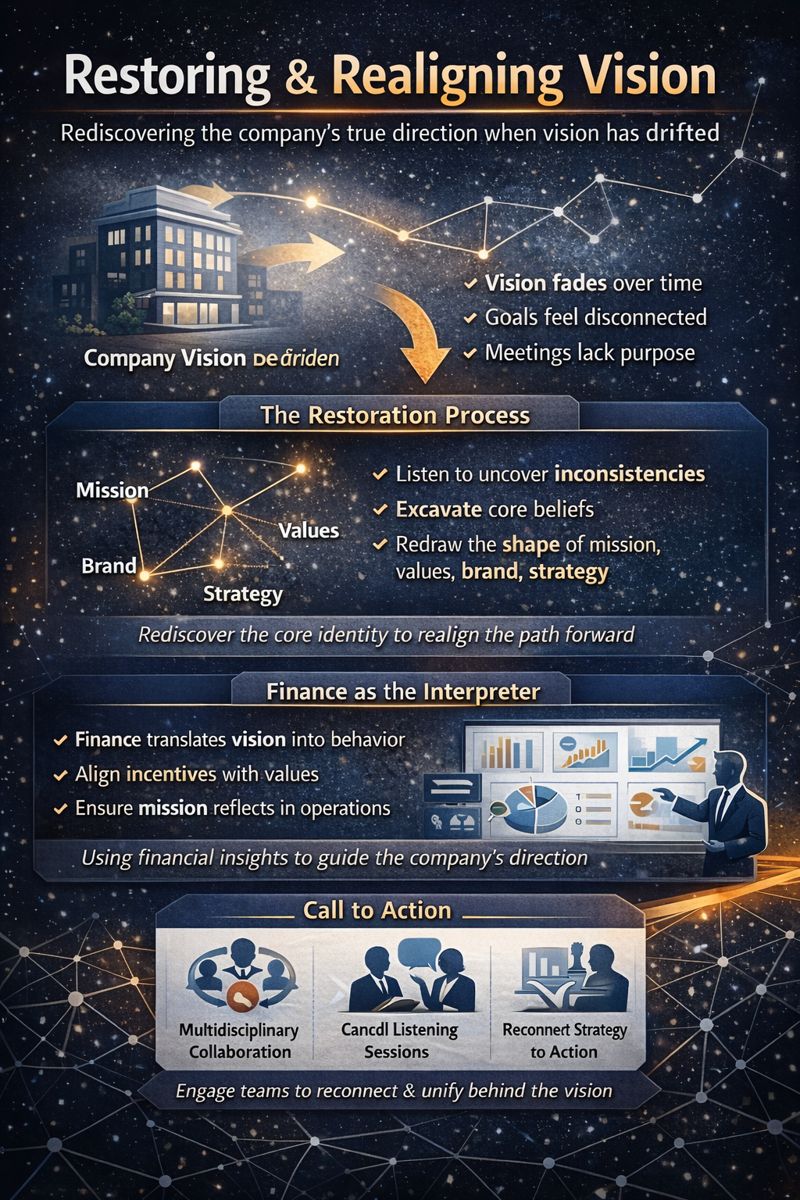
There comes a point in the life of nearly every company when the vision begins to drift. Not publicly, not catastrophically, but subtly. You see it in the slow creep of meetings that resolve nothing, in strategies that feel disconnected from the pulse of the product, in the unease that settles over a team not because they are failing but because they are no longer sure what they are succeeding at.
Vision does not collapse overnight. It fades, like memory left unattended. And when that happens, the real work begins, not of reinvention, but of restoration.
The Restoration Process
To restore vision is to remember what mattered before the noise set in. It is not the invention of a new narrative. It is the excavation of an old truth, buried beneath years of metrics, pivots, expansion plans, and investor decks. The most powerful visions are not manufactured. They are rediscovered.
In many ways, a corporate vision is like a constellation. Its points are scattered, mission, values, long-term strategy, and brand identity, but when drawn together with care and context, they tell a story of direction. When the drawing fades, the dots remain, but the shape is lost. The task of realignment is to draw the shape again.
It begins not with grand declarations but with listening. Founders and CEOs often believe their job is to speak the vision into existence. But restoration begins more quietly. It begins in rooms where people speak candidly about what no longer makes sense. About the assumptions that have gone stale. About the goals that no longer feel anchored. These conversations, often awkward and vulnerable, are where the signal starts to emerge from the noise. A well-led organization will not fear this vulnerability. It will make space for it. Because confusion is not failure. It is feedback.
Finance as the Interpreter
Once the gaps are visible, the next task is coherence. A company may still believe in its founding mission, but if that mission is no longer legible in its product, its pricing, or its culture, then it is no longer vision but nostalgia. Realignment means reconnecting the abstract with the operational. It means ensuring that what a company aspires to be is visible in what it actually does.
This is where finance, often the most underestimated function in the vision conversation, becomes vital. Finance is the interpreter of belief into behavior. Budgets, forecasts, and KPIs are not just control mechanisms. They are expressions of what a company values. If the vision speaks of long-term trust but the incentive plan rewards short-term wins, the dissonance is not philosophical. It is architectural.
Realignment, then, must be multidisciplinary. It is not the work of branding alone, or strategy alone, or HR alone. It is a joint project, part audit, part design. And it must include not just the leaders who set the vision but the operators who enact it. That inclusion is not just symbolic. It is practical. Vision that does not reflect the lived experience of the organization will never be fully believed. The team must be able to see themselves in it, not as bystanders but as protagonists.
The Perils of Over-Reliance
Even in the promise of automation, there are perils. A poorly implemented system can calcify bad assumptions at scale. A dashboard can become a crutch. A model, if over-trusted, can lull leadership into false certainty. And when automation is pursued solely for efficiency, without a corresponding investment in interpretation, the result is not clarity but noise.
The answer is not to reimagine vision through automation, but alongside it. Automation should not replace judgment. It should enhance it. It should clear the underbrush of routine so that insight can flourish, making room not just for faster numbers but for deeper questions: what should we measure? What should we believe? What should we build?
The Gift of Recovered Time
In this light, the real gift of financial automation is time. Time reclaimed from reconciliation can be given to curiosity. Time freed from reporting can be spent on reflection. Time once lost in the cycle of close and reforecast can be repurposed toward learning and imagining. And in this recovered time, vision returns, not as a slogan on a wall but as a discipline in the room.
Once momentum builds through restored vision, small changes become significant. A clarified mission leads to sharper product decisions. A reframed set of values reorients hiring. A simplified strategy enables better capital allocation. These movements are not loud. But they are deeply directional.
There is a moment in every restoration where the organization feels something click back into place. Meetings begin to converge. Language aligns. Priorities feel less like trade-offs and more like expressions of purpose. It is not that ambiguity vanishes. It is that it becomes navigable.
But even as vision is restored, it must remain dynamic. The world changes. Markets evolve. Certainties dissolve. A restored vision is not a monument. It is a compass. And like any compass, it must be recalibrated regularly, honestly, and collectively. That calibration requires rituals, not performative town halls or stylized updates, but real pauses where leadership revisits the central questions:
- What do we believe now?
- What do we know now?
- What do we want to change, and what must never change?
These are not quarterly check-ins. They are the company’s version of breath.
Conclusion
It is easy, in this age of dashboards and AI, to think that automation will bring certainty. It will not. But it can bring coherence. It can help companies align their ambition with their operations, reveal when strategy drifts, and make vision not just visible but viable.
When the work of realignment is done with care, when automation is matched with interpretation, and when vision is treated not as an emergency measure but as an ongoing practice, the company begins to move not just faster but more gracefully. The most inspiring companies are not those that see farther. They are those that see more honestly. And that is not magic. It is discipline.
Disclaimer: This blog is intended for informational purposes only and does not constitute legal, tax, or accounting advice. You should consult your own tax advisor or counsel for advice tailored to your specific situation. Hindol Datta is a seasoned finance executive with over 25 years of leadership experience across SaaS, cybersecurity, logistics, and digital marketing industries. He has served as CFO and VP of Finance in both public and private companies, leading $120M+ in fundraising and $150M+ in M&A transactions while driving predictive analytics and ERP transformations. Known for blending strategic foresight with operational discipline, he builds high-performing global finance organizations that enable scalable growth and data-driven decision-making.
AI-assisted insights, supplemented by 25 years of finance leadership experience.