
Executive Summary
A quiet revolution is taking place inside the enterprise, not in marketing slogans but in how work is actually getting done. We are witnessing the rise of multi-agent workflows, where artificial intelligence agents no longer just assist humans in isolated tasks but collaborate with one another, negotiate trade-offs, escalate ambiguity, and increasingly make decisions autonomously. This shift changes not just productivity metrics but the very nature of enterprise architecture, organizational control, and risk governance. Having spent three decades in finance and operations across high-growth SaaS firms, supply chains, healthcare systems, and professional services, the most powerful changes in business tend to arrive disguised as efficiency gains. The technical evolution that makes multi-agent coordination possible is not just about better models. It is about coordination logic, the ability for agents to call one another, share context, handle ambiguity, and respond to reward signals. The unit of execution is no longer the function or even the team. It is the agent ecosystem. Boards and CFOs should understand that this is not science fiction. It is already operating in vendor selection, FP&A planning, inventory allocation, and legal triage. What changes is not just speed but accountability. Velocity is not the same as judgment. For that, we must design escalation wisely, measure agent disagreement transparently, and retain human stewardship where stakes exceed computation.
The Shift From Automation to Coordination
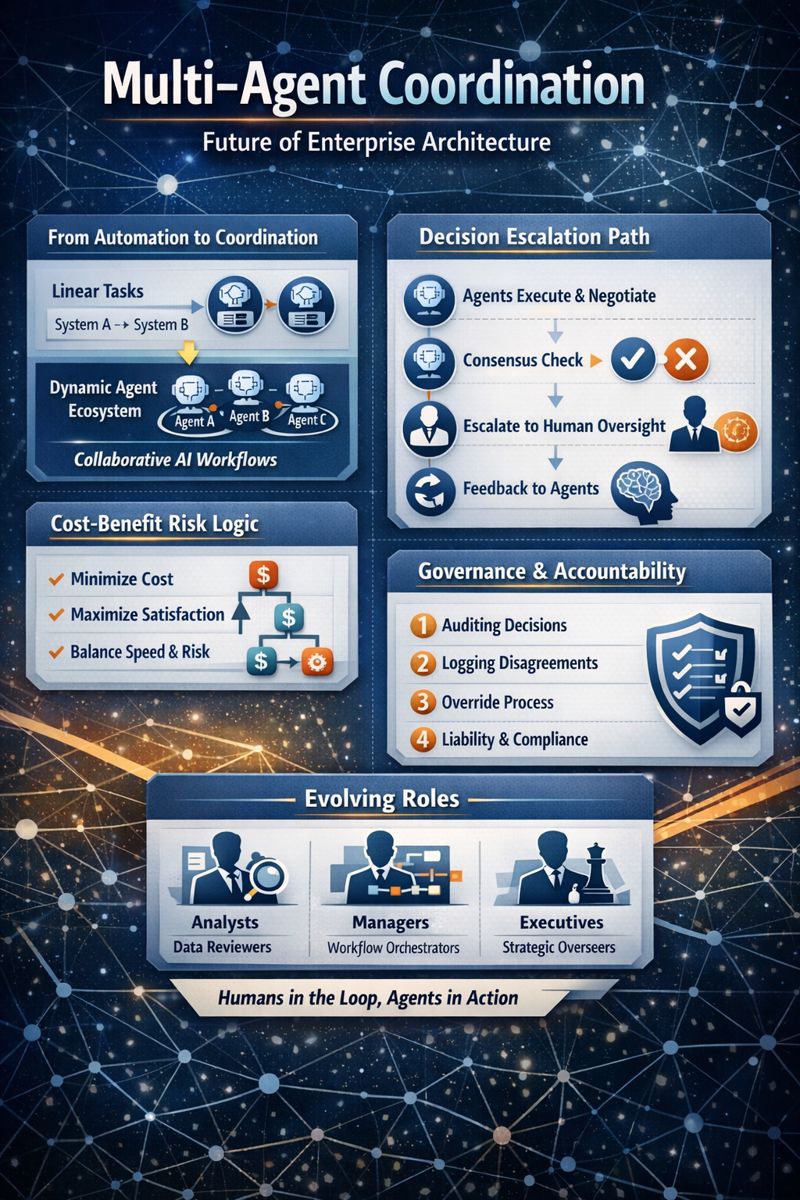
In traditional automation, workflows are linear. A task moves from system A to system B through a defined API or set of logic gates. But with multi-agent systems, the architecture becomes dynamic. Agent A handles data retrieval. Agent B summarizes and detects anomalies. Agent C negotiates thresholds with Agent D. If consensus fails, the system escalates to a human-in-the-loop. This is not just a process. It is a conversation, encoded in computation.
In one Series B fintech company I advised, we implemented a multi-agent system to manage pricing approvals for mid-market clients. One agent monitored deal desk thresholds, another modeled customer LTV based on historical cohorts, and a third reviewed legal risk exposure based on contract clauses. When the agents agreed, pricing was auto-approved. When they diverged, say high LTV but high legal risk, the system escalated to an executive for intervention. What was once a 48-hour cross-functional task became a 15-minute agent conversation, with human judgment reserved for the 5 percent of cases where consensus failed.
Multi-Agent Coordination Architecture
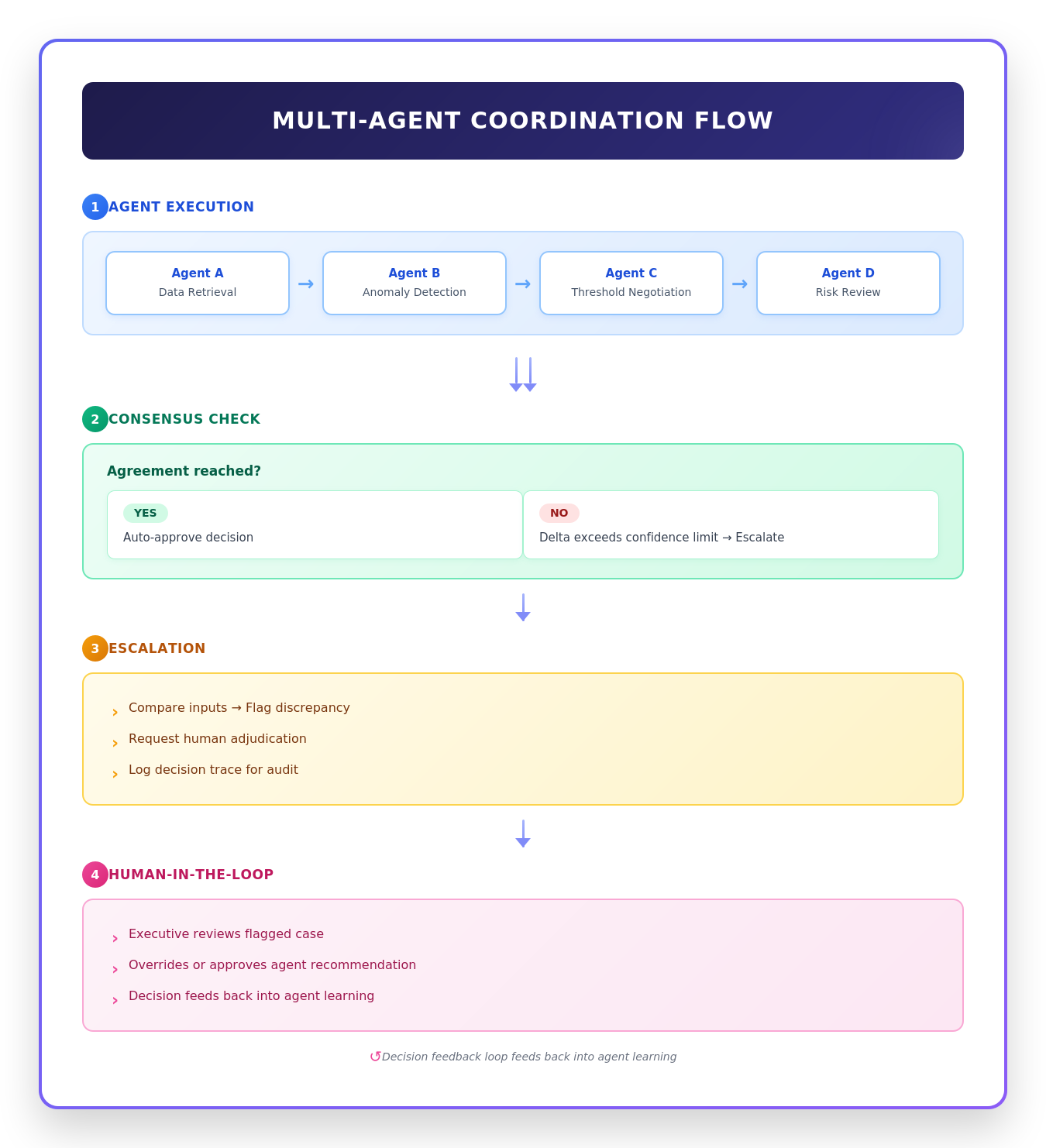
This architecture shows how multi-agent systems move from execution through consensus checking to escalation and finally to human oversight. The four layers work in sequence: agents execute and negotiate, the system evaluates whether agreement has been reached, disagreement triggers a structured escalation path, and human judgment enters only where stakes or uncertainty warrant it. The feedback loop from human decisions back into agent learning is what makes the system improve over time.
Cost-Benefit Risk Trees and Decision Logic
At the heart of coordination is the cost-benefit risk tree. Each agent evaluates options not just based on local optimization but against shared global goals: minimizing cost, maximizing customer satisfaction, reducing time-to-decision. An agent proposing an exception to a procurement policy does so because it weighs the delay cost of a compliance review against the projected revenue gain of expedited deployment. This decision logic, once reserved for senior managers with spreadsheets and heuristics, now resides in a negotiation graph navigated by machines.
In a global logistics firm I worked with, agents managing customs documentation saved thousands of hours annually while reducing error rates by 70 percent. The payoff was clear because the work was repetitive, data-rich, and human-fatiguing. But in high-judgment contexts like investor relations or M&A negotiations, agent contribution may be best confined to pre-diligence preparation, not final word.
Governance and Accountability
As multi-agent systems proliferate, governance becomes both more critical and more complex. Enterprises must define clear answers to four questions:
- Who audits agent decisions, not just technically but organizationally?
- How are disagreements logged, explained, and learned from?
- What is the override process, and can humans veto consensus outputs?
- Where does liability reside, particularly in regulated industries where that question carries legal weight?
These are not afterthoughts. They are architectural requirements. Without them, multi-agent systems risk replicating the same silos they were designed to overcome.
Deployment and Organizational Redefinition
The pragmatic path forward is graduated. Begin where clarity is high, stakes are moderate, and learning loops are short. Let agents schedule, sort, summarize, flag, and simulate. Then graduate them to negotiation and escalation. Finally, allow them to decide, but only when you can replay, audit, and learn from every decision trace.
The rise of multi-agent workflows will also rewire organizational roles. Analysts will become reviewers of agent outputs and curators of training data. Managers will become orchestrators of workflows, ensuring agents talk to the right peers at the right time with the right context. This is not job loss. It is job redefinition.
Conclusion
For the C-suite, the implications are strategic. AI agents coordinating in real time will outperform human committees operating in monthly cycles. Strategic planning, scenario modeling, and resource allocation will move from static slides to living systems. The boardroom will no longer ask for the FP&A deck. It will ask for the agent’s model and the counterfactuals it considered.
We are not building machines to replace managers. We are building machines to negotiate with one another and escalate to managers when it matters most. The enterprise is becoming a network of agents, with humans in the loop, not on the loop. And in that architecture lies the future of how companies will scale, decide, and compete.
Disclaimer: This blog is intended for informational purposes only and does not constitute legal, tax, or accounting advice. You should consult your own tax advisor or counsel for advice tailored to your specific situation.
Hindol Datta is a seasoned finance executive with over 25 years of leadership experience across SaaS, cybersecurity, logistics, and digital marketing industries. He has served as CFO and VP of Finance in both public and private companies, leading $120M+ in fundraising and $150M+ in M&A transactions while driving predictive analytics and ERP transformations. Known for blending strategic foresight with operational discipline, he builds high-performing global finance organizations that enable scalable growth and data-driven decision-making.
AI-assisted insights, supplemented by 25 years of finance leadership experience.