
Executive Summary
In the contractual landscape, glamour lies in deal origination, yet behind every contract lies a sobering necessity: the exit architecture. Escrow agreements, stepdown provisions, and termination rights are essential hedges against irreversibility, ensuring that when partnerships unravel, financial scaffolding does not collapse. In volatile markets, exit planning is fiduciary foresight. The challenge for CFOs lies in designing contracts that remain flexible without becoming fragile. Termination should be a process, not a rupture. Exit design is not paranoia but clarity. When exits are clearly structured, they rarely escalate into disputes. Ambiguity is the true enemy of continuity. Beyond protection, exit provisions serve as instruments of leverage, introducing consequences into partnerships and forcing accountability. They create real options, preserving the ability to pivot without catastrophic loss. Well-structured exit rights are not distrust but institutional discipline.
The Strategic Imperative of Exit Architecture
In contractual commerce, glamour lies in deal origination. Yet behind every contract lies a sobering necessity: the exit architecture. Having managed contract negotiations and risk mitigation frameworks while overseeing procurement, these function as prudence, ensuring that when partnerships unravel, financial scaffolding does not collapse.
In volatile markets, exit planning is fiduciary foresight. The challenge lies in designing contracts that remain flexible without becoming fragile, where economic logic intersects legal language. Termination, when needed, should be a process, not a rupture.
Contract Exit Architecture Framework
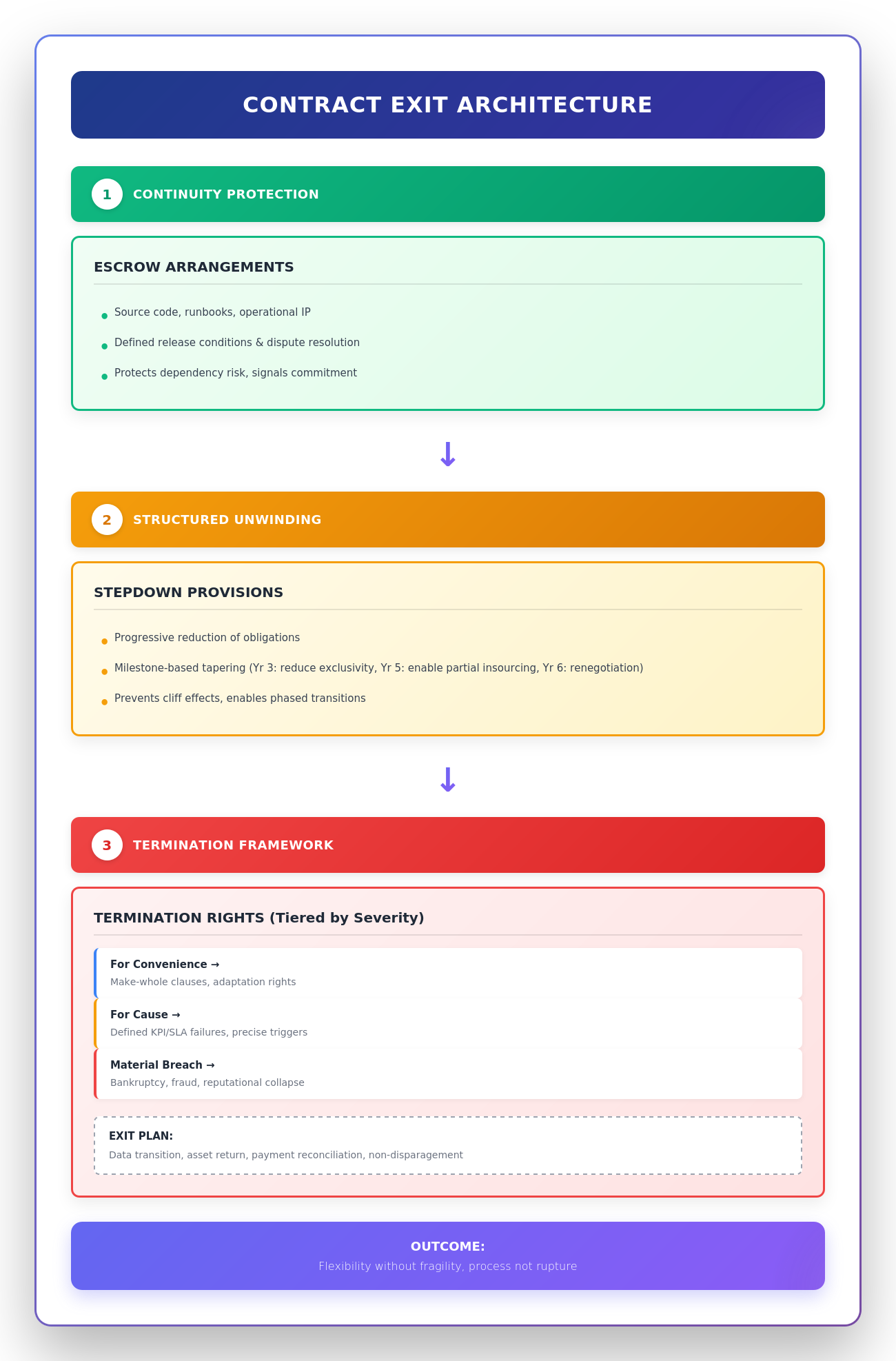
This framework illustrates the layered approach to contract exits, starting with continuity protection through escrow, moving through structured unwinding via stepdown provisions, and culminating in the termination framework. Each tier builds upon the previous one, creating a comprehensive exit architecture that balances protection with operational flexibility. The arrows show the progressive escalation from preventive measures to final termination options, with clear triggers and outcomes at each stage.
Escrow Arrangements: Engineered Resilience
Escrow arrangements provide the first line of defense. While commonly associated with intellectual property or M&A holdbacks, their role in service delivery contracts is equally profound. When structured correctly, escrow protects both parties by ensuring continuity in the event of failure. For example, a vendor delivering critical technology services might place source code, runbooks, or operational IP into escrow, to be released only under narrowly defined failure conditions.
The design must go beyond binary logic. What defines release conditions? Who certifies default? Finance leaders must ensure escrow conditions align with risk tolerance, operational criticality, and working capital exposure. Escrow assures continuity not by extending trust but by managing it.
Stepdown Provisions: Preventing Cliff Effects
Stepdown provisions progressively reduce obligations or unwind complexity as a contract nears conclusion. Stepdowns create tapering effect, allowing both parties to decelerate operations in a structured way, contrasting with abrupt terminations that result in stranded costs and data discontinuities. By embedding these in access rights, service levels, or volume commitments, the CFO introduces optionality.
Stepdowns are particularly effective in long-duration contracts. In five- or seven-year engagements, macroeconomic or organizational changes are probable. Stepdown logic ensures exit does not become a cliff. It can be tied to milestones: year three marks reduced exclusivity, year five enables partial insourcing, year six triggers renegotiation rights. These provisions act as implicit risk-sharing.
Termination Rights: Tiered by Severity
Termination rights represent the final tier in this architecture. Their role is often misunderstood. Termination should not be seen as relationship failure but as recognition of structural change. The key lies in tiering termination clauses into multiple layers, each carrying different rights, obligations, and financial consequences:
Termination for Convenience allows one party, typically the customer, to exit without assigning fault. It protects the right to adapt but must be offset by make-whole clauses to prevent opportunistic behavior.
Termination for Cause is triggered by defined failures in delivery, timelines, or performance metrics. These clauses must be precise, tied to unambiguous KPIs or SLAs.
Material Breach covers existential threats including bankruptcy, fraud, or reputational collapse. The CFO must ensure that termination triggers are neither too lax nor too restrictive. An overly permissive termination right undermines commercial trust; an overly rigid one creates vulnerability.
The real sophistication lies in aftermath planning. Termination is not the end of obligation but the beginning of resolution. Contracts must detail the exit plan: data transition protocols, asset return processes, outstanding payment reconciliations, and non-disparagement covenants. These clauses require more than legal interpretation; they demand operational choreography.
Exit Provisions as Strategic Levers
Beyond protection, exit provisions serve as instruments of leverage and governance. They introduce consequences into partnerships and force accountability. They create real options, preserving the ability to pivot without catastrophic loss.
CFOs must treat exit clauses as capital allocation tools. In industries where demand is cyclical or service providers are capacity-constrained, exit flexibility allows dynamic cost redeployment. If exit clauses are tiered correctly, the enterprise can rebalance vendors without double payment or reputational risk.
The interplay between exit clauses and financial modeling cannot be overstated. A termination-for-convenience clause alters revenue recognition logic, especially in multi-year deals. Similarly, stepdown provisions impact liability recognition and contingent cost forecasts. A CFO must engage in contract review not just for cost but for optionality.
In high-uncertainty sectors, firms quantify the financial value of exit architecture. Scenario modeling calculates asset write-downs, customer churn, transition costs, and reputational impact. These models inform reserve planning and vendor dependency risk. In this framing, exit clauses are quantifiable hedges.
Termination rights also serve as behavioral nudges. When well-crafted, they compel partners to maintain performance discipline. But when vendors know terminations are rarely enforced, clauses become ceremonial. This is why enforcement history matters.
Operational Excellence in Exit Management
CFOs must champion digitization of contract governance. Traditional exit clauses often sit dormant in PDFs, activated only during crisis. A better model integrates these into contract lifecycle management systems. Dashboards track clause maturity, SLA breaches, and trigger thresholds. Alerts notify when stepdown rights approach or escrow triggers are at risk.
There is also a leadership dimension. In moments of disengagement, how a company exits often matters more than why. A poorly handled termination can unravel years of goodwill. Conversely, a well-managed exit that is transparent and fair can reinforce brand reliability. This maturity distinguishes short-term traders from long-term operators.
Conclusion
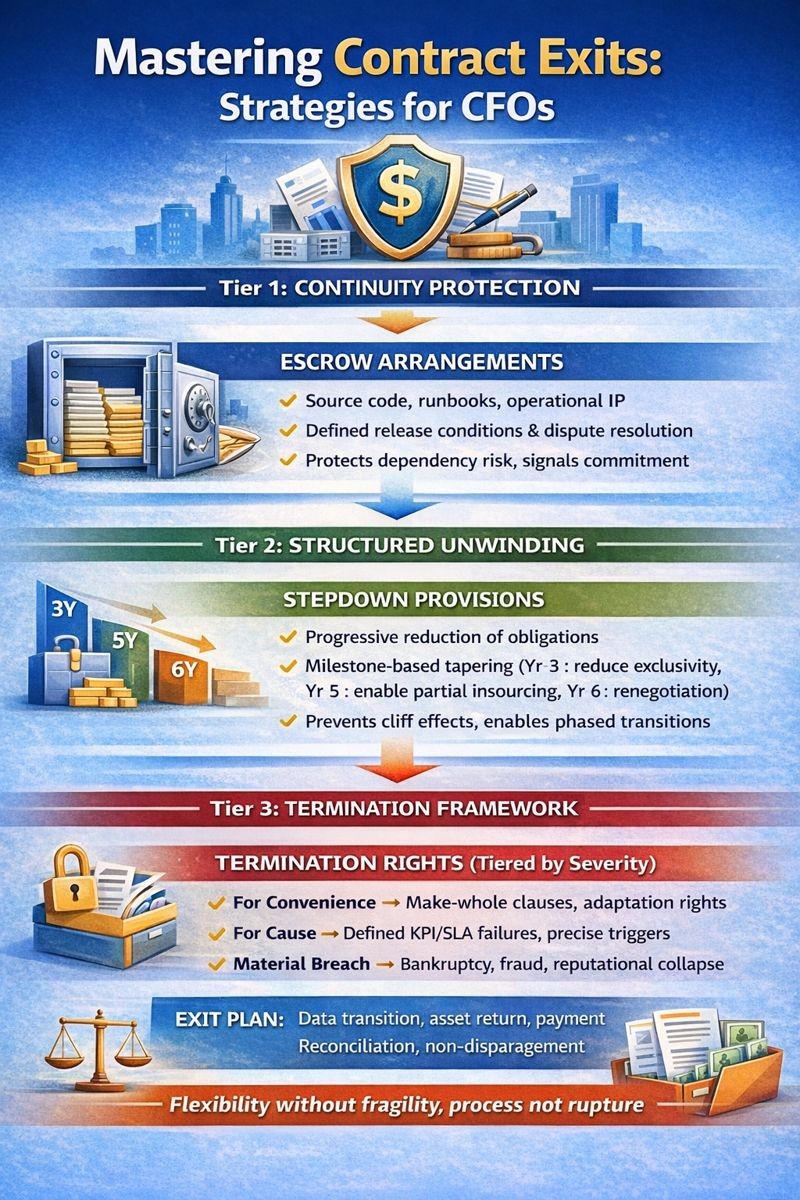
The future of contract governance lies not in complexity but in completeness. Escrow, stepdowns, and termination rights must not be bolt-on features but integrated parts of commercial architecture. They are the quiet circuits of resilience, activated only when needed but designed with the same care as revenue models or incentive curves. CFOs who internalize this philosophy transform worst-case scenarios from existential threats into structured resolutions. They do not merely survive disruption but choreograph it, ensuring that exit design becomes not an exercise in paranoia but in clarity, creating institutional discipline that preserves flexibility without fragility.
Disclaimer: This blog is intended for informational purposes only and does not constitute legal, tax, or accounting advice. You should consult your own tax advisor or counsel for advice tailored to your specific situation.
Hindol Datta is a seasoned finance executive with over 25 years of leadership experience across SaaS, cybersecurity, logistics, and digital marketing industries. He has served as CFO and VP of Finance in both public and private companies, leading $120M+ in fundraising and $150M+ in M&A transactions while driving predictive analytics and ERP transformations. Known for blending strategic foresight with operational discipline, he builds high-performing global finance organizations that enable scalable growth and data-driven decision-making.
AI-assisted insights, supplemented by 25 years of finance leadership experience.