Executive Summary
In every economic cycle, there come moments when even the most seasoned leadership teams confront the unsettling realization that the business as it stands is no longer viable. Whether due to strategic missteps, macroeconomic turbulence, or technological obsolescence, companies find themselves on the edge of decline. At such moments, the imperative is not merely to stabilize but to reconstruct. And reconstruction must begin not with platitudes or vision statements but with a confrontation of truth. This truth is most unflinchingly found in the company’s balance sheet, the clearest mirror of what the company owns, what it owes, and what remains for its shareholders. Turnarounds that endure are built from this bedrock of financial reality. For the modern CFO, this moment demands a forensic mindset. It is not enough to understand the historical cost of an asset or the contractual terms of a liability. One must understand the economic utility of each balance sheet component and whether it serves the company’s strategic direction.
The Balance Sheet as Diagnostic Instrument
The role of the balance sheet in a corporate turnaround is both diagnostic and prescriptive. It reveals the structural imbalances and embedded inefficiencies that often precipitate crisis. A balance sheet in distress may show bloated inventory levels, over-leveraged capital structures, impaired goodwill, and unproductive assets.
Throughout twenty-five years leading finance organizations across cybersecurity, SaaS, gaming, and logistics, I have witnessed companies cling to income statement narratives while their balance sheets groaned under accumulating risk. At one logistics organization managing one hundred twenty million in revenue, forensic examination revealed inventories had grown thirty-five percent year-on-year while sales rose only five percent. The overhang tied up capital and strained cash flow.
Leaders who seek to engineer a turnaround must interrogate each line item, asking: Does the working capital cycle support or constrain growth? Are long-term assets utilized at competitive efficiency? Is the capital structure resilient to macroeconomic shocks? Which assets directly drive the business model forward?
The Three-Phase Turnaround Framework
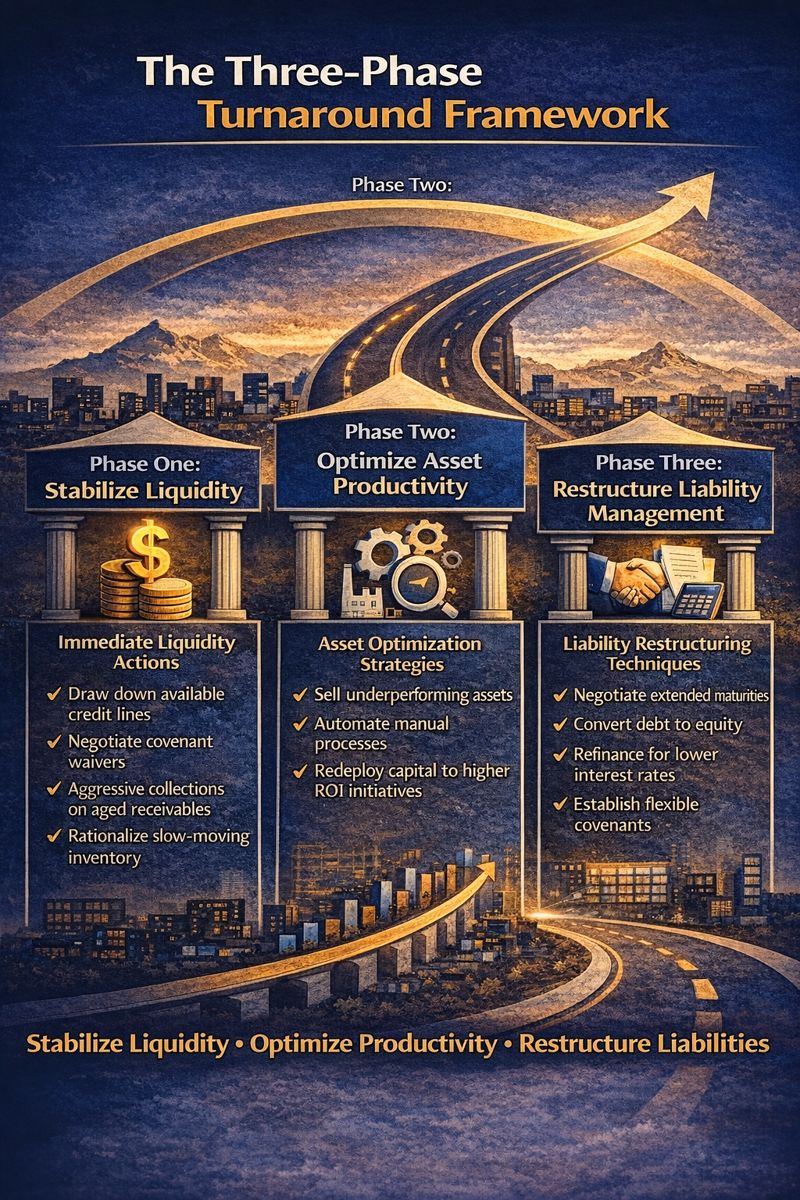
Phase One: Stabilize Liquidity
In a turnaround, liquidity becomes paramount. Access to cash determines the runway available for transformation. At one education nonprofit where I secured forty million in Series B funding, maintaining liquidity visibility proved essential. The thirteen-week cash flow forecast became indispensable.
Immediate Liquidity Actions:
- Draw down available credit lines to maximize cash position
- Negotiate covenant waivers with existing lenders
- Implement aggressive collections on aged receivables
- Rationalize slow-moving inventory to free working capital
These tactical moves create the breathing room necessary to execute strategic reforms.
Phase Two: Optimize Asset Productivity
Once liquidity is stabilized, attention must turn to asset productivity. Assets that do not earn their cost of capital must be redeployed or removed.
At a gaming enterprise where I led global controllership and oversaw one hundred million in acquisitions, post-merger integration demanded rigorous asset evaluation. At one professional services organization, we reduced month-end close from seventeen days to under six days while increasing accuracy by twenty-eight percent through automated reconciliation, freeing finance teams for strategic analysis.
Phase Three: Restructure Liability Management
Liability management is equally crucial. Debt that once funded growth can become a straitjacket when cash flows decline. At a digital marketing organization that scaled from nine million to one hundred eighty million in revenue while securing thirty-six million in growth capital, negotiating favorable debt terms during growth phases created flexibility during market contractions.
Restructuring the liability side of the balance sheet may involve:
- Negotiating extended maturities with existing lenders to match cash flow cycles
- Converting unsecured debt to equity to reduce fixed obligations and restore operational flexibility
- Refinancing high-cost debt with lower-cost alternatives when market conditions permit
- Establishing covenant structures that permit operational flexibility rather than constraining decision-making
The objective is not just survival but sustainability. A right-sized balance sheet supports risk-taking and strategic flexibility. Companies that emerge with clean capital structures can pursue growth opportunities without the shadow of past financial constraints.
At organizations where I led treasury operations and working capital management, debt restructuring often proved as important as operational improvements. The discipline required to negotiate with creditors, model various scenarios, and communicate transparently with stakeholders separates successful turnarounds from those that merely delay inevitable failure.
The CFO as Turnaround Architect
The CFO plays a central role in orchestrating these moves. At organizations where I led FP&A, forecasting, and board reporting across multiple sectors, building trust with stakeholders by demonstrating control over financial fundamentals proved essential.
Transparency is critical. Stakeholders support difficult decisions when presented with clear, data-backed rationale. Employees must understand restructuring reasons. Creditors need assurance of repayment capacity. Shareholders require a vision for value recovery.
Financial governance must reach new levels of rigor. Forecasting becomes a daily discipline. Cash flow must be monitored with granularity. At one SaaS organization operating across US and EU entities, we rebuilt GAAP and IFRS financials with obsessive focus on forecast accuracy. The finance function became the nerve center, enabling rapid feedback loops and course corrections.
Balance Sheet Turnaround Diagnostic Framework
The following framework provides a systematic approach to balance sheet reconstruction:
| Turnaround Phase | Primary Focus | Key Actions | Success Metrics | Timeline |
| Phase 1: Liquidity Stabilization | Cash preservation and runway extension | Draw credit lines, negotiate covenants, accelerate collections, rationalize inventory | 13-week cash forecast positive, current ratio >1.2, liquidity reserves >3 months operating expense | Weeks 1-8 |
| Phase 2: Asset Optimization | Productivity and efficiency improvement | Divest non-core assets, write down impaired goodwill, consolidate facilities, automate processes | ROA improvement, asset turnover increase, impairment charges completed | Months 2-6 |
| Phase 3: Liability Restructuring | Capital structure right-sizing | Extend maturities, convert debt to equity, refinance high-cost obligations, establish flexible covenants | Debt/EBITDA <3.5x, interest coverage >2.5x, covenant headroom >20% | Months 4-12 |
| Phase 4: Strategic Repositioning | Growth platform creation | Invest in core capabilities, rebuild working capital cycle, strengthen customer relationships | Positive free cash flow, gross margin expansion, NRR >100% | Months 9-18 |
From Triage to Transformation
Beyond the numbers, a turnaround must address organizational inertia. Companies in distress often suffer from defensiveness, where past decisions are protected rather than scrutinized. The balance sheet serves as an objective starting point for cultural reset. It reveals which strategies succeeded and which failed.
The journey from crisis to renewal does not end with a single quarter of profitability. It is marked by the institutionalization of discipline. At organizations where I implemented comprehensive KPI frameworks linking resource allocation to performance metrics, governance structures evolved to prevent future misalignment. Board oversight shifts from reactive to actively engaged. Performance management prioritizes leading indicators.
Leadership takes on renewed importance. The CEO and CFO must be in lockstep, modeling transparency, decisiveness, and resilience. At a manufacturing organization where I managed compliance audits during turbulent periods, the CEO-CFO partnership proved essential for orchestrating credible recovery narratives.
As the turnaround progresses, focus must shift to transformation. Companies that thrive post-turnaround embrace digital innovation as a growth engine. At organizations where I implemented NetSuite and OpenAir PSA, automated revenue recognition increased accuracy while reducing manual effort. The CFO must champion this transformation, ensuring technology investments are strategically aligned and financially justified.
Conclusion
Ultimately, rebuilding from the balance sheet up is about more than financial engineering. It is about restoring strategic coherence, aligning the company’s resources with its mission and markets, eliminating complexity, clarifying priorities, and creating a platform for sustainable growth.
This process requires courage, clarity, and relentless execution. But it also offers the opportunity for renewal. Companies that emerge from turnaround are often more focused, more agile, and more resilient. They carry the scars of crisis but also the strength of having faced it squarely.
The balance sheet is not just a report but a roadmap. It tells the story of where a company has been, where it stands, and what it must change to go forward. Throughout my twenty-five years leading finance organizations through periods of growth, stability, and crisis, the balance sheet has consistently proven to be the most reliable guide for decision-making.
At one professional services organization, the discipline of balance sheet analysis enabled us to build enterprise KPI frameworks that tracked not just financial performance but operational health. We could see early warning signals before they became crises. We could allocate capital with confidence based on asset productivity metrics. We could restructure with surgical precision rather than panic-driven reactions.
Leaders who listen to that story with honesty and act on its lessons with urgency give their companies the best chance not just to survive but to thrive. This is the essence of true financial leadership in times of crisis. It begins with truth, proceeds through disciplined analysis, and builds toward transformation. The companies that master this journey emerge not merely restored but reimagined, with balance sheets that reflect strategic clarity and operational excellence rather than accumulated compromise.
Disclaimer: This blog is intended for informational purposes only and does not constitute legal, tax, or accounting advice. You should consult your own tax advisor or counsel for advice tailored to your specific situation.
Hindol Datta is a seasoned finance executive with over 25 years of leadership experience across SaaS, cybersecurity, logistics, and digital marketing industries. He has served as CFO and VP of Finance in both public and private companies, leading $120M+ in fundraising and $150M+ in M&A transactions while driving predictive analytics and ERP transformations. Known for blending strategic foresight with operational discipline, he builds high-performing global finance organizations that enable scalable growth and data-driven decision-making.
AI-assisted insights, supplemented by 25 years of finance leadership experience.