
How CFOs Help Boards Navigate Emotion Without Destroying Shareholder Value
Deciding to exit a business is not simply a financial decision. It is inherently emotional. Boards must balance devotion to legacy, loyalty to leadership, and strategic discipline. When they align, exits can accelerate value and preserve reputation. When they do not, they linger in cognitive dissonance, delay exit timing, and erode returns. Throughout my twenty-five years leading finance across cybersecurity, SaaS, manufacturing, logistics, and gaming, I have learned that getting board buy-in requires reframing exits not as endings but as strategic transitions, anchored in data, alignment, and shared purpose. The tension arises because boards are populated by stewards of the past and strategists for the future. Long-serving members hold attachments to brands, teams, and legacy. Newer directors push results, discipline, and growth trajectory. So when a company confronts a potential exit including divestiture, carve-out, or full sale, a conversation ensues over more than value. It becomes a conversation over identity.
Reframing the Exit Conversation
Good boards make that identity immaterial. They reframe exit choices in terms of strategic focus. Is the asset distracting from core priorities? Is it capitalizing or weighing down enterprise growth? Is it resourced to win in its market? These are not existential questions. They are operational ones. When board debate centers on purpose, value tables follow naturally.
Five Elements That Build Board Buy-In on Exits
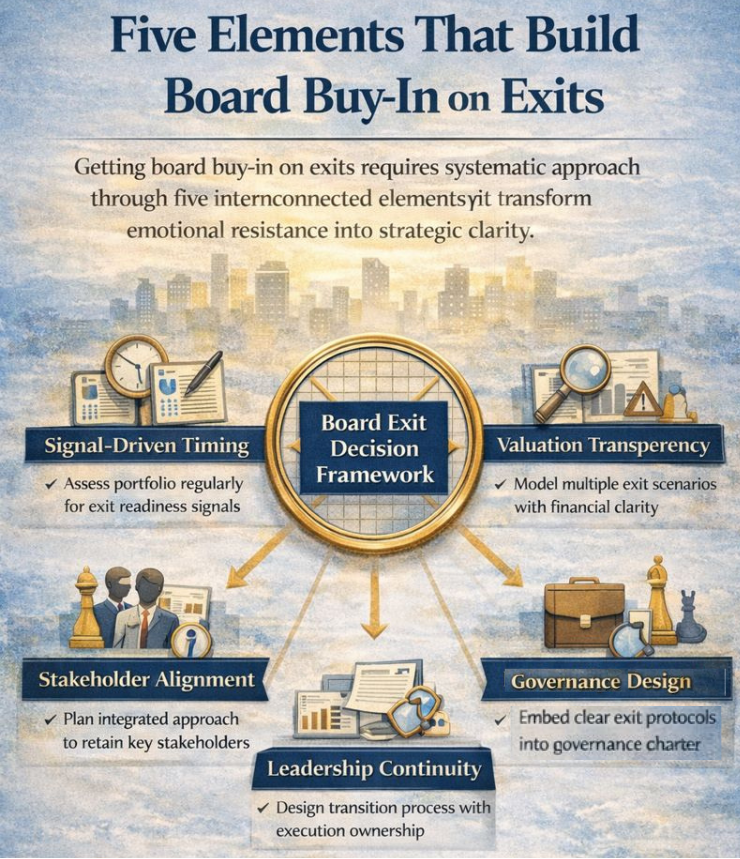
Getting board buy-in on exits requires systematic approach through five interconnected elements that transform emotional resistance into strategic clarity.
Element 1: Signal-Driven Timing
Exits are most valuable when signal-driven, not reactive. Boards must hold periodic portfolio reviews. Every business unit is assessed regularly against forward earnings potential, capital intensity, and strategic fit. Exit rationales are built over time, not in crisis. This continuous assessment creates objectivity. It clarifies when an asset may be drag even as decisions remain disciplined.
A board of a global consumer company which began reviewing underperforming segments annually found that conversations about exits became routine. When a brand missed two successive earnings cycles and failed to meet product innovation targets, the board initiated strategy shift. That decision reflected history but it was not driven by it. It was driven by forward trajectory: brand resonance, omni-channel fit, and margin erosion. And when exit was recommended, board buy-in was not a leap of faith. It was expected.
Element 2: Valuation Transparency
Emotion is pacified when numbers are neutral. Boards should see multiple valuation scenarios: strategic sale, minority carve-out, spin-off, retention with reinvestment. Each must be quantified for IRR, money-on-money multiple, exit multiple, and impact on core enterprise. Financial sensitivity analysis illuminates the value gap between status quo and divestment. It helps shift focus from ties to numbers to leverage.
Importantly, valuations must include cost of delay. Exit is not just value realization. It is optionality release. Opportunity costs grow with indecision. The board must see what foregone return looks like. An industrial board running annual portfolio reviews found that the delay cost in one asset including slowed new investments and leadership attention was equivalent to 30 percent of potential transaction value. That clarity cleared the friction, signaling urgency grounded in financial logic.
When I oversaw $100 million in acquisitions and post-merger integration at a gaming enterprise, we maintained ongoing portfolio valuation models for all business units. This included standalone valuations, strategic buyer premiums, and opportunity cost analyses showing capital locked in underperforming assets. When the board considered divesting a legacy mobile gaming division, we presented three scenarios with five-year projections. The analysis showed that retaining the asset would require $15 million in additional investment with projected 8 percent returns, while divestiture would unlock $45 million for deployment into emerging platforms with projected 22 percent returns. This transparency converted an emotional debate into a strategic decision.
Board Exit Decision Framework
| Element | What It Addresses | Key Activities | Output | Frequency |
| Signal-Driven Timing | When to exit | Periodic portfolio reviews, forward earnings assessment, strategic fit evaluation | Exit readiness indicators | Quarterly reviews, annual deep-dive |
| Valuation Transparency | Financial rationale | Multiple scenario modeling (sale/carve-out/spin-off/retain), IRR/MoM/exit multiple analysis, cost of delay quantification | Value gap illumination | Biannual valuation updates |
| Stakeholder Alignment | Impact management | Exit communication plan, employee transition, customer retention, brand protection | Integrated stakeholder plan | Developed with transaction team |
| Leadership Continuity | Execution ownership | Identify divestiture process owner, performance maintenance lead, capital redeployment champion | Continuity roadmap | Defined at proposal stage |
| Governance Design | Decision process | Approval thresholds, decision pathways, disclosure protocols, execution monitoring | Exit protocol framework | Embedded in governance charter |
Element 3: Stakeholder Alignment
Exits affect employees, customers, and brand reputation. Boards must understand and support an integrated stakeholder plan. It means governance over exit communication, covenant protection, transition leadership, and investor narrative. Building this plan alongside the transaction team assures the board that exit is not abandonment. It is stewardship.
In one software enterprise, the board’s early involvement in exit communication created alignment with customers and regulators. Leadership hosted advisory councils to articulate transition rationale. They reassured teams. They managed brand messaging, partner terms, and data protections. When exit unfolded, no major stakeholder objected. The perception was not divestiture but evolution.
Element 4: Leadership Continuity
Exits are not just financial events. They are leadership transitions. Boards must consider who will own the aftermath including strategic oversight, integration, and cultural handoff. A director championing exit should also identify the executive responsible for shepherding the divestiture process, maintaining performance in the remaining business, and orchestrating capital redeployment. That continuity reduces uncertainty and invites board confidence.
In a healthcare carve-out, the board insisted the departing unit’s general manager remain for six months post-close to ensure knowledge transfer, team morale, and client stability. This arrangement was structured into the exit proposal. The board’s advocacy for it helped the seller receive a premium. They understood the interdependency of value and continuity.
Element 5: Governance Design
If exit requires 75 percent approval but is emotionally charged, that threshold may trigger paralysis. Boards must map decision pathways: who recommends, who approves, who manages disclosure, who monitors execution. These structures signal intent. They reduce post-exit second-guessing. They create clarity.
Strong boards design exit protocols into their governance rhythms. They review portfolio metrics quarterly, test exit scenarios annually, update valuation models biannually, and refresh stakeholder plans quarterly. They maintain ongoing decision directories noting when and why exit conversations were raised, deferred, or revisited. This transparency makes buy-in a path not a pivot.
Emotion will not vanish. Legacies matter. But disciplined boards know emotion without structure is hesitation. They use timing, valuation, stakeholder planning, leadership continuity, and governance design to ground the decision. When framed through purpose and value, exit becomes not loss but choice.
From Approval to Execution: Where Buy-In Is Tested
Once the board is aligned in principle, execution becomes the crucible. Buy-in is not cemented by the vote. It is validated by how decisions unfold. Strong boards approach exits not as transactions but as transitions with structured governance, calibrated communication, and post-deal oversight that reflects maturity, not detachment.
Board Cohesion and Narrative Architecture
The most decisive factor post-decision is board cohesion. Even if the vote is unanimous, latent dissent can fracture execution. Board members must align behind the message. Internal skepticism becomes external noise if not addressed. Chairs play the decisive role here: they call dissenting directors one-on-one after the vote. They listen, not to relitigate but to unify. They ask for full support of the exit narrative, not just procedural compliance. And they offer shared authorship, inviting these directors to shape messaging to stakeholders. That inclusion disarms resentment. It converts compliance into commitment.
Narrative architecture is equally critical. Boards and management must co-author the story. Exits test public confidence. Messaging cannot be one-sided. It must be future-linked. Boards participate in investor briefings, town halls, and in some cases analyst calls. The script is coordinated. The storyline must tie exit to growth, not avoidance, not retreat. A board’s silence in exit messaging signals detachment. Its participation signals conviction.
In one SaaS company, the founder resisted exit. Eventually, the board voted to divest a legacy enterprise line that no longer fit the cloud-native strategy. The board did not leave the CEO to tell the story. The chair and two directors participated in the town hall. They explained the rationale, acknowledged emotional ties, and clarified how the decision aligned with long-term mission. The response was not rebellion. It was recognition.
A less prepared board in a similar sector made the exit decision without engagement. They underestimated employee backlash, overrelied on legal narratives, and refused stakeholder briefings. Trust collapsed. Customers churned. Analysts questioned strategy. The exit succeeded legally but failed reputationally. Buy-in without communication is fragility.
Dual-Path Oversight: Transaction and Transformation
Execution oversight follows a dual path: transaction and transformation. On the transaction side, boards monitor deal terms, covenant protection, regulatory milestones, and closing integrity. The audit or special committee remains active. They schedule structured touchpoints, not micromanagement but checkpoints. Milestones such as buyer communications, separation planning, and legal handoffs are surfaced. Risks are escalated early.
On the transformation side, the board must track capital redeployment. The true measure of exit success is not headline value but reinvestment outcome. Boards must ask: has the freed capital generated greater enterprise value than the retained asset could? Was the reallocation consistent with strategic objectives? Has it enhanced talent, accelerated growth, strengthened resilience?
A global services board conducted a post-exit review one year after divestiture. The board found capital had been partially redeployed into two high-growth verticals but half remained idle. The result: share price plateaued, investor disappointment mounted. The board responded by tightening capital allocation frameworks and mandating post-deal tracking dashboards. They embedded oversight not just into the exit but into the reentry.
Continuous Learning and Board Evolution
Disciplined boards treat exits as learning events. They conduct post-exit reviews, benchmark peer performance, and assess whether board composition supported or hindered the decision.
Exit decisions often reveal gaps in mergers and acquisitions, transformation, or capital markets expertise. Strong boards act on that insight through refreshment.
Why This Matters to CFOs
CFOs sit at the center of exit tension. They translate emotion into economics, narrative into numbers, and strategy into capital flows. When boards lack structure, CFOs absorb the friction. When governance is disciplined, CFOs become catalysts for value creation.
My background as a CPA, CMA, and CIA provides technical grounding. But what differentiates effective exit governance is not modeling skill. It is discipline, transparency, and foresight embedded long before the decision is forced.
Conclusion
That is the final insight: exits are mirrors. They reveal judgment, discipline, values. They expose whether governance is merely procedural or deeply strategic. Great boards do not just approve exits. They steward them. They balance emotion with data, protect value while honoring legacy, and ensure the organization emerges not weaker but sharper. Exits are not endings. They are acts of commitment to focus, to value, to future. Getting board buy-in is not persuasion. It is construction of process, of principle, of purpose. When done well, exits clarify what matters most. That is the art of board leadership at the threshold of transformation.
Disclaimer: This blog is intended for informational purposes only and does not constitute legal, tax, or accounting advice. You should consult your own tax advisor or counsel for advice tailored to your specific situation.
Hindol Datta is a seasoned finance executive with over 25 years of leadership experience across SaaS, cybersecurity, logistics, and digital marketing industries. He has served as CFO and VP of Finance in both public and private companies, leading $120M+ in fundraising and $150M+ in M&A transactions while driving predictive analytics and ERP transformations. Known for blending strategic foresight with operational discipline, he builds high-performing global finance organizations that enable scalable growth and data-driven decision-making.
AI-assisted insights, supplemented by 25 years of finance leadership experience.