
Executive Summary
Investment decisions in high-growth companies often mirror personality dynamics rather than strategic coherence, creating fragility when leadership transitions occur. The strategic CFO must transform investment committees from informal consensus mechanisms into formalized frameworks that embed discipline without paralyzing creativity. This transformation requires establishing clear investment intent that defines what kinds of bets the organization makes, institutionalizing structured processes with consistent proposal templates and uniform evaluation rubrics, and embedding accountability through post-investment reviews that treat every allocation as a closed-loop learning experiment. The framework must balance simplicity with depth, being accessible to functional leaders while satisfying board scrutiny. Success depends on navigating organizational resistance through communication and inclusion, building capability through training, and ensuring sustainability through codification and succession planning. The ultimate test of an investment framework is whether it survives its creators, requiring written charters, documented rubrics, and performance dashboards. When designed well, the investment committee becomes more than a meeting; it becomes an institutional mindset that teaches the organization to think in trade-offs, value risk-weighted returns, and respect capital across quarters, cycles, and generations of leadership.
Many companies, particularly in high-growth sectors, treat investment decisions as the byproduct of momentum. The implicit belief is that good ideas will fund themselves. In such environments, the investment committee becomes a rubber stamp rather than a rigorous decision-making body. The danger is twofold: capital allocation mirrors personality dynamics rather than strategic coherence, and when leadership turns over, institutional memory evaporates. Projects lose context. Priorities shift with personnel. Having led finance organizations across cybersecurity, SaaS, logistics, and digital marketing while managing capital allocation decisions totaling over $150M in M&A transactions and growth investments, I have witnessed firsthand how the absence of structured frameworks creates strategic drift that undermines long-term value creation. The challenge for the CFO is not merely to implement process but to architect frameworks that institutionalize wisdom.
From Informal Consensus to Formalized Process
The strategic CFO understands that investment decisions, especially under conditions of finite capital, must be structured to transcend individual preferences. They must reflect a coherent framework connecting strategic goals with economic discipline. The first step is diagnosis. What is the current cadence of investment decisions? Who drives the agenda? What criteria are used, explicitly or implicitly? Most importantly, how are outcomes tracked over time? In many firms, the answers are vague. Project proposals vary wildly in structure, ranging from informal hallway conversations to elaborate presentations. Assumptions are unvetted. Retrospectives are non-existent. When I led FP&A, audit, and analytics for a programmatic marketing platform, the initial diagnostic revealed that investment proposals ranged from one-page concept notes to forty-page business cases with no common evaluation standard, making meaningful comparison impossible.
Establishing intent comes next. The purpose of an investment committee is not to police ideas but to evaluate them with rigor and consistency. This requires clarity on investment thesis. What kinds of bets is the company willing to make? What is the desired return profile, financial or strategic or both? How does the firm weigh short-term certainty versus long-term optionality? Without these principles explicitly articulated and agreed upon, frameworks are meaningless. In overseeing $100M in acquisitions and post-merger integration for a multi-studio gaming enterprise, the breakthrough came from defining explicit investment criteria: strategic acquisitions that expanded intellectual property portfolios received different hurdle rates than efficiency investments in existing operations, with clear financial and strategic thresholds for each category.
Once intent is clear, structure follows naturally. The CFO must institutionalize the committee itself. Membership must be stable, cross-functional, and accountable. Meetings must be regular and scheduled well in advance. Agendas must be published with sufficient lead time for preparation. Templates must be mandatory to ensure consistency. Proposals must be scored against a uniform rubric covering strategic fit, economic return, execution risk, and time-to-value. Each score must be debated through rigorous questioning, not dictated by authority. Decisions must be documented with clear rationale. This does not mean bureaucracy for its own sake; it means intentional design. A well-run investment committee becomes a source of clarity and alignment, not constraint. It teaches the organization how to think in terms of capital deployment, not just operational initiatives.
Designing the Investment Framework
A durable framework must balance simplicity with depth. Every proposal must follow a consistent format including problem statement, strategic rationale, financial model, execution roadmap, risk mitigation plan, and expected return profile. The financial model must reflect both upside and risk through sensitivity analysis, breakeven points, payback period, and return on invested capital. Projects should be evaluated not only on IRR but on capital efficiency and time-to-impact. When I managed $18M in R&D budgets and $122M in manufacturing budgets for a medical devices company, evaluating projects on multiple financial dimensions prevented overinvestment in technically elegant but commercially unviable innovations.
Beyond the numbers, qualitative scoring matters. Strategic alignment must be assessed: does this investment reinforce core capabilities or expand into distraction? Execution feasibility must be tested: does the proposing team have the skills and bandwidth to deliver? Timing must be debated: is the market ready? To operationalize this, the CFO can implement a scoring rubric where each criterion is scored one to five, producing a weighted investment score.
Investment Evaluation Framework
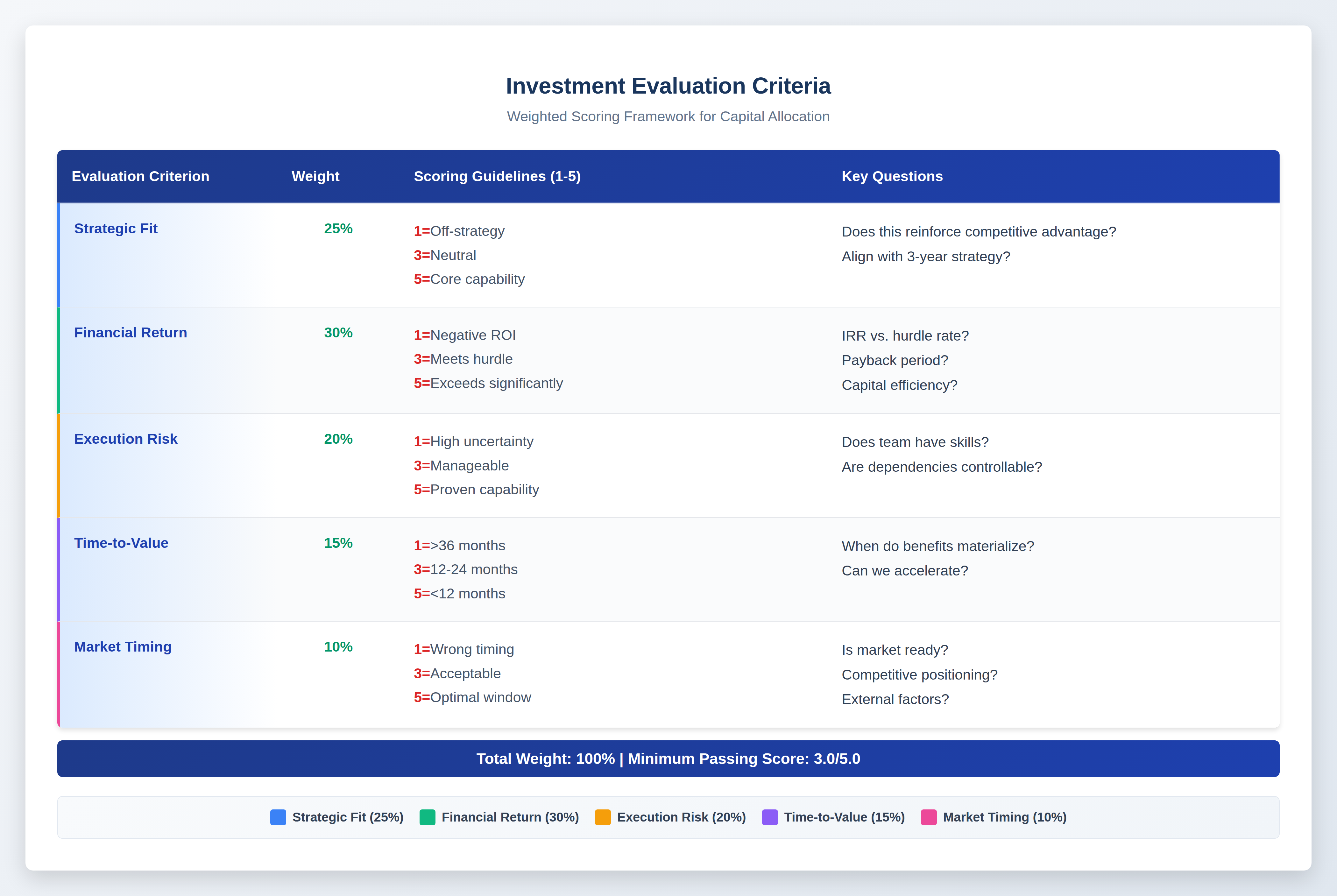
Scoring Methodology: Weighted average produces investment score (1.0-5.0). Scores ≥4.0 = Strong approval; 3.0-3.9 = Conditional approval with milestones; <3.0 = Rejection or significant revision required.
The framework must include a pre-mortem. Before approval, the committee must imagine failure. What could go wrong? What signals would emerge early? How reversible is the investment? The output is a capital allocation roadmap reviewed quarterly, showing all approved projects, their funding status, milestones, and owners.
Embedding Accountability and Learning
Process without feedback is ritual. The investment framework must include robust post-investment analysis. Every material investment should be reviewed at six or twelve months post-funding. These reviews must be brutally honest but psychologically safe. The goal is not to assign blame but to surface insight. What assumptions proved wrong? What signals were missed?
These learnings must feed back into the framework. If execution risk is consistently underweighted, the rubric must be adjusted. This feedback loop is the engine of rigor. In implementing NetSuite and OpenAir PSA systems while building enterprise KPI frameworks for cybersecurity operations, tracking actual versus projected utilization rates and project margins improved subsequent investment forecasting accuracy by 28 percent.
Accountability means naming owners. Every investment must have a single accountable executive. Transparency amplifies accountability. The CFO should publish a quarterly investment performance dashboard including key metrics for each active project, variance to plan, and milestone status. The investment committee must also hold itself accountable through annual reviews of its own decisions. Culture supports accountability when the CFO champions an environment where admitting mistakes is a sign of strength.
Navigating Resistance and Ensuring Sustainability
No transformation happens without resistance. Shifting to structured investment processes threatens existing power dynamics. The CFO must navigate this resistance with empathy and resolve. Start with communication, explaining why the process is changing: capital is finite and stakes are higher. Inclusion builds ownership by involving key leaders in designing the framework. Training is essential. When I drove company scale from $9M to $180M revenue while implementing financial planning systems, the critical success factor was comprehensive training that taught leaders how to translate strategic initiatives into financially rigorous investment proposals.
The ultimate test of a framework is whether it survives its creators. To sustain rigor, the framework must be codified in written charters, documented rubrics, and performance dashboards in central systems. The CFO must build a second line of ownership by training functional finance leaders and operations heads. Succession planning matters: evaluate successors not just on technical skill but on commitment to capital discipline. The board should receive an annual audit of the investment process. When the framework enables breakthrough investments, those stories must be told.
Conclusion
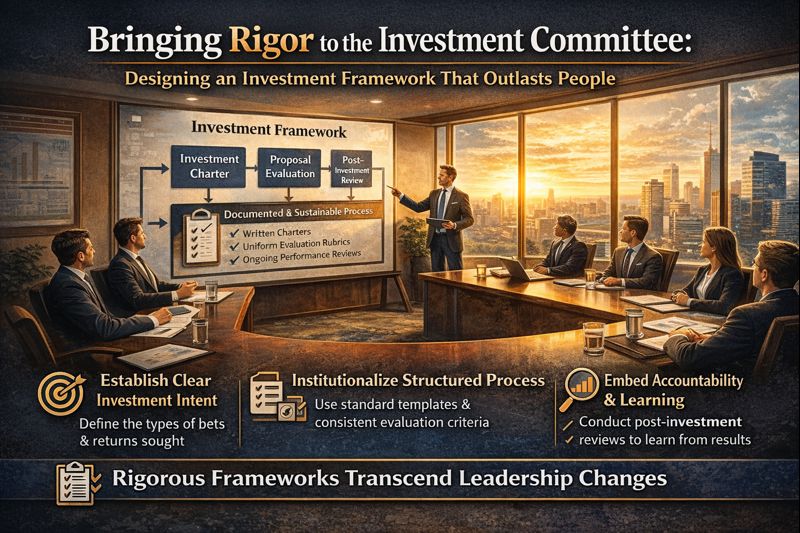
The investment committee, when designed well, becomes more than a meeting; it becomes an institutional mindset that teaches the company to think in trade-offs, value risk-weighted returns, and respect capital across quarters, cycles, and generations of leadership. In high-functioning organizations, capital allocation is not episodic but institutional, and the CFO, as its architect, ensures that every dollar works not only hard but wisely. This requires moving beyond personality-driven decisions to frameworks grounded in strategic clarity, economic discipline, and organizational learning. The frameworks that outlast their creators are those built on transparent processes, honest feedback loops, and cultural commitment to excellence in capital stewardship.
Disclaimer: This blog is intended for informational purposes only and does not constitute legal, tax, or accounting advice. You should consult your own tax advisor or counsel for advice tailored to your specific situation.
Hindol Datta is a seasoned finance executive with over 25 years of leadership experience across SaaS, cybersecurity, logistics, and digital marketing industries. He has served as CFO and VP of Finance in both public and private companies, leading $120M+ in fundraising and $150M+ in M&A transactions while driving predictive analytics and ERP transformations. Known for blending strategic foresight with operational discipline, he builds high-performing global finance organizations that enable scalable growth and data-driven decision-making.
AI-assisted insights, supplemented by 25 years of finance leadership experience.