
Executive Summary
In the golden age of Silicon Valley startups, the growth gospel was clear: scale fast, fail fast, pivot hard. Revenue growth, particularly double-digit or better quarter-over-quarter, became the central hymn in this entrepreneurial liturgy. But beneath the surface of these dazzling trajectories lies a sobering paradox: the faster the growth, the greater the likelihood that foundational systems including operational, financial, and technological will become brittle, outdated, or entirely overwhelmed. Throughout my twenty-five years leading finance across cybersecurity, SaaS, manufacturing, logistics, and gaming, I have learned that this is the growth trap: a seductive momentum that outpaces the infrastructure necessary to support it. To understand this trap is to examine the very physiology of a firm: its bones including processes, its nerves including data and information systems, and its muscles including people and culture. If growth resembles calories consumed, then systems are the metabolic rate.
The Growth Trap: When Momentum Masks Fragility
Consider the dot-com era’s cautionary tales. Pets.com enjoyed 30x revenue growth in under two years yet burned through $300 million before collapsing due to no scalable logistics system, no robust supplier network, and no coherent strategy for unit economics. Webvan, flush with $800 million in funding, constructed a fleet of warehouses before mastering demand forecasting, expanding too quickly with no architectural integrity to its systems.
In contemporary settings, the growth trap manifests in subtler ways. Take a SaaS startup that goes from $2 million to $25 million in ARR in three years. On the surface, it is a rocket ship. But under the hood? A jumbled CRM, manual billing, fragmented customer data across legacy systems, no coherent product roadmap, and a finance team scrambling each quarter to reconcile bookings.
Data Corroboration:
- Only 25% of rapidly growing companies have operational processes rated as scalable and efficient (McKinsey Global Survey, 2022)
- Firms that prioritized systems maturity alongside revenue growth were 1.8x more likely to sustain profitable expansion over a ten-year horizon
- Companies that automated 30% of their back-office processes saw 40% improvement in scalability with lower marginal costs at every revenue tier (McKinsey, 2023)
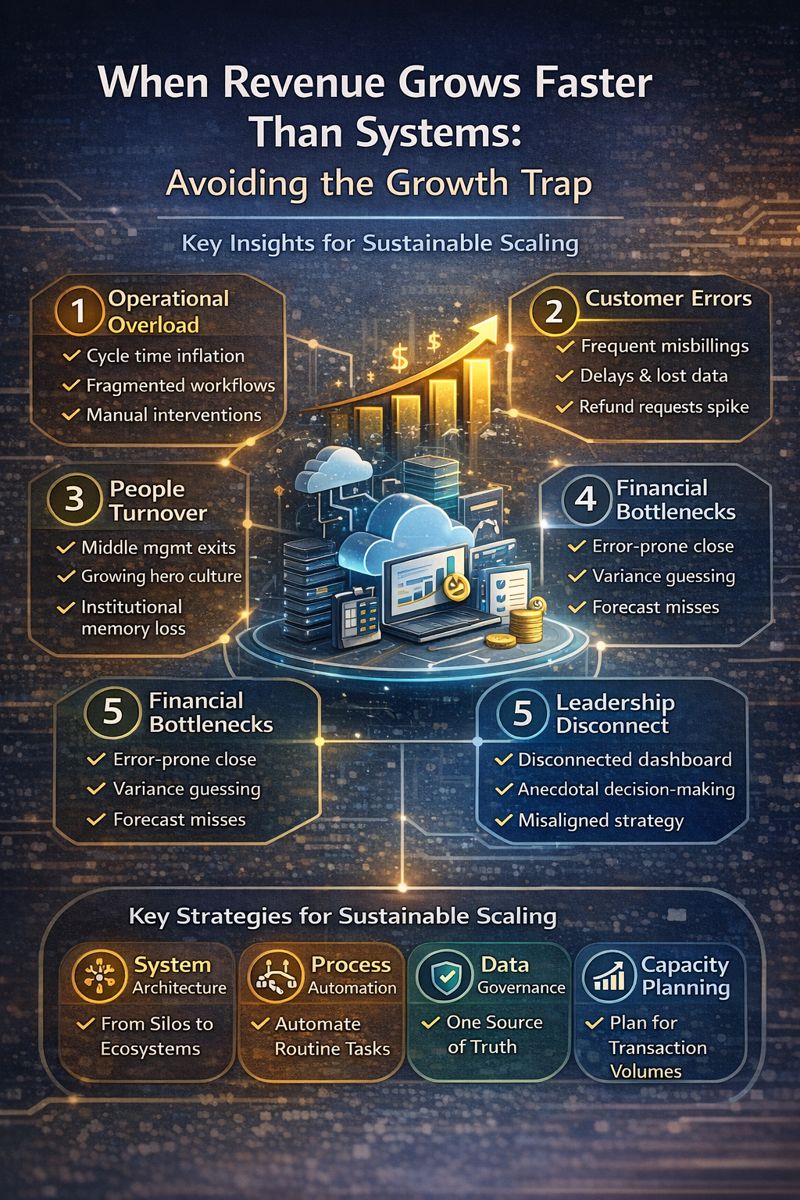
Growth Trap Warning Signs
| Category | Early Indicators | Systemic Impact | Measurement |
| Operational | Cycle time inflation (processes taking weeks instead of days) | Declining internal responsiveness | Days to close books, time to onboard customer, approval cycle time |
| Customer | Errors (misbilling, delays, lost data) vs. product-market fit complaints | Backend systems fraying | Error rates, refund requests, support ticket trends |
| People | Middle management turnover due to system navigation burden | Reliance on heroics vs. institutional processes | Attrition by role, exit interview themes |
| Financial | Close process dragging, variance analysis becoming narrative invention | Data landscape too fragmented | Days to close, budget vs. actual variance, forecast accuracy |
| Cognitive | Leadership abstracting from operational reality | Dashboard filters vs. mirrors | Ratio of narrative to evidence in board meetings |
The underlying issue is not growth itself. It is asymmetrical growth. When revenue outpaces system capability, an imbalance emerges that can warp an organization’s sense of reality. Leadership begins to believe its own press releases. Strategic decisions are based on incomplete data. Hiring accelerates beyond HR’s capacity to onboard and train.
When I managed global finance for a $120 million logistics organization experiencing rapid growth from 800 to 1,200 employees, we faced classic growth trap symptoms. Our billing system, designed for 5,000 monthly invoices, was processing 18,000. Manual interventions increased from 8 percent to 34 percent of transactions. Days sales outstanding increased from 32 to 47 days. Rather than continue band-aiding the system, we invested $2.5 million in automated billing infrastructure with integrated collections workflows. Within two quarters, manual interventions dropped to 6 percent, DSO improved to 28 days, and we established capacity for 50,000 monthly invoices, positioning us for continued growth without system strain.
Recognizing Early Symptoms of Systemic Lag
The most immediate signs emerge not in the financials but in operational and cultural metrics. The dashboard is lying when revenue figures mask infrastructure decay.
Quantitative Indicators
- Cycle Time Expansion – Finance team taking 12 days to close books that previously took five is not simply tired. They are compensating for process fragmentation.
- Error Rates and Rework – Uptick in customer billing errors, refund requests, or internal change request backlogs suggests growth is overwhelming quality control points.
- Manual Interventions per Transaction – High ratio of human touchpoints per business transaction is unsustainable at scale. If each customer order requires three emails, two spreadsheets, and one Slack message to process, organizational cognition is under pressure.
- System Downtime and Latency – Any system exhibiting lag or failure during peak usage reveals poor fit between infrastructure and transaction volume.
- Project Overruns and Delays – When even small initiatives slip beyond original scope or budget, it is often not project management but a system that no longer supports predictable execution.
Behavioral Indicators
- Rising Informal Communication Load – If strategy requires Slack hacks, Zoom whisper networks, or hallway huddles to succeed, then systems have failed. Informal workarounds are organizational scar tissue.
- Hero Culture – In mature organizations, outcomes are the product of systems. In overstretched ones, they are the product of heroes. If success is consistently driven by exceptional effort rather than ordinary process, the company is betting its future on burnout.
- Cognitive Load Fatigue – When employees express fatigue not from workload but from the complexity of navigating internal processes, it signals a breakdown in design.
- Loss of Institutional Memory – When onboarding new employees becomes a relay of tribal knowledge rather than systematized process, it suggests that systems have not scaled with the organization.
- Internal Metrics Disputes – If marketing and finance cannot agree on revenue, or if operations and sales dispute fulfillment times, it is not a philosophical disagreement. It is a systems misalignment.
Infrastructure as Strategy: Five Strategic Levers
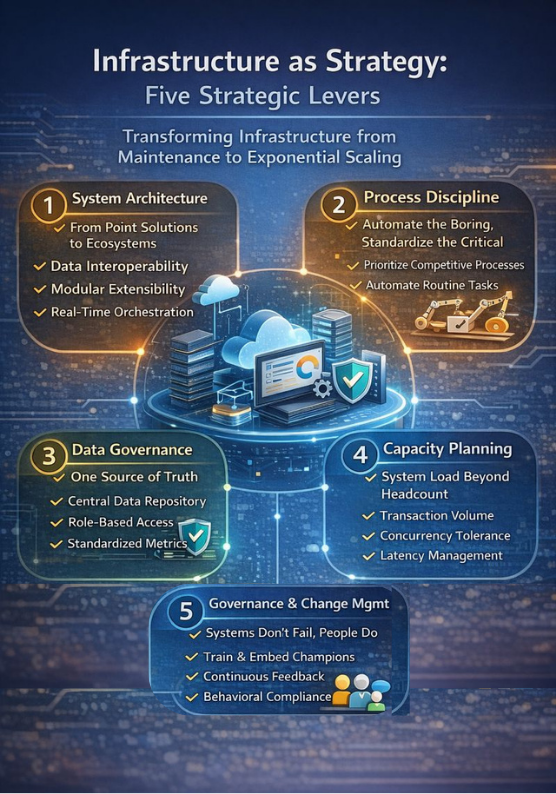
To break free from reactive patterns, companies must elevate infrastructure from maintenance to mandate. The following five strategic levers offer a blueprint for designing systems that scale not linearly but exponentially.
1. System Architecture: From Point Solutions to Ecosystems
Most organizations evolve from spreadsheets to SaaS to ERP in patchwork manner. To scale gracefully, system architecture must transition from siloed point solutions to an integrated ecosystem with three core tenets:
- Data interoperability: Systems talk to each other natively
- Modular extensibility: Swap out components as business evolves
- Real-time orchestration: Workflows reflect live view of operations
2. Process Discipline: Automate the Boring, Standardize the Critical
The most scalable companies automate the boring and standardize the critical. The key is distinguishing between processes that define competitive advantage and those that merely maintain hygiene:
- Competitive moat: Unique customer onboarding flow – invest in flexibility
- Hygiene process: Vendor invoice approvals – automate ruthlessly
3. Data Governance: One Source of Truth
As data becomes the raw material of decision-making, its governance becomes the backbone of trust. Scalable systems begin with clear data ownership and lineage:
- Governed data warehouse as central repository
- Role-based access to dashboards with traceable logic
- Defined metric layers where definitions are standardized and version-controlled
4. Capacity Planning: System Load Beyond Headcount
Systems strain is tied to transaction volume, workflow complexity, and data throughput more than employee count. Modern infrastructure strategy requires capacity planning across three vectors:
- Transaction volume: Can systems handle 10x increase in API calls, invoices, or SKUs?
- Concurrency: Can multiple teams operate simultaneously without degradation?
- Latency tolerance: Can systems maintain performance during monthly closes or product launches?
5. Governance and Change Management: Systems Don’t Fail, People Do
The most overlooked lever in infrastructure scaling is not technology but behavior. This includes:
- Training protocols tied to system go-lives
- Champions embedded in business units
- Cadence of feedback loops between users and system owners
- Performance metrics that reinforce compliance
When I improved month-end close from 17 days to under six days at a cybersecurity firm, the transformation required all five strategic levers. We implemented NetSuite ERP with native integrations to CRM and billing systems (architecture), automated journal entry validations and intercompany reconciliations (process discipline), established single source of truth for financial data with controlled access (data governance), modeled capacity requirements for 3x transaction growth (capacity planning), and conducted monthly training sessions with embedded finance champions in each department (change management). This comprehensive infrastructure approach enabled us to maintain the six-day close even as transaction volume tripled over the subsequent 18 months.
Early Warning Systems: Institutionalizing Vigilance
What is needed is not more dashboards but the right kind of instrumentation: a system of early warnings that reveals not just how fast you are growing but what that growth is doing to the infrastructure underneath.
Infrastructure Health Framework
| Dimension | Leading Indicator | Warning Threshold | Intervention |
| Process Velocity | Average cycle time by key process | >30% increase quarter-over-quarter | Process audit, automation investment |
| Quality | Error rate, rework percentage | >15% of transactions requiring manual intervention | Root cause analysis, system redesign |
| Capacity | System latency, downtime incidents | Peak usage >80% of capacity | Infrastructure scaling, load balancing |
| People | Employee NPS, exit interview themes | Declining scores, system frustration cited | Change management review, training investment |
| Data | Metric definition disputes, reporting conflicts | Multiple versions of same metric | Data governance initiative, single source of truth |
| Financial | Close cycle time, forecast accuracy | >5 day increase in close, <85% forecast accuracy | System integration, reporting automation |
Feedback Loop Mechanisms
- Quarterly Systems Health Review – Leadership teams conduct structured review of system performance including inventory of process failures, system bottlenecks, and audit logs of exception handling.
- Exception Reporting Protocols – Exceptions reveal where systems are under-designed. Formalizing a process for capturing and reviewing these turns friction into fuel.
- Business Capability Heat Maps – Map each business capability against two axes: importance and performance. Capabilities that are critical but underperforming become candidates for immediate investment.
- Internal SLA Monitoring – When internal commitments begin to slip, it is a leading indicator of capacity mismatch.
- Systemic Readiness Scorecard – Synthesized view combining operational metrics, behavioral data, and system telemetry into single readiness index. How ready is this company, at current system maturity, to absorb another 20% growth?
Executive Discipline: The Courage to Listen
At its core, building an early warning system is a discipline of executive humility. It requires leadership to admit that revenue does not equate to readiness. It demands an appetite for hearing bad news early. And it relies on the conviction that early action, while politically inconvenient, is economically priceless.
The companies that endure including Amazon, Toyota, and Microsoft have cultivated cultures of vigilance. They audit themselves before the market forces them to. In that sense, early warning systems are not just about avoiding failure. They are about buying time. Time to course correct. Time to invest. Time to scale with grace rather than speed.
My certifications as a CPA, CMA, and CIA provide technical foundation for systems design, process optimization, and continuous improvement. But what separates companies that scale durably from those that fracture under growth is not technical sophistication alone. It is the discipline to measure system health as rigorously as revenue growth, the architecture to design infrastructure as strategic enabler rather than support function, the vigilance to institutionalize early warning mechanisms, and the humility to invest in systems before crisis forces remediation at 3x the cost and 5x the political friction.
Conclusion
Growth is not a goal. It is a consequence. Sustainable growth, the kind that compounds, is never accidental. It is cultivated, protected, and constantly recalibrated. Early warning systems are not bureaucratic tools. They are the organs of adaptation. In their presence, companies become self-aware. In their absence, they become stories of what could have been. And in the end, no amount of revenue will rescue a business that failed to notice its own unraveling.
Disclaimer: This blog is intended for informational purposes only and does not constitute legal, tax, or accounting advice. You should consult your own tax advisor or counsel for advice tailored to your specific situation.
Hindol Datta is a seasoned finance executive with over 25 years of leadership experience across SaaS, cybersecurity, logistics, and digital marketing industries. He has served as CFO and VP of Finance in both public and private companies, leading $120M+ in fundraising and $150M+ in M&A transactions while driving predictive analytics and ERP transformations. Known for blending strategic foresight with operational discipline, he builds high-performing global finance organizations that enable scalable growth and data-driven decision-making.
AI-assisted insights, supplemented by 25 years of finance leadership experience.