
Executive Summary
Hypergrowth is intoxicating. It brings funding, press coverage, new customers, and the electric sense that a company is winning. But it also brings something far less glamorous: hiring pressure. Teams double in size seemingly overnight. New offices are opened, roles get filled before job descriptions are written, and onboarding becomes a logistical rather than cultural function. Throughout my twenty-five years leading finance across cybersecurity, SaaS, manufacturing, logistics, and gaming, I have learned that in this environment, one of the most elusive goals is preserving what made the company successful in the first place, its culture. Scaling a company without scaling its dysfunction requires more than hiring fast. It demands hiring well and building systems that transmit values as effectively as they transmit workflows. Culture does not scale on its own. It must be actively designed, reinforced, and embedded in every stage of the talent lifecycle.
The Cultural Compression Problem
In a small company, culture is ambient. It is communicated through shared history, informal conversations, and the founder’s presence. Everyone knows what good looks like because they have seen it modeled.
But in hypergrowth, this ambient transmission breaks down. New hires arrive faster than values can be communicated. Middle managers, often hired externally, interpret culture through their own lens. Institutional knowledge becomes fragmented. Suddenly the company feels different. Not necessarily worse but less cohesive.
This is cultural compression: when the speed of hiring exceeds the organization’s capacity to transmit its DNA. It is one of the most common and most avoidable causes of identity loss in scaling companies.
Cultural Transmission Framework
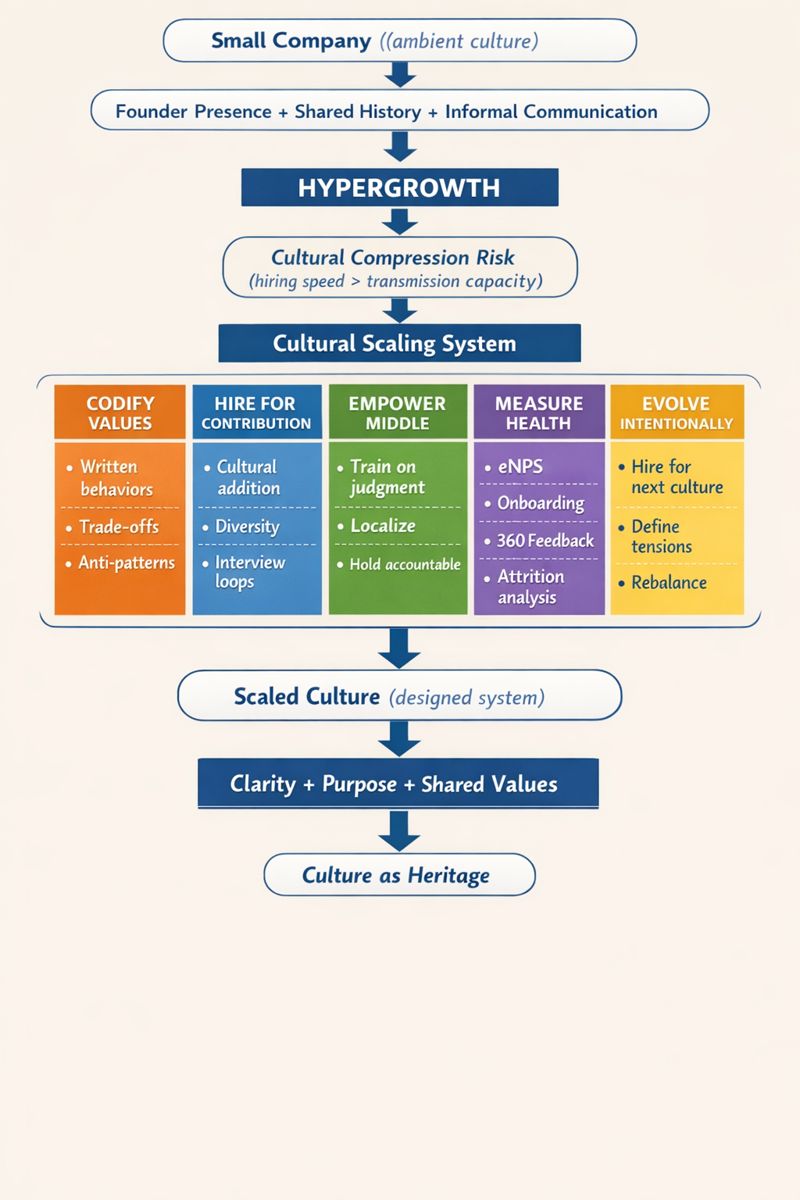
This framework shows the cultural transmission evolution from small company ambient culture through hypergrowth compression risk to a designed cultural scaling system. The system has five pillars: Codify Values (written behaviors, trade-offs, anti-patterns), Hire for Contribution (cultural addition, diversity, values-based interviews), Empower Middle (train on judgment, localize culture, hold accountable), Measure Health (eNPS, onboarding completion, 360 feedback, attrition), and Evolve Intentionally (hire for next culture, define tensions, rebalance values). These combine to create scaled culture as designed system with clarity, purpose, and shared values that becomes organizational heritage.
From Culture Fit to Cultural Contribution
One of the ways companies try to preserve culture is through the notion of culture fit. But this concept can backfire. It often becomes a proxy for sameness, hiring people who look, think, and behave like existing employees. This can lead to groupthink and unintentional exclusion.
A better approach is to hire for cultural contribution. The question becomes: how will this person make our culture stronger, more expansive, or more resilient? This opens the door to diversity in thought, background, and experience while still anchoring on shared values.
Codifying What Matters
Values that are not written down will not survive scale. To preserve culture, leadership must codify it. But codification is more than slogans. It means defining behaviors that exemplify each value, trade-offs that reflect cultural priorities such as speed versus rigor or innovation versus consistency, and anti-patterns that signal misalignment.
This codex becomes the foundation for hiring, onboarding, performance management, and even exits. It is not static but it is sacred. When done right, it turns values from sentiment into standard.
When I managed global finance for a $120 million logistics organization during rapid expansion from 800 to 1,200 employees, we codified our finance team culture around three principles: ownership mentality, proactive communication, and continuous improvement. We defined specific behaviors for each including ownership meant surfacing problems early rather than waiting to be asked, proactive communication meant updating stakeholders before they needed to ask, and continuous improvement meant documenting every process change. These became interview criteria, onboarding checkpoints, and performance review dimensions. This codification maintained team effectiveness and cohesion despite 50 percent headcount growth in 18 months.
Hiring as Cultural Transmission
The hiring process is not just about skill assessment. It is the first cultural signal a candidate receives. High-growth companies must design their process to evaluate and transmit values at every stage:
Job Descriptions – Reflect not just competencies but context. Why does this role matter? What kind of decision-making will it require?
Interview Loops – Include values-based interviews alongside functional ones. Train interviewers to probe for decision-making patterns, not just resume lines.
Offer Stage – Reinforce expectations, values, and what success looks like. Clarity beats charisma.
Onboarding – Prioritize cultural immersion. Introduce key artifacts including the origin story, early pivots, and core principles that explain how the company thinks, not just how it works.
A well-run hiring process is your first defense against cultural drift. It weeds out misalignment and sets the tone for performance.
Empowering the Middle
As companies scale, the cultural center of gravity shifts from the founders to the middle. These are the directors, managers, and team leads who shape how culture is actually lived.
Investing in this layer is critical. Train them not just on policies but on judgment. How should values guide trade-offs? Give them space to localize culture without diluting it. Teams in different geographies or functions will adapt values contextually. Hold them accountable. Culture is not owned by HR. It is modeled, reinforced, and protected by leaders at every level.
Hiring for the Next Culture
The paradox of scaling culture is that it must evolve. The behaviors that served a 20-person company may not scale to 200. Culture must adapt without losing its essence. This means hiring not just for today’s culture but for the one you want to become. Ask what tensions are we navigating such as founder intuition versus operational rigor, what values do we need to reinforce or rebalance, and who can help us evolve without derailing?
My certifications as a CPA, CMA, and CIA provide technical foundation for organizational development and talent management. But what separates companies that scale culture effectively from those that fracture under growth is not process sophistication alone. It is the discipline to codify values explicitly, the wisdom to hire for cultural contribution rather than fit, the investment to empower middle management as culture carriers, and the courage to evolve culture intentionally while preserving its essence.
Conclusion
In hypergrowth, what scales naturally is noise including Slack channels, Jira tickets, meetings, and headcount. What must be deliberately scaled is the signal: clarity, purpose, and shared values. Hiring is not a race. It is a relay. Every new employee carries the baton of culture. If that baton is dropped, the race continues but the team loses alignment. Companies that endure do not just hire quickly. They hire wisely. They codify what matters, design for coherence, and evolve with integrity. In doing so, they build not just headcount but heritage. In the end, culture is not what you say. It is what you scale.
Disclaimer: This blog is intended for informational purposes only and does not constitute legal, tax, or accounting advice. You should consult your own tax advisor or counsel for advice tailored to your specific situation.
Hindol Datta is a seasoned finance executive with over 25 years of leadership experience across SaaS, cybersecurity, logistics, and digital marketing industries. He has served as CFO and VP of Finance in both public and private companies, leading $120M+ in fundraising and $150M+ in M&A transactions while driving predictive analytics and ERP transformations. Known for blending strategic foresight with operational discipline, he builds high-performing global finance organizations that enable scalable growth and data-driven decision-making.
AI-assisted insights, supplemented by 25 years of finance leadership experience.