
Executive Summary
Growth is intoxicating. It validates product-market fit, attracts capital, and electrifies teams. It is the scoreboard by which high-growth companies are judged, the metric every founder, board member, and investor wants to see up and to the right. But behind the acceleration lies a truth often obscured in the rush: growth can break a business as fast as it builds one. Throughout my twenty-five years leading finance across cybersecurity, SaaS, manufacturing, logistics, and gaming, I have learned that unchecked growth introduces systemic fragility. Sales outpace delivery. Hiring dilutes culture. Operations buckle under demand. In this environment, growth ceases to be value-creating and becomes entropy. The core problem is one of misaligned cadence. Organizations scale inputs without refining the systems, behaviors, and mental models needed to absorb those inputs. Judgment is the throttle. It is the capacity of leadership to distinguish between additive growth and performative velocity.
The Illusion of Speed and the Cost of Unchecked Growth
The fallacy of move fast and break things is that what breaks is not always recoverable. Trust erodes. Teams burn out. Customers defect. Brand reputation tarnishes. The smarter mantra is move with precision and build resilience. It is a slower rhythm in the short term but it outlasts competitors in the long arc.
Companies that grow too fast often mistake correlation for causation. Early wins are over-attributed to strategy rather than timing or market conditions. Success becomes hubris. The role of judgment is to constantly interrogate whether what worked at $5 million ARR will work at $50 million. More often than not, it will not.
Judgment-driven growth means asking harder questions:
- Does this new customer segment increase complexity without improving margin?
- Does the next market launch strain operational excellence?
- Is the org structure evolving to support the ambition?
These are not anti-growth questions. They are preconditions for sustainable acceleration. Strategic patience is not indecision. It is the discipline to sequence initiatives, to build feedback loops into every expansion decision, and to reward internal dissent when it prevents overreach. High-performing CFOs act as friction, not to block but to slow, inspect, and strengthen the pace of scale.
When I managed global finance for a $120 million logistics organization experiencing rapid growth, we faced pressure to expand into three new markets simultaneously. Our analysis revealed that entering all three would require duplicating compliance infrastructure, fragmenting leadership attention, and delaying critical technology investments in core operations. We sequenced market entry over 18 months instead of six, establishing full operational maturity in each before proceeding to the next. This disciplined approach enabled 40 percent revenue growth with improving margins rather than the revenue growth with eroding margins our initial aggressive timeline projected.
Operationalizing Judgment Through Systems
Judgment as a System Framework
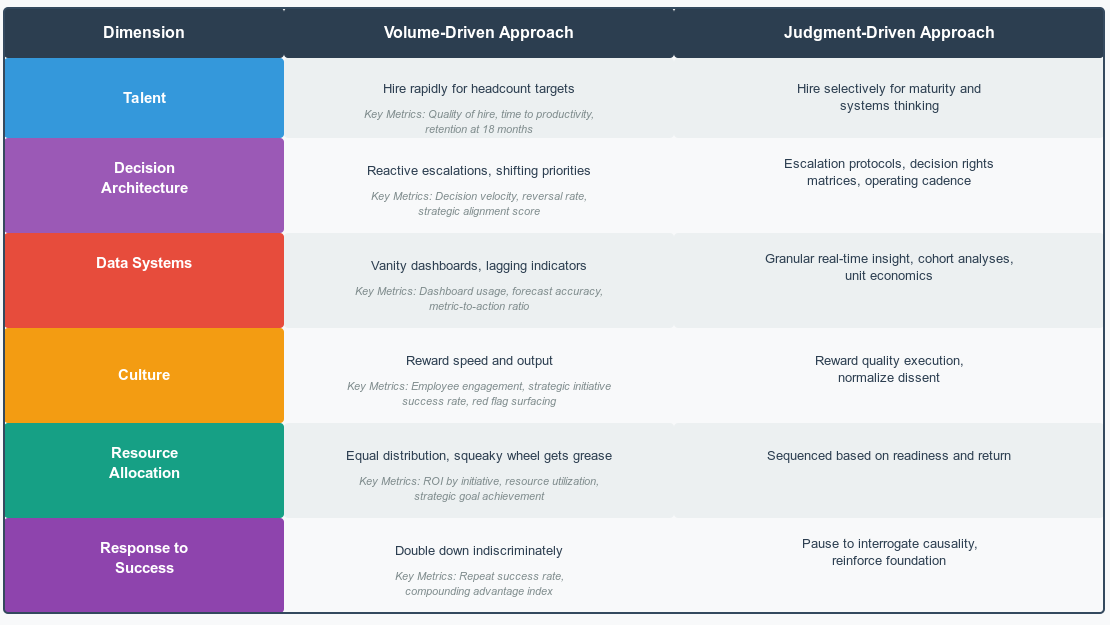
Judgment is often mischaracterized as an innate trait. In fact, it is a system. Organizations that scale well are those that embed judgment structurally in who they hire, how they decide, and what they measure.
Hiring for Judgment:
- Case interviews testing decision trade-offs under constraint
- Reference checks probing resilience in ambiguity
- Onboarding teaching first principles rather than playbooks
Decision Architecture:
- Weekly metrics reviews surfacing leading indicators
- Monthly cross-functional reviews interrogating trade-offs
- Quarterly offsites pressure-testing strategic bets
Data systems must evolve in lockstep. Judgment is not guesswork. It is informed by pattern recognition. Scalable businesses invest early in systems that deliver decision-grade metrics: cohort analyses, unit economics by SKU, funnel conversion by geography.
CFOs play a pivotal role in shaping this architecture. They must move from budget stewards to strategic synthesizers. Finance teams become internal consultants building decision models, scenario plans, and capital efficiency diagnostics.
When I improved month-end close from 17 days to under six days at a cybersecurity firm, we simultaneously built real-time financial dashboards that transformed decision-making cadence. Leadership shifted from monthly retrospective reviews to weekly forward-looking discussions. This enabled faster course correction on underperforming initiatives and accelerated investment in high-ROI opportunities, improving overall capital efficiency by 23 percent.
Scaling as Strategic Discipline
At scale, every decision is a trade-off. The illusion that more is always better is what derails firms in mid-growth. Scaling with judgment requires clarity on what not to pursue and the discipline to say no repeatedly.
Sequencing is Strategy:
- Which products to launch first
- Which markets to enter
- Which hires to prioritize
Mis-sequencing destroys momentum. Entering a new geography before operational maturity dilutes execution. Launching a second product before the first achieves retention breaks focus.
Building Resilience:
- Alternate plans and contingency capital
- Modular systems enabling pivots
- Redundancy in critical functions
Strategic drift occurs subtly. One quarter of missed goals. A high-profile churn. An unvetted partnership. Without a judgment system, organizations rationalize these events. They mistake activity for progress. Strategic discipline, reinforced by judgment, insists on course correction early.
Judgment should be institutionalized in governance:
- Board meetings asking harder questions
- Investor updates including failure retrospectives
- Performance reviews emphasizing decision quality over output
My certifications as a CPA, CMA, and CIA provide technical foundation for financial analysis and operational assessment. But what separates companies that scale durably from those that fracture under growth is not analytical rigor alone. It is the discipline to sequence rather than accelerate indiscriminately, the systems to embed judgment structurally rather than rely on heroic leadership, and the courage to act as friction that strengthens rather than friction that blocks, ensuring every layer of growth reinforces the foundation.
Conclusion
The endgame of scaling with judgment is not just survival but superiority. Firms that scale with integrity build cultures that endure, brands that outlast trends, and operating models that attract the best talent. Judgment becomes the moat. Growth at the speed of judgment is not slower growth. It is smarter growth. It is the compound interest of good decisions, well-sequenced bets, and organizational self-awareness. It is the difference between flameout and flywheel.
Disclaimer: This blog is intended for informational purposes only and does not constitute legal, tax, or accounting advice. You should consult your own tax advisor or counsel for advice tailored to your specific situation.
Hindol Datta is a seasoned finance executive with over 25 years of leadership experience across SaaS, cybersecurity, logistics, and digital marketing industries. He has served as CFO and VP of Finance in both public and private companies, leading $120M+ in fundraising and $150M+ in M&A transactions while driving predictive analytics and ERP transformations. Known for blending strategic foresight with operational discipline, he builds high-performing global finance organizations that enable scalable growth and data-driven decision-making.
AI-assisted insights, supplemented by 25 years of finance leadership experience.