



Executive Summary
It is a truth that should be self-evident but often is not: boards have a job. They are not ceremonial observers. They are not goodwill ambassadors. They are fiduciaries, bound not only by statute but by consequence. When they fulfill their obligations with rigor, alignment, and discipline, value is protected, risks are contained, and leadership is kept honest. When they do not, the cost is measured in value erosion, strategic drift, and sometimes in irreversible damage to reputation or solvency. Throughout my twenty-five years leading finance across cybersecurity, SaaS, manufacturing, logistics, and gaming, I have learned that fiduciary duty is not an abstraction. It consists of specific obligations that are enforceable, practical, and measurable. Directors must act with care, loyalty, and obedience to the enterprise’s mission and strategic continuity. They must oversee management, scrutinize material risks, ensure regulatory compliance, and serve the long-term interests of shareholders and stakeholders. These are not philosophical suggestions. They are enforceable standards. Yet in too many boardrooms, these duties are reframed as a checklist or worse, reduced to vague references in governance manuals.
Why Fiduciary Discipline Matters More Than Ever
Modern enterprises operate with compressed timelines, asymmetric information, and elevated regulatory scrutiny. Capital moves faster. Risks compound earlier. Reputational damage travels instantly.
In this environment, fiduciary discipline is not optional governance hygiene. It is institutional risk control.
Yet many boards confuse activity with oversight. They attend meetings, review decks, and approve resolutions while missing the deeper obligation: independent judgment, structured challenge, and accountability for outcomes.
The most effective boards do not rely on personality or heroics. They rely on architecture. They design governance so that discipline is routine, not reactive. And they do it without drama.
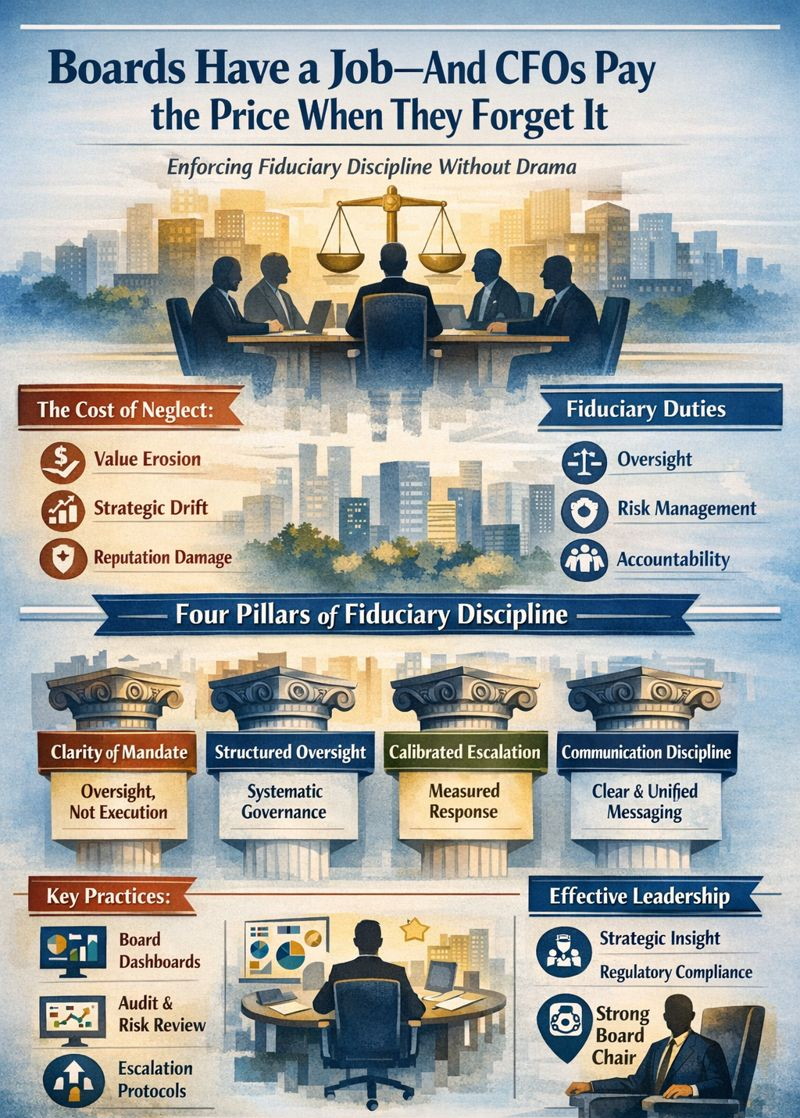
Four Foundational Pillars of Fiduciary Discipline
| Pillar | Definition | Key Practices | Common Failure Mode |
| Clarity of Mandate | Understanding board role vs. management role | Board charter defines governance boundaries, reviewed annually | Boards drift into advisory role, confusing governance with execution |
| Structured Oversight | Continuous validation and inquiry system | Operating cadence, committee alignment, governance indicators | Passive review, reactive engagement, information overload |
| Calibrated Escalation | Graduated response to emerging concerns | Escalation ladder, trigger thresholds, third-party reviews | Ignoring red flags or overreacting to minor issues |
| Communication Discipline | Clear, bounded, unified messaging | Precision in language, boundaries on individual commentary | Ambiguity, freelance director statements, mixed signals |
Clarity of Mandate: The Board’s Job Is Oversight, Not Execution
Clarity of mandate begins with understanding what the board is there to do. Too many boards drift into ambiguity. They confuse governance with advice. They act as strategic consultants or cheerleaders. They lose their footing. Boards must be clear: they do not run the company. They do not set execution plans. But they are responsible for ensuring that the strategy is sound, the risks are measured, and the leadership is competent and accountable.
That clarity should be etched into the board charter. It should inform every agenda. It should guide every conversation with management. When boards have a clear mandate, they can organize themselves around it. The charter must go beyond legal language. It must define governance purpose in clear terms. What is the board’s mandate with respect to strategy? How often is that mandate reviewed? What are the boundaries of authority? The best charters articulate how the board oversees capital allocation, major risks, and leadership performance.
When I led board reporting at a gaming enterprise where I oversaw $100 million in acquisitions and post-merger integration, we established formal audit committee processes and structured board reporting calendars. The board charter explicitly defined decision thresholds requiring board approval, strategic review cadence, and risk escalation protocols. This clarity prevented ambiguity about when management should seek board guidance versus proceed independently.
Structured Oversight: Governance Is a System, Not a Meeting
Oversight is not passive review. It is a continuous process of validation and inquiry. It involves building an operating cadence that prioritizes strategic topics, allocates time proportionally to material risks, and structures pre-meeting materials that enable insight rather than obfuscate it.
Effective oversight is granular. It defines in advance what success looks like, not only for the enterprise but for the board’s role within it. It sets key governance indicators: quality of information flow, depth of discussion, frequency of dissent, clarity of resolution. It aligns committees not around job titles but around decision-making levers.
The audit committee is not only a recipient of financial statements. It is a gatekeeper of economic truth. The compensation committee does not just review bonuses. It ensures behavioral alignment across the organization. The nominating committee is not a social club. It is the custodian of board composition, skill matrices, and leadership succession.
The agenda is the true governance map. A weak agenda reflects a passive board. A strong one reflects intentionality. It allocates time against what matters. The most effective agendas begin with strategic review, not quarterly earnings, but drivers of long-term value. They prioritize topics where the board adds judgment: entering new markets, redefining talent strategy, shifting capital structure. Administrative items are sequenced at the end, not the start.
Every board meeting should include a standing review of enterprise risk, not as a compliance exercise but as a strategic discussion. What risks are emerging? Which are accelerating? How are mitigation plans performing? The review must include leading indicators, not just lagging outcomes. And it must include triggers, pre-defined signals that prompt deeper board engagement.
Calibrated Escalation: Addressing Risk Without Creating Chaos
Fiduciary discipline is revealed most clearly when something feels off.
The difference between strong and weak boards is not whether issues arise. It is how they respond.
Disciplined boards design escalation ladders in advance. They define:
- What constitutes a concern versus a crisis
- What additional analysis is required at each stage
- When third-party reviews are triggered
- How regulators, investors, and employees are informed
In one manufacturing organization, an accounting irregularity surfaced. Because escalation protocols were already in place, the response was immediate, structured, and calm. Independent review, regulator coordination, and stakeholder communication occurred within days. There was no improvisation. No panic. Governance worked as designed.
Communication Discipline: Governance Speaks Through Precision
The final pillar is communication discipline. This refers to how the board speaks to each other, to management, and to stakeholders. Language matters. Precision matters. Boards must be clear in their messaging, not only in minutes and resolutions but in the informal signals that shape culture. Ambiguity invites misinterpretation.
Communication discipline also means boundaries. Directors must know when to speak as individuals and when to speak as a board. They must understand their responsibility to support decisions once they are made, even if they personally dissented. Discipline in communication preserves the integrity of governance. It reinforces unity without suppressing diversity.
Stakeholder engagement is a governance function. Investors, regulators, employees, and partners all look to the board for signals. That communication must be consistent, accurate, and aligned with enterprise strategy. Directors must avoid freelance commentary. The board speaks through defined channels. And when issues arise, it responds with unity and clarity.
How Boards Operationalize Fiduciary Discipline
Fiduciary discipline is not self-sustaining. It must be designed into the operating system of the board. One board created a dashboard of ten fiduciary indicators. These included not only financial performance but also culture metrics, compliance health, customer attrition, leadership turnover, and capital productivity. Each director received this dashboard before meetings with three pages of commentary. When indicators showed variance, they prompted targeted discussions. Over time, this system institutionalized a culture of inquiry.
The chair plays a pivotal role in sustaining this discipline. The chair is not a traffic cop. They are a conductor. Their job is to orchestrate participation, manage time, frame discussions, and enforce follow-up. The chair must ensure that every voice is heard, that dissent is surfaced and resolved, and that decisions are recorded with precision.
My certifications as a CPA, CMA, and CIA emphasize governance, internal controls, and risk management. But what separates effective boards from ceremonial ones is not technical expertise alone. It is the discipline to embed fiduciary obligations into repeatable systems, the courage to escalate concerns proportionally, and the wisdom to communicate with precision and unity.
Conclusion: Stewardship Without Spectacle
Enforcing fiduciary discipline is not about control. It is about stewardship. It is about ensuring that the enterprise is governed with integrity, foresight, and courage. Boards that internalize this role become more than advisors. They become partners in resilience. They become stewards of value. And they fulfill the job they were entrusted to perform, not with drama but with distinction.
Disclaimer: This blog is intended for informational purposes only and does not constitute legal, tax, or accounting advice. You should consult your own tax advisor or counsel for advice tailored to your specific situation.
Hindol Datta is a seasoned finance executive with over 25 years of leadership experience across SaaS, cybersecurity, logistics, and digital marketing industries. He has served as CFO and VP of Finance in both public and private companies, leading $120M+ in fundraising and $150M+ in M&A transactions while driving predictive analytics and ERP transformations. Known for blending strategic foresight with operational discipline, he builds high-performing global finance organizations that enable scalable growth and data-driven decision-making.
AI-assisted insights, supplemented by 25 years of finance leadership experience.