



Executive Summary
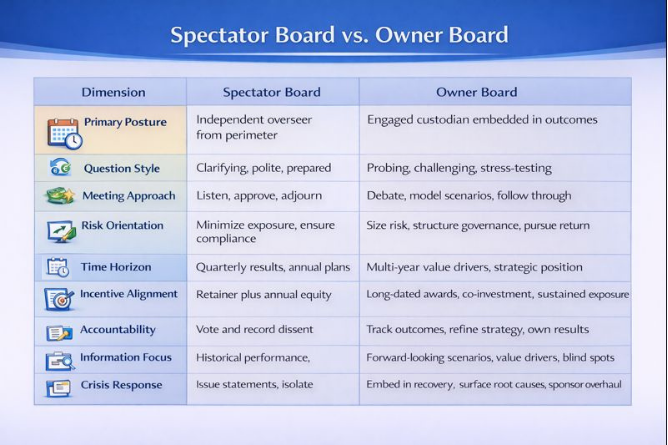
The architecture of a boardroom is often weighed down by convention. Chairs are filled with accomplished individuals whose résumés glimmer with achievement. They bring perspective and prestige. Yet too many sit quietly as if in an audience, nodding politely rather than engaging. The distinction between spectators and owners matters. Boards that think like owners transcend their formal role. They confront complexity with curiosity, stretch assumptions with rigor, and shape outcomes with conviction. Throughout my twenty-five years leading finance across cybersecurity, SaaS, manufacturing, logistics, and gaming, I have learned that to nurture such a board requires intention and design. It begins with a mindset. Spectators view themselves as independent overseers, featuring from the perimeter. They ask questions. They listen. They approve or delay, but they seldom challenge. Owners lean in. They take stakes, mentally and financially. They insist on shared accountability. They make it personal. They carry the fate of the enterprise as if it were their own, aligning long-term prosperity with their own. This posture is not naive optimism. It is disciplined, humble, and unafraid of hard truths.
The Spectator versus Owner Mindset
A board’s composition shapes its culture. A board may have functional diversity across audit, HR, and sales. Yet if no one dares to ask what have we overlooked, the board drifts into affirmation rather than interrogation.
Without contrarian voices, confidence becomes complacency.
The remedy is not token dissent. It is genuine intellectual challenge rooted in rigorous analysis and mature judgment. It is ownership thinking in action.
Board Mindset Comparison Framework
Consider a global telecom where the board had long deferred to the CEO’s forecast for capital deployment in new markets. A new director with turnaround experience insisted on modeling downside cases and structuring exit mechanisms before capital was committed. When one market underperformed, the board had pre-negotiated retrievability. That exit saved hundreds of millions. A spectator board would not have anticipated it—let alone implemented it.
Four Interlocking Principles of Ownership Boards
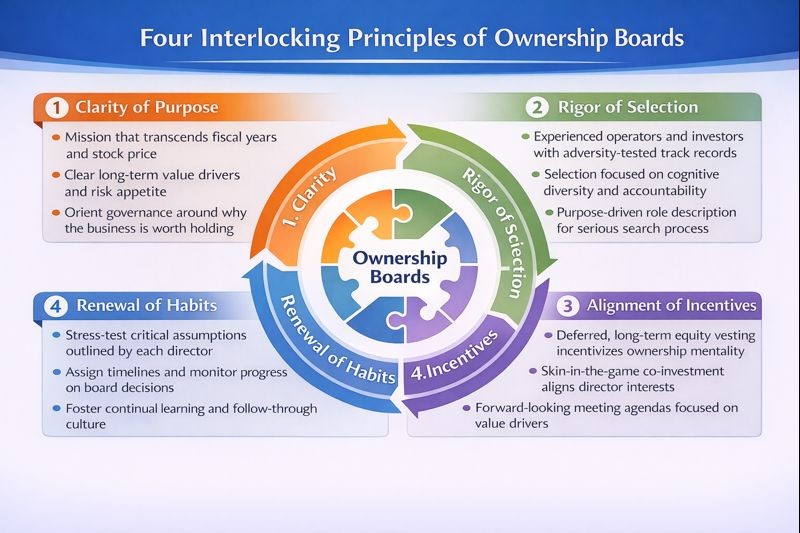
Creating a board that thinks like owners requires four interlocking principles: clarity of purpose, rigor of selection, alignment of incentives, and renewal of habits. These principles form a virtuous cycle.
Principle 1: Clarity of Purpose
Purpose is a magnet for ownership.
It orients governance around the defining question: why is this business worth holding? Investors ask return thresholds. Owners ask why.
Clarity of purpose takes three forms:
- Mission that transcends fiscal years and stock price—unambiguous, deliberated, not PR-crafted.
- Long-term value drivers—market penetration, resilience, talent development, innovation velocity, impact footprint.
- Risk appetite—owners do not avoid risk; they define it, size it, and govern it.
When I led board reporting at a gaming enterprise where I oversaw $100M in acquisitions and integration, the board’s clarity on long-term value drivers—sustainable engagement and franchise longevity over short-term monetization spikes—shaped acquisition evaluation and post-acquisition metrics.
Principle 2: Rigor of Selection
The talent you appoint to the board signals what behavior you value. The ideal board member is an experienced operator or investor who has lived through adversity. They have made hard decisions, taken personal accountability, and seen outcomes. They talk in concrete terms. They can arm-wrestle in Excel or outline fallback plans in paragraphs. They display intellectual humility.
Selection begins with an unflinching assessment of the board’s gaps. What experiences are missing? What cognitive diversity is absent? Which industries or geographies are underrepresented? This is not box-ticking. It is granular: who has been in the receiver chair when a key global acquisition soured? Who has hired tens of thousands through digital transformations? Who has rebuilt a business after regulatory loss?
The search process itself must reflect seriousness. Begin with a purpose-driven role description: this individual will join a board committed to long-term ownership thinking, they will challenge including the chair, they will deploy mental capital and not simply vote. This framing sets expectations. The role cannot be filled with someone seeking a seat at the country club.
Principle 3: Alignment of Incentives
Once directors are selected, binding their orientation to ownership requires structure and incentives. Many boards remain passive because meeting structures reward reactivity. A typical board packet might include quarterly results, compliance updates, CEO reports, and occasional analyst forecasts. Board meetings become chore as directors cycle through slides before approving next item.
Instead, ownership-oriented boards build forward-looking agendas. They start meetings with a deep dive into value-driver performance: the brand index, the pipeline yield curve, the cash-return cadence of new investments. They run workshops modeling mergers under different scenarios or predicting disruption from adjacent technologies. They treat board time as a strategic asset with rigorous preparation, pre-work modeling, devil’s advocate assumptions, and post-meeting treatment that includes real decisions on capital, talent, and material risks.
Incentives should align with the time horizon. If directors are compensated only with retainer and annually vesting equity, the window of personal economic stakes is narrow. Owners want evergreen alignment. That may mean deferring part of compensation into long-dated awards that vest only over multiple years, or holding realized proceeds only if performance thresholds are met long after the CEO’s next bonus cycle.
When I secured $40 million in Series B funding and an $8 million credit line at a nonprofit organization, the board established long-term incentive structures tied to sustainable financial health metrics rather than short-term fundraising success. This alignment ensured board members focused on building enduring financial resilience rather than optimizing for the next funding announcement.
Board Incentive Alignment Framework

Principle 4: Renewal of Habits
Habits embody culture.
Owners listen with a pen. They test assumptions in real time. They ask: what did we assume, where will we be wrong, and what is our fail-safe? They follow through. Spectators ask their questions once and disappear into lunch.
These habits are learnable. One board created a ritual: each director submits two “hard assumptions” embedded in strategy and outlines a stress scenario. Three assumptions are randomly selected and discussed in meeting. Presentations shrink. Interrogation rises. The board trains itself to think like investors.
Follow-through is the ultimate differentiator. Ownership boards assign timelines and revisit progress. They do not approve and forget. They steward.
Operationalizing Ownership: From Theory to Practice
An ownership mindset must not only be articulated but operationalized. Boards that aspire to think like owners must hardwire this discipline into the machinery of governance. It cannot depend on goodwill or accident. It must be coded into structure, ritual, and review.
Annual Board Evaluation with Ownership Metrics
Too often, board evaluations are compliance documents, a survey, a few light comments, anonymized data that gets filed but not followed. A board thinking like owners treats the evaluation as a strategic check-in. It begins with ownership-specific questions:
- Did our interventions materially improve decision quality this year?
- Did we pressure-test key assumptions in capital, talent, and innovation?
- How did we handle dissent, did we surface and resolve it constructively?
- What initiatives bear our fingerprints?
- How much time did we spend on strategic foresight versus compliance review?
- What percent of board time created forward-looking value?
They also measure alignment. Do directors’ economic exposure and time investment match the scale and risk of the enterprise? Is compensation tied to long-term outcomes? The best boards benchmark themselves against peer boards not in name but in posture.
When I improved month-end close from 17 days to under six days at a cybersecurity firm, the board’s focus on operational excellence metrics rather than just financial results demonstrated ownership thinking. They tracked process improvement velocity, system implementation milestones, and capability building alongside traditional financial metrics. This multidimensional approach to board oversight reinforced a culture of continuous improvement.
Role Clarity and Committee Structure
Owner boards distinguish governance, advice, and control with precision.
- Audit committee mandate expands beyond review into liquidity stress-testing and architecture resilience.
- Compensation committee goes beyond benchmarking into behavioral economics.
- Some boards add innovation oversight committees to ensure the long game is resourced.
Ownership boards ask: if an acquirer evaluated this company, where would they see underleveraged assets and value creation potential?
Scenario Immersion and Red Team Exercises
Owner-boards conduct structured foresight sessions. They assign directors to scenario teams. Each team researches a disruptive force including regulatory upheaval, AI transformation, activist threats, or geopolitical stress and models its enterprise implications. The output is not simply slides but action maps: what investments should be accelerated, which partnerships reconsidered, which cost centers restructured.
Even more effective is the use of red-team blue-team formats in board workshops. A director team proposes a core strategic action including a merger, divestiture, or capital injection. Another team is tasked to attack it: model downside, test assumptions, build counter-thesis. The full board watches. This mock-conflict tests analytical rigor and psychological safety. Boards that conduct such exercises regularly are significantly less prone to groupthink.
Learning Rhythm and Language
In ownership cultures, the board’s learning rhythm is intentional. Directors read before meetings but also meet between meetings. They debrief after site visits. They circulate papers on industry shifts and investor views. They engage in structured learning, bringing in investors, regulators, competitors, and futurists.
A subtle yet powerful differentiator in owner-boards is language. Language encodes values. Spectator-boards talk about compliance, process, and oversight. Owner-boards talk about resilience, compounding, capital efficiency, and advantage sustainability. In one energy transition board, directors replaced quarterly theme reviews with value driver interrogations, reviewing how capital expenditures correlated with new business lines, not just execution timelines.
Crisis Response and Succession as Ownership Tests
When boards experience crisis, their culture is tested. Ownership thinking proves critical in such moments. Consider the case of a health services enterprise facing reputational crisis after a data breach. The board had two paths: isolate management and issue symbolic statements, or embed itself in recovery. They chose the latter. Directors took part in real-time response war rooms. They monitored recovery metrics. They met with regulators and clients. They built a parallel oversight mechanism. They surfaced root causes not only in IT but in strategic underinvestment. Years later, the firm emerged stronger.
Succession planning is another test. Owner boards treat CEO succession as a strategic inflection, building bench readiness over years, aligning stakeholders early, and selecting for the next decade, not the last decade.
Conclusion
Building a board that thinks like owners is not about perfection. It is about posture. It is about aligning structure, culture, incentives, and process so that board engagement creates long-term value. It is about treating the boardroom not as theater but as a lab, where ideas are tested, where decisions are refined, and where enterprise destiny is shaped. Such boards do not merely attend meetings. They move the enterprise. They challenge constructively. They invest emotionally and intellectually. They persist. They care. They learn. They align. They take responsibility. And they leave a legacy not of oversight but of ownership.
Disclaimer: This blog is intended for informational purposes only and does not constitute legal, tax, or accounting advice. You should consult your own tax advisor or counsel for advice tailored to your specific situation.
Hindol Datta is a seasoned finance executive with over 25 years of leadership experience across SaaS, cybersecurity, logistics, and digital marketing industries. He has served as CFO and VP of Finance in both public and private companies, leading $120M+ in fundraising and $150M+ in M&A transactions while driving predictive analytics and ERP transformations. Known for blending strategic foresight with operational discipline, he builds high-performing global finance organizations that enable scalable growth and data-driven decision-making.
AI-assisted insights, supplemented by 25 years of finance leadership experience.