




Executive Summary
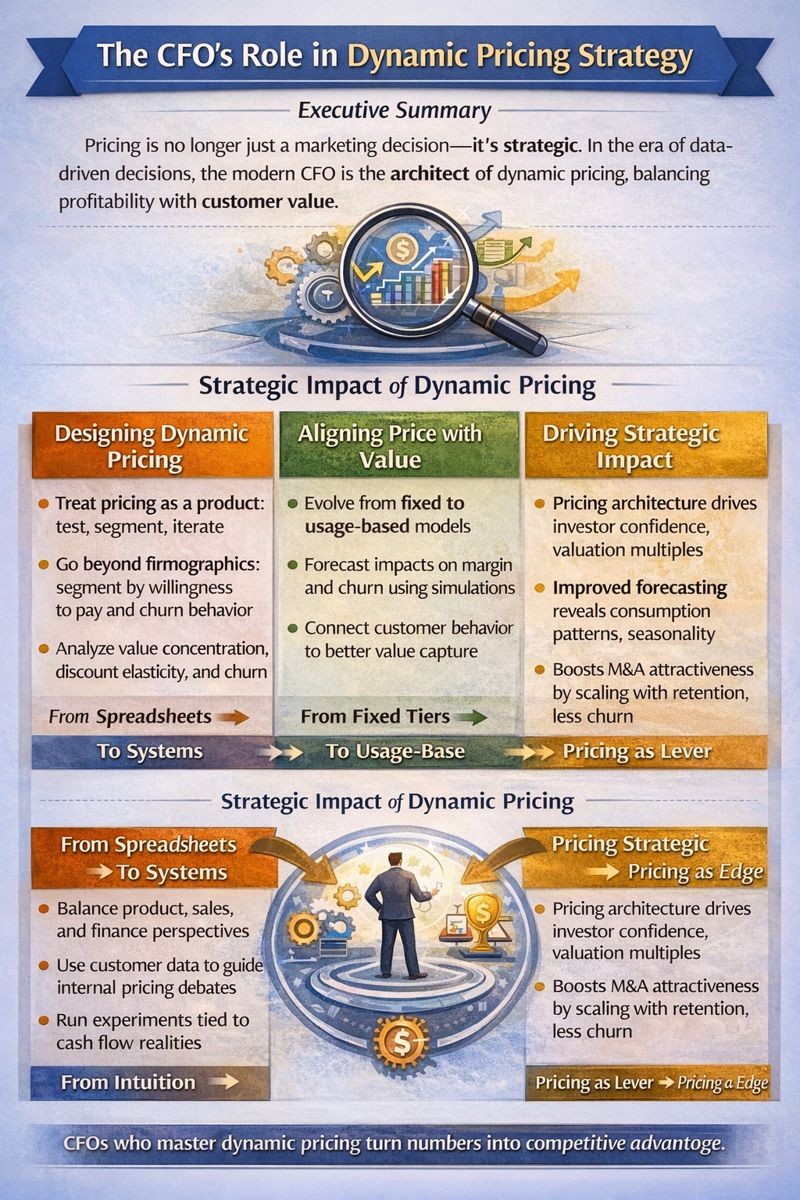
It used to be that pricing was the territory of marketing. Then product got involved. Then sales weighed in. And finally, finance showed up to check the math. But today, in markets defined by constant data feedback, pricing has become too strategic to be siloed. It is no longer a tactic. It is a system. And in that system, the modern CFO is not just an approver of price but its architect. Throughout my twenty-five years leading finance across cybersecurity, SaaS, manufacturing, logistics, and gaming, I have learned that dynamic pricing, once the domain of airlines and ecommerce giants, has now found its way into enterprise software, consumer subscriptions, and B2B services. In many sectors, price is not fixed. It is elastic, personalized, and continuously evolving. That reality demands a new kind of thinking: pricing as design, pricing as experimentation, pricing as a living reflection of customer value. And that brings the CFO front and center.
From Spreadsheets to Systems
For too long, pricing lived in spreadsheets and PowerPoint decks. It was negotiated, argued, and often guessed. The sales team pushed for discounts. Product teams set prices based on features. Finance did some lifetime value math and hoped it worked out. But in markets that move at the speed of data, that model no longer holds. Pricing must be grounded in behavior. It must respond to usage, conversion patterns, cohort trends, competitive shifts, and operational cost curves, all in real time. And only the CFO is positioned to integrate that level of complexity with the clarity of strategy.
At its core, pricing is value capture. If product creates value and go-to-market delivers it, pricing determines how much you get to keep. That means it sits at the intersection of margin, customer psychology, and operating leverage. Price too high, and you lose volume. Price too low, and you erode margin and brand. Set the wrong metric, per seat when the real value is in consumption, and you distort adoption. Tie price to features instead of outcomes, and you limit expansion. The art of pricing is not just finding the number. It is choosing the frame.
When I rebuilt GAAP and IFRS financials for a high-growth SaaS company and designed cohort analysis frameworks, we analyzed pricing effectiveness across customer segments. We discovered that our per-seat pricing model was constraining adoption in larger enterprises where value scaled with usage, not headcount. By introducing consumption-based tiers for enterprise customers while maintaining seat-based pricing for smaller customers, we unlocked expansion revenue without cannibalizing the base business.
Pricing as Product
The best CFOs treat pricing like a product. They design it. They test it. They iterate. They embed telemetry into usage to see which features drive real engagement. They segment customers not by firmographics but by willingness to pay and churn behavior. They look at revenue concentration and price elasticity curves. They model not just revenue uplift but margin durability and cash flow impact.
Consider this: in a subscription business, a 10 percent increase in price with flat churn often yields more net profit than a 20 percent increase in bookings with rising customer acquisition cost. Yet most companies spend all their energy acquiring new logos and almost none optimizing how much they earn from the ones they already have. A CFO who understands pricing dynamics can flip that equation, focusing less on sheer growth and more on efficient growth.
This becomes even more critical when unit economics are under pressure. In periods of capital abundance, companies could afford aggressive pricing discounts to drive market share. But in today’s market, where capital is costlier and burn multiples matter, pricing becomes a lever for sustainability. A CFO-led pricing strategy can ensure that growth does not come at the expense of longevity.
Aligning Price with Customer Value
Dynamic pricing is also a way to align better with customer value. As more businesses move to usage-based models or hybrid subscriptions, the pricing model becomes a signal of trust. Customers do not just want fair prices. They want prices that grow with their use. A CFO’s role is to make sure that model works for cash flow, for systems, and for profitability. That means re-architecting billing systems, creating pricing simulations, and modeling the effects of seasonality, enterprise negotiations, and customer tiering.
But the real strategic power of CFO-led pricing comes from scenario modeling. What happens if we introduce a freemium tier? What if we migrate to usage-based billing? What if we bundle services into tiers? Each of these has implications for top-line, churn, gross margin, support cost, and capital efficiency. The CFO is the only executive who sees across all of them. And that is why they must lead, not with force but with insight.
When I managed global finance for a $120 million logistics organization, we faced pricing pressure from commoditization. Rather than competing solely on price, we redesigned our pricing model to reward customers for predictable volume commitments and operational efficiency. Customers who provided advance scheduling and consolidated shipments received preferential pricing. This aligned our pricing with behaviors that reduced our cost to serve while maintaining margin.
The Cultural and Operational Shift
There is also a cultural shift required. Many companies still treat pricing as a set-it-and-forget-it decision. In truth, pricing is never done. It is an iterative process, informed by market feedback and internal evolution. That means building pricing review into the operating cadence, monthly, quarterly, annually, depending on velocity. It means viewing the price page not as a marketing artifact but as a strategic asset.
Internally, pricing discussions often trigger emotion. Sales wants simplicity. Product wants differentiation. Finance wants predictability. Customers want fairness. A CFO must navigate these tensions not by dictating but by translating. They connect customer behavior to margin trends. They frame revenue conversations in terms of lifetime value. They align pricing experiments with cash flow realities. And in doing so, they elevate the debate from price as a friction to price as a force multiplier.
Done well, dynamic pricing also enables better forecasting. Fixed-price models often mask seasonality and underutilization. But usage-based pricing, when instrumented properly, allows for leading indicators of revenue. The CFO can start to predict not just what revenue will be but why, and adjust resource planning accordingly. This turns finance into a proactive operator, not just a reactive reporter.
When I built enterprise KPI frameworks using MicroStrategy, Domo, and Power BI tracking bookings, utilization, backlog, annual recurring revenue, pipeline health, customer margin, and retention, we added pricing metrics including average contract value by tier, discount rates by segment, and price realization versus list price. This visibility allowed us to identify where discounting was strategic versus where it was simply eroding margin unnecessarily.
Strategic Impact on Valuation and M&A
It also helps with investor storytelling. Few things impress sophisticated investors more than a CFO who can articulate the price-value equation of their business. Not just what customers pay but how pricing influences expansion, retention, and efficiency. A great pricing narrative shows maturity. It signals control. And it tells the market this company knows how to monetize its innovation.
That maturity also pays off in mergers and acquisitions. Buyers pay premiums for businesses with pricing models that scale. A business with strong net dollar retention, low churn, and usage-based pricing will often trade at higher multiples than one with the same revenue but flat pricing and fragile cohorts. Because pricing tells you how future value is captured, not just what was earned last year.
When I led board reporting at a gaming enterprise where I oversaw $100 million in acquisitions and post-merger integration, pricing model sophistication was a key valuation driver in our acquisition evaluations. Targets with dynamic pricing that captured player engagement and spending patterns commanded premium multiples because their revenue was more predictable and scalable than competitors with static pricing.
Conclusion
The CFO as price architect is not a theoretical concept. It is a practical necessity in markets where competition is real, capital is constrained, and customer behavior is dynamic. Pricing is no longer just about what customers pay. It is about what the company becomes. And in that transformation, the CFO is not a bystander. They are the designer. In a world where every dollar must work harder, pricing is leverage. And leverage, in the hands of someone who understands both math and behavior, becomes not just a tool but an edge.
Disclaimer: This blog is intended for informational purposes only and does not constitute legal, tax, or accounting advice. You should consult your own tax advisor or counsel for advice tailored to your specific situation.
Hindol Datta is a seasoned finance executive with over 25 years of leadership experience across SaaS, cybersecurity, logistics, and digital marketing industries. He has served as CFO and VP of Finance in both public and private companies, leading $120M+ in fundraising and $150M+ in M&A transactions while driving predictive analytics and ERP transformations. Known for blending strategic foresight with operational discipline, he builds high-performing global finance organizations that enable scalable growth and data-driven decision-making.
AI-assisted insights, supplemented by 25 years of finance leadership experience.